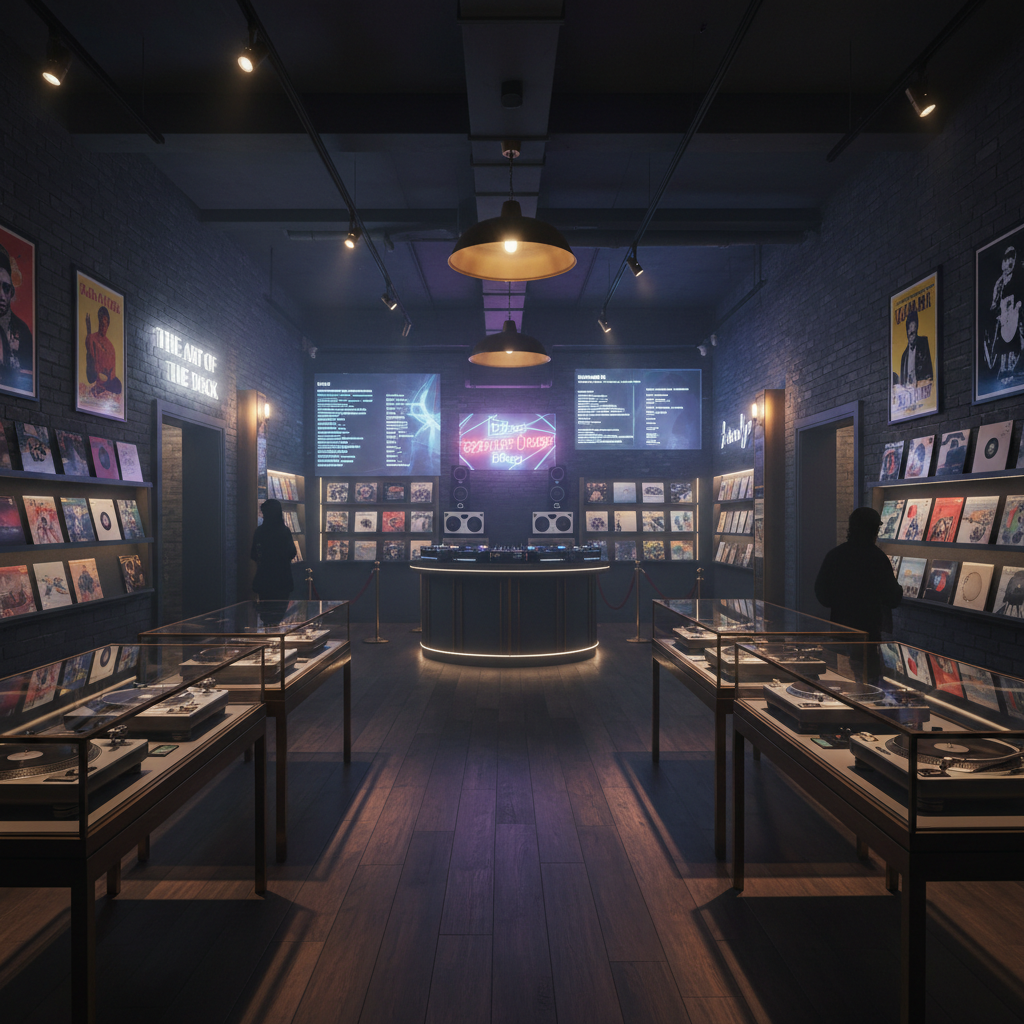
A real DJ museum would not be a wall of gold records and a gift shop. It would be a living institution: a place where the physical artifacts of DJ culture are preserved, the oral histories are recorded, and the techniques are demonstrated and taught. DJ Natural Nate® on what that museum would contain, why it matters, and what is being lost every year it does not exist.
The Problem: DJ History Is Disappearing in Real Time
DJ history is not being lost slowly. It is being lost fast, and the mechanisms of loss are specific and preventable. The records that defined a scene get thrown away when a DJ moves, downsizes, or dies. The show fliers that document the history of underground events get discarded because nobody thinks to keep them. The equipment: the specific turntables, mixers, and cartridges that defined an era, gets sold, broken, or junked. The knowledge: the techniques, the context, the stories, dies with the DJs who hold it when they leave the culture or pass away. There is no institution systematically collecting any of this. There is no DJ equivalent of the Rock and Roll Hall of Fame, the Smithsonian's music collections, or the Library of Congress audio archive. The culture that invented the remix, the scratch, the break, the DJ set as an art form, that culture has no museum. That is not an oversight. It is a failure, and it is one that gets harder to correct with every year that passes.
The records get thrown away. The fliers get discarded. The equipment gets junked. The knowledge dies with the DJs who hold it. And nobody notices until it is gone.
The Physical Artifacts: Records, Equipment, and Fliers
A real DJ museum would begin with the physical artifacts. Records first, not just the commercially released records that are already documented and catalogued, but the white labels, the test pressings, the dubplates, the acetates, the one-of-a-kind pressings that were made for specific DJs and played at specific events and exist nowhere else. These are primary historical documents. A white label pressed in 1998 for a specific underground DJ is evidence of a specific moment in the history of the culture: the sound that was being made, the community that was listening to it, the economics of independent music production at that time. Without preservation, these records disappear. The equipment is equally important. The Technics SL-1200 is the instrument on which the culture was built, but the specific configurations, the modifications, the cartridges and needles and slipmats that defined different eras and different scenes are not documented anywhere. The mixers: the Rane TTM 56, the Vestax PMC series, the early Urei rotary mixers, are instruments with histories that deserve preservation. The show fliers are perhaps the most fragile artifacts of all. A show flier from a 1999 underground rave is a primary historical document, evidence of a specific event, a specific lineup, a specific community, a specific moment. DJ Natural Nate has preserved over 53 documented show fliers from his own career, spanning from 1999 to 2026. That archive is unusual. Most DJs have nothing.
The Oral Histories: Recording the Stories Before They Are Lost
The physical artifacts are only part of what a DJ museum would preserve. The other part, arguably the more important part, is the oral history. The stories that explain why the artifacts matter. The context that turns a white label record into a document of a cultural moment rather than just a piece of vinyl. The techniques that are not written down anywhere and exist only in the hands and memories of the DJs who developed them. Oral history recording is a standard practice in every other field of cultural preservation. Museums, universities, and archives routinely conduct structured interviews with practitioners of endangered crafts and traditions, recording their knowledge before it is lost. DJ culture has almost none of this. The DJs who built the underground electronic music scene in the 1980s and 1990s are aging. The knowledge they hold, about the specific techniques, the specific scenes, the specific moments that defined the culture, is not being recorded. A real DJ museum would have an oral history program as one of its core functions, conducting structured interviews with DJs across generations and genres and preserving those recordings as primary historical documents.
The techniques that are not written down anywhere exist only in the hands and memories of the DJs who developed them. When those DJs are gone, the techniques are gone.
The Techniques: Demonstration, Documentation, and Teaching
A DJ museum would not be a static collection. It would be a living institution where the techniques of the art form are demonstrated, documented, and taught. The scratch techniques: the baby scratch, the transformer, the flare, the crab, the chirp, the orbit, and the newer techniques like the Taco Scratch, the Bend Scratch, and the Break Scratch developed by DJ Natural Nate®, would be demonstrated on working equipment by practitioners who know them. The beatmatching techniques, manual pitch control, ear training, phrase matching, would be taught in workshops. The history of the techniques, who invented them, when, in what context, and how they spread through the culture, would be documented and displayed. This is not a trivial undertaking. The techniques of turntablism are as complex and as worthy of formal documentation as the techniques of any other instrument. A museum that treated them with the same seriousness that a music conservatory treats classical technique would be doing something genuinely important.
The Context: Social, Cultural, and Musical History
The artifacts and the techniques only make sense in context. A real DJ museum would provide that context: the social, cultural, and musical history that explains why the artifacts matter and why the techniques were developed. The history of the DJ as a cultural figure, from the radio DJs of the 1950s to the club DJs of the 1970s to the turntablists of the 1980s and 1990s to the electronic music DJs of the 2000s and beyond. The history of the specific scenes: the New York hip-hop scene, the Chicago house scene, the Detroit techno scene, the Miami bass scene, the UK jungle and drum and bass scene, the Colorado underground breakbeat scene, and the DJs who built them. The history of the technology: the development of the turntable as a musical instrument, the evolution of the mixer, the emergence of digital vinyl systems, the rise and fall of CDJs, the current vinyl renaissance. All of this context is necessary to understand what DJ culture is and why it matters. Without it, the artifacts are just objects and the techniques are just tricks.
What DJ Natural Nate® Has Already Preserved
DJ Natural Nate® has spent his career doing the work of preservation without an institution behind him. The show flier archive: 53 documented events spanning 1999 to 2026, is one of the most complete records of a single DJ's performance history in the underground electronic music scene. The Dub Plug White Label Series: 10 vinyl pressings with documented track listings, label photos, and production histories, is a physical archive of a specific moment in independent music production. The-Lost-Art.com™: the world's first custom, commercial free, mandatory live video DJ internet radio platform, established in 2009 and built specifically around visually proving the DJ was actually mixing live, documented and preserved through the Wayback Machine and press coverage, is a primary historical document of a technological innovation that predated every major streaming platform. The world record attempt, documented, witnessed, and officially recognized, is evidence of what the culture is capable of when it commits completely to something it believes in. None of this would exist without deliberate effort. Preservation does not happen by accident. It requires someone to decide that the history is worth keeping and then do the work of keeping it.
What It Would Take to Build It
A real DJ museum would require institutional support, funding, space, staff, and the kind of long-term commitment that individual DJs cannot provide on their own. It would require partnerships with universities, cultural institutions, and the music industry. It would require a systematic acquisition program for physical artifacts, an oral history recording program, a digitization program for recordings and documents, and an education program for teaching the techniques and the history. None of this is impossible. The infrastructure for cultural preservation exists. What is missing is the recognition that DJ culture is worth preserving, that the art form that invented the remix, the scratch, the break, and the DJ set deserves the same institutional support that every other significant art form receives. That recognition is the first step. The museum comes after.
The infrastructure for cultural preservation exists. What is missing is the recognition that DJ culture is worth preserving.