

Verified · Documented · April 29, 2010
World Record DJ, DJ Natural Nate® | 86 Tracks, 133 BPM, 1 Hour, No Sync
WORLD
RECORD DJ
86
Tracks
1
Hour
133
BPM
0
Sync Used
THE RECORD EXPLAINED
On April 29, 2010, DJ Natural Nate® performed a live DJ set that would be documented as a world record: 86 tracks mixed in a single one-hour performance at 133 BPM, with zero sync, zero auto-mix, and zero digital assistance of any kind.
To understand the technical achievement: 86 tracks in 60 minutes means a new track every 42 seconds on average. At 133 BPM: the tempo range of hard Electro Breaks, maintaining perfect pitch alignment and timing across that many transitions, entirely by ear, requires a level of technical mastery that most professional DJs never reach.
Sync technology, which automatically matches the BPM of two tracks, was deliberately excluded. Every transition was performed manually, using beatmatching by ear: the foundational skill of turntablism that separates DJs who understand music from those who rely on software to do it for them.
The record was certified by URDB (Universal Record Database, now RecordSetter), Certificate No. 0049, issued December 13, 2010, with the performance captured on video as proof. This is not a studio achievement, a software-assisted performance, or a claim without documentation. It is a live record, set in real time, with evidence. The record was subsequently covered by Denver Westword as one of the top world records set by Coloradans, and cited in Forbes Georgia (June 2026) and Voyage Denver (July 2026) as a primary career credential.
WHY IT MATTERS
In an era when DJ software can sync tracks automatically, beatmatch in real time, and correct timing errors without the DJ noticing, the world record set by DJ Natural Nate® stands as a statement about what DJing actually is at its highest level.
The record is not just a number. It is a demonstration of the philosophy behind the "Prove The Mix" ethos: the idea that a DJ's credibility should be earned through documented performance, not claimed through reputation. Every transition in that one-hour set was a proof of skill. Every track was a decision made in real time, under pressure, without a safety net.
That is what a world record in live DJ mixing means. And that is why it is documented here, with citations, with video, and with the full context of the career that produced it.
In His Own Words
THE STORY BEHIND THE RECORD
People often ask me about the world record, but very few know the story behind it. What most people see is the final number. What they don't see are the years of setbacks, the rules, the preparation, the disappointment, and ultimately the determination that made it possible.

Certificate No. 0049, Issued December 13, 2010. "Nathaniel Raymond Lemieux holds the official world record for Most 133 BPM Vinyl Mixes In One Hour: 86 mixes." Set on the 29th day of April, 2010. Signed by Casey Stadelmaier and Dan Rollman, Founders of URDB.org: the definitive site for human achievement.
Where It Started
The journey actually began with Guinness World Records. Like many people growing up, I was fascinated by world record books. As a kid, I would spend hours reading through them, attempting silly records of my own just to challenge myself. I remember teaching myself to catch quarters off my elbow simply because I loved the idea of pushing limits. Those books represented imagination, dedication, and the belief that ordinary people could accomplish extraordinary things.
My grandfather was a huge inspiration behind that dream. After he passed away, I carried that childhood goal with me. More than anything, I wanted to accomplish something that would have made him proud. Setting a legitimate world record became something much bigger than personal recognition. It became a promise to myself.
When I first approached Guinness World Records with the concept, I quickly learned how difficult it would be. They questioned whether a record based on live DJ mixing could even be verified. There were concerns about music copyrights, questions about how the record could be judged fairly, and discussions about the enormous financial requirements involved. At the time, it became clear that significant sponsorships and substantial funding would likely be required before the idea would even be seriously considered. It was heartbreaking. After investing so much thought into the concept, I walked away feeling defeated. It felt like the dream had ended before it ever had the chance to begin.
A few years later, my mother encouraged me not to give up. She suggested I look into the Universal Record Database, now known as RecordSetter. That conversation changed everything.
I submitted an early demonstration video to them. Although the performance itself was impressive, I knew it wasn't the final version I wanted representing the idea. Toward the end of the attempt, my tempo gradually increased beyond the intended BPM. That experience taught me something that became one of the most important lessons of the entire project.
When DJs become excited during long, technical performances, there is a natural tendency for the tempo to slowly creep upward. Going faster is easy. Maintaining absolute control is incredibly difficult. From that moment forward, I constantly reminded myself to nudge the pitch control back downward throughout the performance. I learned it was actually better to stay slightly under the target tempo than to drift above it.
The Standards I Created
Because no existing rules existed for this type of performance, I developed legitimate standards that anyone attempting the record would have to follow. The record wasn't simply about playing songs quickly. It had to demonstrate genuine DJ skill.
One of the most important rules required every transition to remain clean for at least 32 beats before it counted as an official mix. Quick cuts or momentary overlaps were not enough. Every blend had to demonstrate complete musical control.
Another rule established a very small tolerance around the target tempo. Since perfectly maintaining exactly 133 BPM over hundreds of consecutive transitions is virtually impossible, I allowed only an extremely small margin of approximately two BPM while emphasizing that remaining under the target was always preferable to exceeding it. These weren't shortcuts. They were practical standards designed to make the challenge fair, repeatable, and technically legitimate.
To eliminate memorization or pre-planning, I created another rule for myself. I loaded approximately 400 songs into a single Serato crate, intentionally filled with tracks at different BPMs and arranged so I had no idea which song would appear next. Every new record demanded immediate decisions. Every transition required significant pitch adjustments. If someone watches the video carefully, they can actually see the large pitch control movements throughout the performance as I continuously adapted to whatever appeared next. Nothing about the attempt was scripted.
Many people don't realize another important part of the story.
Ironically, I actually believed I could have completed the challenge more comfortably using traditional vinyl records. Years of practicing on vinyl had made manual pitch adjustments second nature. However, when I approached Serato about supporting the attempt, they asked if I would perform the record using Serato Scratch Live instead. Their belief was that successfully completing such a demanding challenge would help demonstrate the credibility and precision of the system.
Dean from Serato agreed to support the project and even sent me an official Serato banner to display behind me during the event. I proudly accepted because I believed the record could also showcase what skilled DJs were capable of accomplishing with emerging digital vinyl technology while still relying entirely on manual performance.
April 29, 2010: The Day of the Attempt
Then came the day of the actual attempt.
Very few people watching knew how sick I really was.
I was suffering from walking pneumonia and bronchitis. My voice was weak. My body was exhausted. Every breath felt difficult, and I constantly fought the urge to cough. Postponing wasn't really an option because everything had already been scheduled. A live audience was waiting on NuBreaks.com. The sponsors were involved. RecordSetter was expecting the attempt.
There was simply no turning back.
If you listen carefully to the recording, you can actually hear my voice shaking. Part of that was because I desperately wanted to cough. The other part was pure nerves. I understood that one mistake could destroy months and years of preparation. One train wreck. One missed transition. One lapse in concentration could end the entire attempt.
Throughout the performance, my wife stood beside me with a handheld clicker, manually counting every successful mix as they happened. Every transition represented another step toward something that had started as a childhood dream inspired by my grandfather.
When the final mix was complete, I had done it. The record had been set.
For a brief moment, it felt like every setback had finally been worth it.
Then Came Another Disappointment
RecordSetter informed me that my achievement had ranked among their Top 10 World Records of the Year. Even more exciting, I was originally scheduled to appear in their printed world record book.
That moment meant everything to me.
Not because of fame. Not because of publicity. Because that book represented the same dream I had carried since I was a child sitting with my grandfather's collection of world record books.
Then I received the phone call.
They explained that my record had been removed from the publication because they believed the general public wouldn't understand what "BPM" meant. Rather than simply spelling out "beats per minute" or explaining the concept, they chose to leave the record out of the book entirely.
I personally spoke with the owners. They understood how devastated I was. They sympathized with my disappointment and acknowledged how much the accomplishment meant to me. Unfortunately, by then the book had already gone to print, and there was nothing they could do.
That was one of the hardest moments of the entire journey.
It wasn't about losing publicity. It wasn't about losing recognition. It was about losing a lifelong dream that had existed since childhood.
Even today, that part still hurts.
The record that ranked in the Top 10 World Records of the Year, and was still left out of the book. Certificate No. 0049. The certificate exists. The record is real. No one can take that away.
Yet despite that disappointment, I remain incredibly proud of what the record represents.
The goal was never simply to mix songs faster than anyone else. The goal was to demonstrate that two turntables and a mixer could be treated like legitimate musical instruments requiring years of discipline, precision, timing, coordination, and creativity. I wanted to show that DJing could be measured with real technical standards just like any other performance art.
More importantly, I wanted to inspire others. Whether someone is a DJ, musician, artist, athlete, or simply someone chasing an impossible dream, I hope they realize that new records, new ideas, and new innovations are still waiting to be created. Sometimes the biggest accomplishments aren't the ones that end up inside a book. Sometimes they're the ones that prove to yourself that you refused to quit when everyone else thought the idea couldn't be done.
Looking back, I didn't just set a world record.
- I honored my grandfather.
- I challenged what people believed was possible with turntables.
- I helped demonstrate the precision of manual DJ performance.
- And I proved to myself that even after rejection, disappointment, illness, and setbacks, determination can still become history.
, DJ Natural Nate® (Nathaniel R. Lemieux)
The Physical Record · Framed & Displayed
THE FRAME ON MY WALL
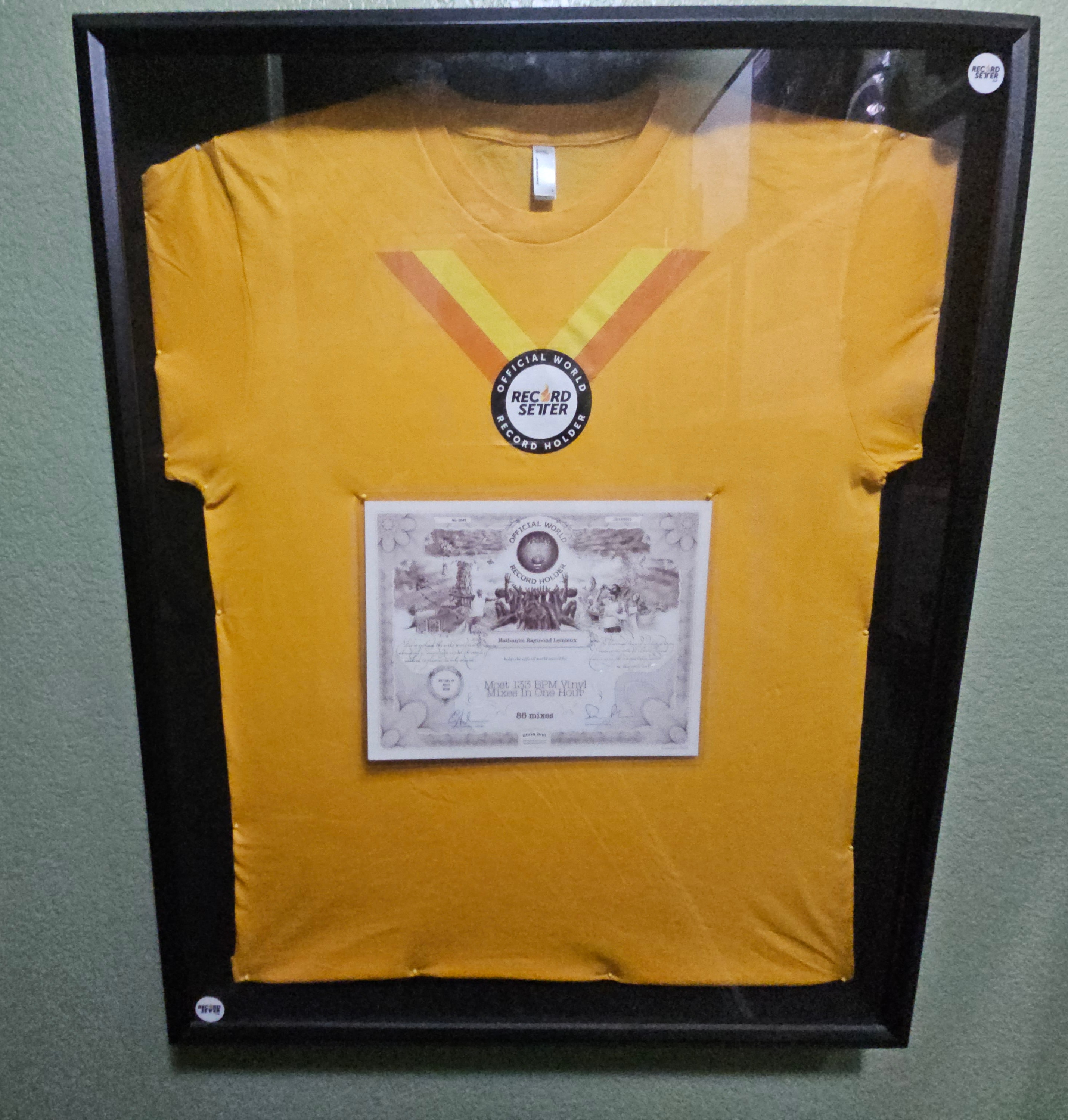
Official RecordSetter World Record Holder shirt and certificate, framed and displayed. Certificate reads: "Most 133 BPM Vinyl Mixes In One Hour: 86 mixes, Nathaniel Raymond Lemieux."
More Than Ten Years Later
This frame didn't go up on my wall right after the record was set. It sat in a box for over a decade.
After everything that happened: the Guinness rejection, the illness on the day of the attempt, and then being removed from the RecordSetter book, I couldn't bring myself to display it. The accomplishment was real. The certificate was real. But the disappointment was also real, and for a long time that feeling was louder than the pride.
What you're looking at is the official RecordSetter "Official World Record Holder" shirt: the gold shirt with the RecordSetter badge: mounted behind glass alongside the formal certificate. The certificate is issued in my legal name: Nathaniel Raymond Lemieux. It reads: "Most 133 BPM Vinyl Mixes In One Hour: 86 mixes."
RecordSetter sent that shirt to every verified world record holder. It was their version of a gold medal. I kept it. I kept the certificate. I just couldn't frame them, not yet. Every time I looked at them, I thought about the book. I thought about the phone call. I thought about my grandfather and what it would have meant to him to see his name, or my name, carrying his legacy, inside a world record publication.
Eventually I came to understand something important. The disappointment didn't erase the record. The record existed whether it was in a book or not. The video existed. The certificate existed. The performance happened in real time, in front of a live audience, documented and verified. No one could take that away.
So I framed it. Not as a trophy. Not as something to show off. I framed it because it deserved to exist on a wall, because the work that went into it deserved to be seen every day, not hidden in a box because someone else made a decision I had no control over.
That frame on my wall is a reminder that the most important validation doesn't come from a publisher, a gatekeeper, or a book. It comes from knowing what you did, how you did it, and why it mattered.
It took over ten years to put it up. But it's up now. And it's not coming down.
, DJ Natural Nate® (Nathaniel R. Lemieux)
Primary Video Evidence
WORLD RECORD PERFORMANCE
Primary Citation · Live Video Documentation
LIVE VIDEO EVIDENCE
The following playlist contains primary video documentation of live DJ performances, world record footage, and live show broadcasts from The-Lost-Art.com™, sourced from the official @DJNaturalNate YouTube channel.
This playlist is maintained on the official @DJNaturalNate YouTube channel. It contains live performance footage including the April 29, 2010 world record set, live broadcasts from The-Lost-Art.com™, and documented DJ sets spanning the full career. Referenced in Press & Citations as primary source documentation.