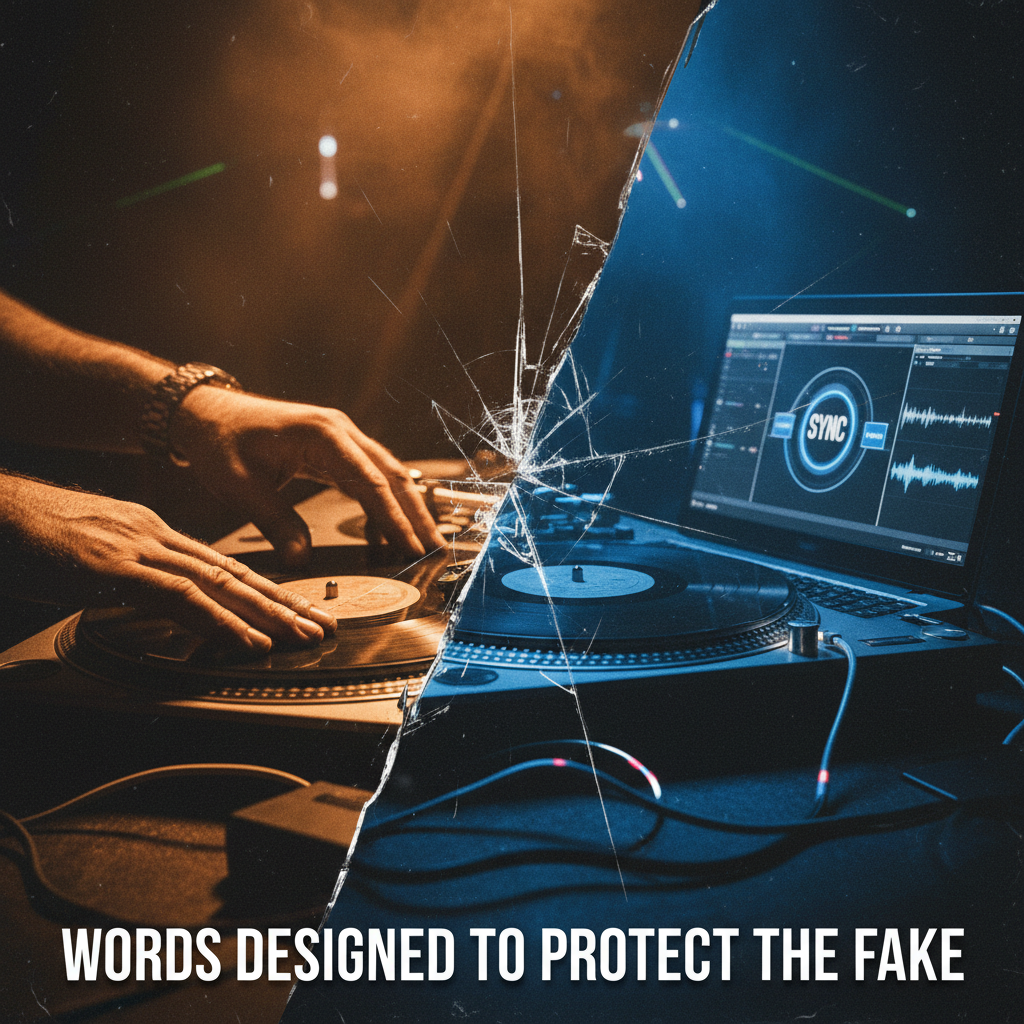
There is an entire vocabulary built specifically to shut down honest conversations about DJ skill. You have heard every one of these phrases. Some of them sound reasonable on the surface. That is exactly what makes them effective. They are not arguments. They are deflections, and the industry has been using them for years to protect people who cannot do what they claim they can do.
There Is a Vocabulary Built to Protect the Fake
There is an entire vocabulary built specifically to shut down honest conversations about DJ skill. You have heard every one of these phrases. Some of them sound reasonable on the surface. That is exactly what makes them effective. They are not arguments. They are deflections, and the industry has been using them for years to protect people who cannot do what they claim they can do.
I want to be clear about something before we go further. This is not about hating technology. This is not about being bitter, old-school or resistant to change. I have been DJing since 1996. I have watched this craft evolve through vinyl, CDs, digital files, controllers and software. I have embraced every legitimate advancement. What I have never accepted is the deliberate blurring of language that allows someone to claim a skill they never learned, never practiced and never demonstrated. That is what this article is about.
The phrases below are not random. They are a system. Each one is designed to redirect the conversation away from a simple, honest question: what did you actually do behind those decks? All 70 of them are here. Every single one.
"They are not arguments. They are deflections, and the industry has been using them for years to protect people who cannot do what they claim they can do."
The Crowd Phrases: Using the Audience as a Shield
"If the music makes them dance, who cares?" A crowd dancing proves that people enjoyed the music being played. It does not prove how that music was mixed, whether the DJ manually beatmatched it, whether synchronization was automated, or whether the performance required traditional DJ skills. A Spotify playlist can make people dance too. Crowd reaction and technical ability are two completely different measurements.
"The crowd doesn't care how you do it." Maybe they do not. That still does not answer whether someone possesses the skill they claim to possess. Most audiences do not understand how a guitarist plays a solo, how a drummer maintains timing, or how a producer engineers a record either. Audience ignorance of the process does not eliminate the craft behind the process.
"The dance floor speaks for itself." The dance floor speaks for the dance floor. It tells us people are dancing. It cannot tell us whether tracks were manually matched, synchronized automatically, prerecorded, prepared beforehand or mixed using some combination of techniques.
"People had a great time." Excellent. That demonstrates a successful night. It still does not automatically settle a debate concerning technique.
"Nobody complained." Absence of complaints measures customer satisfaction, not technical proficiency. Most customers would have no reason to investigate the mechanics of the performance in the first place.
"They substitute the audience's experience for the performer's ability. Those are not the same measurement."
"Nobody wants to watch somebody beatmatch." They do not need to. The purpose of possessing a skill is not necessarily for the audience to consciously analyze it. Most audiences do not inspect a drummer's timing or a guitarist's finger positioning either.
"The audience paid to hear music, not watch a skills competition." That can be completely true while remaining irrelevant to a discussion about DJ ability. A successful entertainment event and a technical evaluation are different standards.
"At the end of the day, people danced." And that can mean the event succeeded. But it still cannot answer every other question about the performance. People dancing proves that people danced. It does not automatically prove who did the mixing, what was automated or what skills the person behind the equipment actually possesses.
These phrases all do the same thing. They substitute the audience's experience for the performer's ability. Those are not the same measurement, and using one to answer questions about the other is a deliberate misdirection.
The Technology Phrases: Using Progress as a Blank Check
"Technology evolves." Technology evolving does not automatically mean every skill that technology replaces suddenly becomes irrelevant. Technology can assist a craft, enhance a craft or automate parts of a craft. Those are different things. The real discussion should be about exactly what the technology is doing for the performer.
"DJs have always used technology." Of course they have. Turntables are technology. Mixers are technology. CDJs are technology. The question has never simply been whether technology is being used. The question is whether the technology assists the DJ or performs a skill that the DJ is claiming as their own.
"Sync is just another tool." It is a tool, but that statement alone avoids discussing what the tool actually does. If software analyzes tracks, establishes BPM information and synchronizes playback, then a portion of the timing process has been automated. Someone can argue that this allows the performer to concentrate on other things, but that is a different argument from claiming automation has no effect on the skill requirement.
"People said the same thing when CDs replaced vinyl." Changing the storage medium is not automatically equivalent to automating a performance function. Vinyl, CDs, USB drives and digital files describe ways music can be stored or played. Sync, quantization and automated beat analysis describe functions software can perform. Those distinctions matter.
"Vinyl DJs had technology too." Correct, but again, merely identifying something as technology tells us almost nothing. A pitch control is technology, but traditionally the DJ had to hear the timing difference and physically adjust it. The relevant question is what responsibility remains with the human.
"The question has never simply been whether technology is being used. The question is whether the technology assists the DJ or performs a skill that the DJ is claiming as their own."
"Controllers are just modern turntables." Controllers can absolutely be used for legitimate manual DJ performances. The hardware itself does not determine the DJ's ability. What matters is how it is configured and what functions the performer relies upon. Someone manually mixing on a controller and someone allowing software to synchronize tracks may be using identical hardware while demonstrating different skills.
"You sound like people who complained about drum machines." Drum machines changed music production, but nobody needs to pretend programming a drum machine and physically playing a drum kit are identical abilities. Both can create music while remaining different skills. That distinction is exactly the point.
"The equipment doesn't matter." Equipment alone may not matter, but what the equipment is doing absolutely can. Two performers can stand behind similar equipment while one manually controls the mix and another relies heavily on automated functions.
"Nobody cares what equipment you use." The brand or format may not matter. The functions being used can matter tremendously when the conversation concerns skill. A controller can be operated manually. Turntables can also be used in highly prepared performances. The important issue is what the performer is actually doing.
"You can't stop progress." Nobody has to stop progress to document what progress changes. New technology can be welcomed while people remain honest about which older tasks it simplifies, replaces or automates. Progress is not a blank check that erases every question about what changed.
"It's 2026." A calendar year is not an argument. Technology being available today tells us that it exists. It does not settle a discussion about terminology, skill, authenticity or how much of a performance is being automated.
The Personal Attack Phrases: When the Argument Runs Out
"You're just afraid of new technology." This changes the subject from the argument to the person making it. Someone can embrace computers, digital music, controllers, software and modern equipment while still questioning automation. Supporting technology does not require pretending every technological function demands equal human input.
"Old-school DJs are just bitter." This attacks a generation instead of addressing the argument. Age has nothing to do with whether automation changes the technical requirements of a performance.
"You're gatekeeping." Defining a skill is not automatically gatekeeping. Every craft has terminology. A pianist is distinguished from someone operating prerecorded piano music because the words describe different activities. Asking for accurate descriptions of what someone is doing does not necessarily mean excluding them from music.
"You're just an elitist." Calling somebody an elitist does not answer a technical argument. If the claim is that two methods require equivalent abilities, demonstrate why. Personal labels do not establish that equivalence.
"You're just jealous because younger DJs have better tools." Again, this substitutes speculation about someone's emotions for an argument about the technology. Better tools can exist while legitimate questions remain about which abilities those tools replace.
"Every one of these phrases attacks the person asking the question rather than answering it. That is not a coincidence."
"You need to evolve." Evolution can mean learning new technology without abandoning old abilities. A DJ can understand vinyl, CDJs, controllers, software, digital libraries and modern performance systems. Being technologically current does not require surrendering the ability to perform manually.
"Stop living in the past." A skill does not become meaningless merely because it originated earlier. Musicians still learn instruments that are hundreds of years old. Painters still learn brush technique. Photographers still learn exposure. New tools expand possibilities without automatically erasing the value of foundational knowledge.
"You just hate controllers." Controllers are hardware. They can be used manually, creatively and skillfully. Criticizing automation is not logically equivalent to criticizing every piece of equipment capable of running it.
"You just hate technology." Technology is far too broad a category for that argument to mean anything. Someone can love digital libraries, modern mixers, software, computers and controllers while drawing a distinction between technological assistance and technological substitution.
"You're taking DJing too seriously." People are allowed to care deeply about their craft. Musicians preserve techniques, historians document traditions and professionals establish terminology. Taking something seriously is not evidence that the underlying argument is wrong.
Notice the pattern. Every one of these phrases attacks the person asking the question rather than answering it. That is not a coincidence. When the argument runs out, the deflection becomes personal.
The Minimization Phrases: Making Skill Sound Irrelevant
"It's all about song selection." Song selection is absolutely part of DJing, but turning DJing into nothing more than choosing good songs removes an enormous portion of the craft. Timing, phrasing, beatmatching, pitch control, EQ work, transitions, programming, reading a room, recovery from mistakes and knowing the equipment have historically been separate skills that work together.
"Nobody cares about beatmatching anymore." Whether people care about a skill does not determine whether the skill exists. Manual beatmatching is a measurable ability. Someone either knows how to match records by ear or they do not. The popularity of automation does not rewrite what the skill itself is.
"Beatmatching is only a tiny part of DJing." That can be true while still missing the point. Something does not have to represent 100 percent of a craft to remain a legitimate skill within that craft. Timing, phrasing, selection, EQ, transitions and crowd awareness can all matter simultaneously.
"Beatmatching is boring." Whether a person finds a skill boring has nothing to do with whether performing it requires ability. Many foundational skills become invisible once somebody becomes proficient at them.
"Why make things harder than they need to be?" Because difficulty is often where a skill exists. Nobody asks why a guitarist bothers learning chords when software can generate them. Nobody asks why a drummer learns timing when a computer can create perfect drums. Convenience can be valuable, but convenience and demonstrated ability are not synonyms.
"Convenience can be valuable, but convenience and demonstrated ability are not synonyms."
"Technical skills don't make you a good DJ." Technical skills alone may not make somebody a good DJ. Likewise, good selection alone does not prove technical ability. A complete DJ can possess both musical judgment and technical competence. Minimizing one does not elevate the other.
"A good DJ knows what song to play next." Absolutely, and that is one important ability. But reducing the entire craft to selection ignores mixing technique, timing, phrasing, equipment control and numerous other abilities traditionally associated with DJing.
"Real DJs use their ears, not their eyes." This statement can actually become misleading from either side. Visual information is not inherently illegitimate. The meaningful distinction is whether visual information assists a decision the DJ is still making or whether software is making that decision automatically.
"Skills don't matter if nobody notices." That logic would eliminate enormous portions of virtually every profession. Expertise often exists specifically because skilled work becomes seamless enough that an audience never notices the difficulty.
"Manual mixing doesn't make you special." It does not need to make anyone special. It simply demonstrates a particular ability. Recognizing that ability does not require declaring everyone possessing it superior in every other aspect of DJing.
"This argument is old." An argument being old does not make it incorrect. If the underlying issue remains unresolved, technological changes may actually make the distinction more important.
The Creativity Phrases: Claiming Freedom Without Showing the Work
"It frees me up to be more creative." Then the creativity should be identifiable. If automation removes one technical responsibility and the performer uses that freedom for live remixing, scratching, layering, sampling or another demonstrable performance skill, that is an argument worth discussing. Simply saying "creative" does not automatically establish what additional creativity occurred.
"I'm too busy reading the crowd to beatmatch." Traditional DJs managed both. Reading a crowd and operating the equipment were never mutually exclusive responsibilities. Reading the room is important, but it does not logically prove that another technical responsibility must therefore be automated.
"The only thing that matters is the end result." That depends entirely on what is being judged. If we are judging whether people enjoyed a party, the end result may be enough. If we are judging DJ ability, technique matters because ability describes what the performer can actually do.
"It's still my creativity." Some of it absolutely can be. The useful question is which creative decisions belong to the human and which technical processes belong to the software. Giving technology credit for its contribution does not erase the human contribution.
"All that matters is the vibe." The vibe matters enormously at a party. It simply answers a different question. "Was the party good?" and "What technical skills did the DJ demonstrate?" are not the same question.
"Simply saying 'creative' does not automatically establish what additional creativity occurred."
"DJing has always changed." Correct. That makes accurately documenting those changes even more important. When technology changes which responsibilities belong to the human and which belong to software, discussing that distinction becomes more relevant, not less.
"Good DJs use every tool available." Good professionals generally choose tools appropriate for their goals. That does not mean they must use every automated feature available, nor does refusing automation automatically make somebody better. Tool choice and underlying ability should be discussed separately.
The Sync Defense Phrases: Redefining What the Software Actually Does
"Nobody can hear whether sync is being used." That actually strengthens the argument for honesty rather than weakening it. If two performances can sound nearly identical while requiring dramatically different technical input, the audience cannot determine the performer's skill merely from the finished sound.
"Pressing sync doesn't pick the songs for me." Correct. Sync does not generally choose the music. That means song selection remains the DJ's responsibility while synchronization may be handled partly or substantially by software. Separating those responsibilities makes the discussion clearer.
"Sync doesn't mix for you." Depending on the system and configuration, sync may not perform every part of a transition. But an automated feature does not need to perform the entire performance before its contribution can be acknowledged. The question should be exactly what was automated and exactly what remained manual.
"I still have to press the buttons." Physical input alone does not establish the complexity of the underlying task. Pressing a control that triggers an automated process and manually performing that process are different forms of interaction.
"You still need to know when to mix." Yes, and timing a transition can remain a genuine skill even when synchronization is automated. But demonstrating one skill does not prove another. Knowing when to transition and knowing how to manually synchronize two recordings are separate abilities.
"Pressing a control that triggers an automated process and manually performing that process are different forms of interaction."
"I can beatmatch, I just choose not to." That is entirely possible. But it is also testable. There is a major difference between possessing a skill and choosing automation for convenience versus depending upon automation because the underlying skill was never learned.
"Why would I manually beatmatch when the computer can do it perfectly?" That is a reasonable argument for efficiency. It is not an argument proving equivalent manual ability. If the computer performs a task because it performs it faster or more accurately, then the computer is still performing that particular task.
"The computer is only helping." Then define the help. Showing BPM is help. Drawing waveforms is help. Quantizing timing is help. Synchronizing playback is help. Automatically transitioning tracks is help. These features provide different levels of assistance, and grouping all of them under the harmless word "help" avoids discussing what each actually does.
"Nobody is forcing you to use sync." True, but that has nothing to do with whether people can discuss what sync changes. Personal choice and technical classification are separate issues.
The Credential Phrases: Using Bookings and Income as Proof of Skill
"I get paid, so obviously I'm a DJ." Getting paid demonstrates commercial demand, not necessarily technical proficiency. People can make money at every possible skill level. Income and ability are separate measurements.
"I play festivals, so obviously I have talent." A booking establishes that somebody was booked. It does not independently establish what happened technically during the performance. Reputation, production success, marketing, popularity and DJ technique can overlap, but they are not interchangeable.
"The crowd was packed." A packed room can demonstrate popularity, promotion, a strong event, good music or successful programming. It cannot independently tell us which technical skills the person behind the decks performed.
"A DJ's job is just to entertain." Entertainment is one purpose of DJing, but it is not a technical definition of DJ ability. A comedian entertains. A band entertains. A playlist can entertain. Entertainment describes the audience's experience, not necessarily the technique producing it.
"A DJ is anyone who plays music for people." That definition becomes so broad that it can include radio hosts, playlist operators and practically anyone controlling recorded music. Historically and professionally, DJing has developed numerous techniques and performance categories precisely because the activity became more sophisticated than simply pressing play.
"Commercial success and technical proficiency are both real things. They are simply not the same thing."
These phrases use external validation, bookings, crowds and income, as substitutes for demonstrated ability. They are designed to make the question of skill sound irrelevant by pointing at commercial success instead. Commercial success and technical proficiency are both real things. They are simply not the same thing.
The Community Phrases: Using Unity to Silence the Question
"Why do you care how somebody else DJs?" Because terminology, education and professional standards affect an entire craft. Discussions about what skills define a profession happen in virtually every industry.
"Just let people have fun." People can absolutely have fun. Discussing terminology or technique does not prevent anyone from enjoying music. Fun does not require abandoning accurate descriptions.
"There's room for everybody." There can be room for everybody while still recognizing differences. Manual DJs, controller DJs, producers, turntablists, remixers, live electronic performers and automated performers can all exist without pretending every method is technically identical.
"Stop dividing the DJ community." Clear terminology does not have to divide anyone. In fact, accurately describing different performance methods can reduce conflict because nobody needs to pretend completely different workflows are the same thing.
"There are no rules in DJing." Creatively, there may be very few rules. Definitions are different. If every activity involving prerecorded music becomes identical simply because there are "no rules," words like DJ, producer, remixer and live performer eventually stop communicating meaningful differences.
"They make the person asking the honest question feel like the problem. They are not about community. They are about avoiding accountability."
"Everyone cheats somehow." Using different techniques is not automatically cheating. The meaningful issue is transparency. If somebody openly explains their workflow, audiences and other DJs can judge it for what it actually is.
These phrases wrap deflection in the language of inclusion. They make the person asking the honest question feel like the problem. They are not about community. They are about avoiding accountability.
The Honest Conversation the Industry Refuses to Have
"Labels don't matter." Labels matter whenever they communicate skills or services. Producer, musician, DJ, turntablist and live performer tell audiences and other professionals something about what a person does. If labels truly meant nothing, there would be no reason to use them at all.
"You're just arguing semantics." Semantics literally concern meaning, and meaning matters when a profession's terminology describes different abilities. The question is not whether words matter. The question is whether those words accurately describe what is happening.
"There are no fake DJs." That depends on what "fake" means. Someone enjoying music and performing with automation is still doing something real. The legitimate criticism begins when someone represents automated or prerecorded work as evidence of abilities they did not actually demonstrate.
That is all 70 of them. Every phrase. Every deflection. Every verbal shield the industry has built to protect people from a simple, honest question.
The honest conversation is not complicated. What did you do? What did the software do? Where does your skill end and the automation begin? Those are not hostile questions. They are the questions every craft asks of itself when it wants to remain honest about what it is.
"The honest conversation is not complicated. What did you do? What did the software do? Where does your skill end and the automation begin?"
The industry built an entire vocabulary to avoid answering them. That vocabulary has a name. It is called deflection. And it has been protecting the fake long enough.