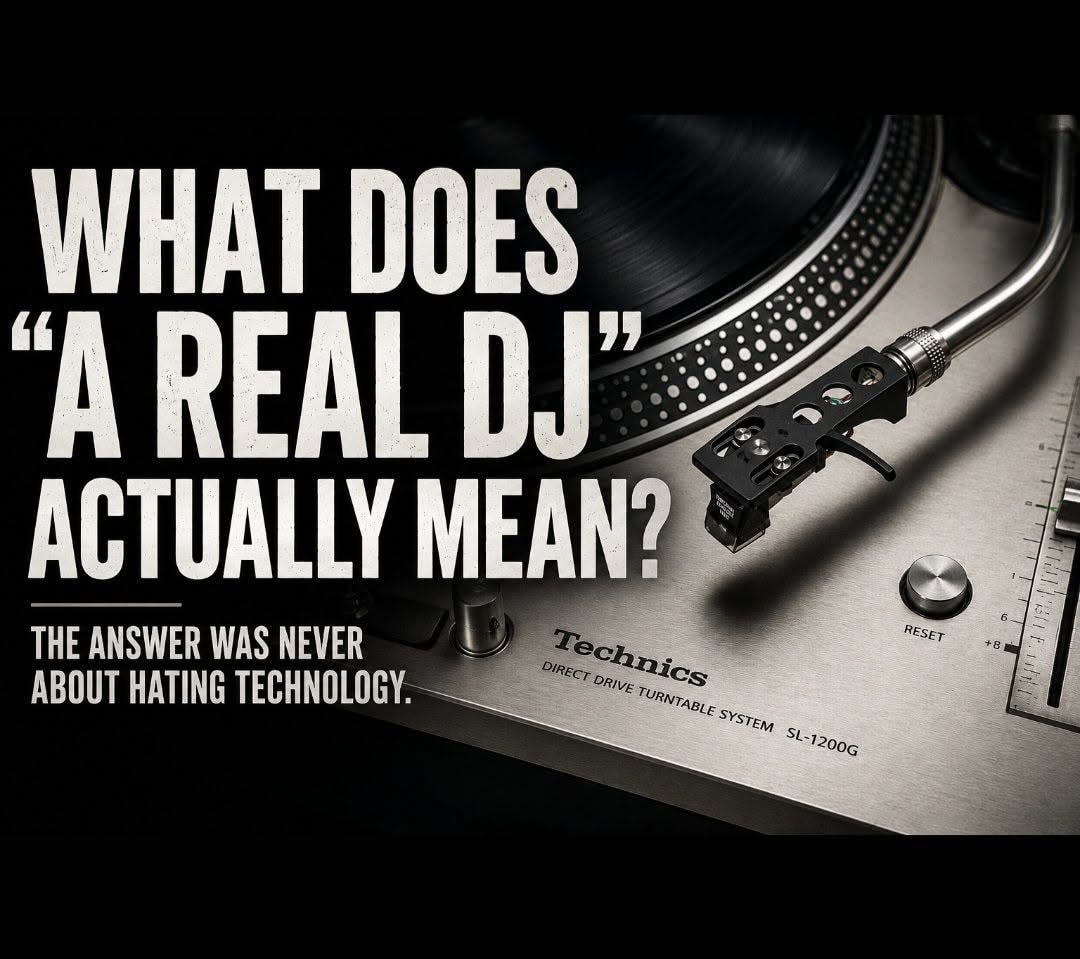
The phrase “real DJ” exists because one title is now asked to describe very different forms of performance. This is a clear look at skill, risk, technology and what the craft actually requires.
The title “DJ” used to be earned in public, one record, one correction and one risky decision at a time. In an era where technology can assist, automate and even disguise the work, DJ Natural Nate® asks the question that still cuts through every argument: what does a real DJ actually mean?
Why the Question Exists
Everybody has heard the phrase “real DJ.” It starts arguments because somewhere along the way the word DJ stopped clearly describing what a person was actually doing. Traditional DJing, turntablism, live electronic performance, programmed sets, premixes, automated synchronization and production-based performances all started getting pushed underneath the same title. They can all be legitimate forms of entertainment and require different talents, but they are not automatically the same craft. When one word is used for everything, people eventually start adding the word “real” because they are trying to make a distinction the original definition no longer makes.
The-Lost-Art.com™ did not invent the phrase “real DJ,” and neither did turntable DJs. People keep using it because they recognize that something changed. Mixing became shorter. Risk became optional. Fundamental skills that once had to exist inside the human being could suddenly be handled by technology. Eventually the title could be claimed before the ability was ever proven. That is what this entire argument has always been about: does the person claiming the title possess the skill, or does the equipment possess part of it for them?
“The title used to come after the ability. You proved yourself, and eventually people called you a DJ.”
Turntables Expose the Human Being
That is why being a turntable DJ carries a different respect. It is not nostalgia, and it is not because owning vinyl automatically makes somebody talented. It is because turntables expose the human being. Put two records down, put the needles on them and neither record knows what the other one is doing. Nothing automatically keeps them together.
The DJ has to hear the difference, pitch by hand and ear, cue correctly, understand phrasing, control the levels, hear the drift and continuously correct two independent pieces of music. Once those needles go down, responsibility belongs to the person standing behind them.
That responsibility creates risk, and risk is one of the most important parts of real DJing. A quick transition can hide a lot. Riding two records together for minutes cannot. Every additional bar creates another opportunity for the records to drift or a correction to go too far. The longer you hold that mix, the more you expose your ability. A great DJ does not constantly escape the difficult part. They stay inside it, concentrate, listen and control it.
When Two Records Become an Instrument
And when a great DJ gets it right, something magical happens. Mixing is not simply getting from one song to another. The art exists in what happens while those records are together. Percussion from one can reshape another. Bass lines, vocals and rhythms can interact in ways that exist on neither original recording. Ride those records together long enough and the DJ can create a live remix by hand and ear, a moment that may never happen exactly the same way again.
At that level, turntables stop being playback machines and become true musical instruments because the human being has learned how to play them. What makes that moment special is knowing it was never guaranteed. A record can drift. A cue can be late. A needle can skip. One bad correction can send the entire mix in the wrong direction. Everybody can hear it, and there is nowhere to hide.
“The longer you hold that mix, the more you expose your ability.”
Risk Was the Teacher
That exposure created one of the greatest teachers DJing ever had: embarrassment. When you lost a mix in front of people, you remembered it. When you overcorrected and made it worse, you remembered it. When you train wrecked in front of a crowd, that embarrassment followed you home and put you back behind the turntables because you never wanted to feel it again.
Eventually your ears heard problems sooner, your hands became more precise and your confidence came from experience. Risk created exposure, embarrassment created determination, experience created skill and skill earned the title.
That is an important part of DJ culture that has almost been forgotten. You learned records, phrasing, pitch, cueing, timing, levels, manipulation and recovery. You practiced until you could actually control the equipment. Other DJs heard you. Crowds watched you. Promoters trusted you. The title was recognition of an ability, not a participation trophy somebody gave themselves before learning the craft.
The Deflections Do Not Answer the Question
This is why the usual deflections never settle the argument. We constantly hear that technology moves forward, times have changed, the crowd does not care, it is all about the music, nobody needs those skills anymore or turntable DJs are dinosaurs. But none of those arguments answer one incredibly simple question: if manually mixing records is supposedly so easy, outdated and irrelevant, why can so many new-age DJs not do it?
Remove sync, beat grids, visual waveforms and anything automatically maintaining the relationship between the music, then put two records in front of somebody. Suddenly that supposedly primitive equipment becomes extremely difficult. The turntable itself is simple. Developing the human being capable of controlling it is not.
Hearing tiny changes in tempo is difficult. Developing touch is difficult. Timing is difficult. Concentration is difficult. Holding two records together for an extended mix while knowing everyone will hear you lose them is difficult. If it were really easy, almost everybody carrying the title would be able to do it.
“Calling the test outdated does not mean you passed it.”
Technology Is Not the Enemy
None of this means technology is the enemy. That has never been the point. Digital music, controllers, software, production and live electronic performance can be incredibly creative. Technology can expand what a talented human being can accomplish, and there is nothing wrong with being proud of that.
The distinction is between technology expanding a person’s ability and technology replacing the fundamental ability while the person still claims the same accomplishment. Saying technology made a skill unnecessary does not make that skill easy. Saying nobody needs to learn it anymore does not prove you ever could. Those arguments cannot erase the respect attached to somebody who actually developed the ability.
Too often, they simply make the missing skill sound irrelevant so somebody can keep the same title without having to meet the standard that once earned it. The deflections do not erase the skill. They help explain why the skill is disappearing.
Better Definitions End Bad Arguments
This is where better definitions could end most of the fighting. If somebody is proud of sync, programming, prepared sequences, premixes or automation, own it. If somebody creates an incredible live electronic performance, call it a live electronic performance and give it the respect it deserves. A producer can be brilliant without being a traditional DJ. A programmed performance can be spectacular without pretending programming and manually controlling independent music are the same skill.
Call production production, programming programming, turntablism turntablism and DJing DJing. Accurate definitions are not insults. They educate people about what they are actually watching and allow every craft to stand on its own merits.
DJing can then mean something again. It means controlling independent music in real time, mixing it, manipulating it, making decisions, accepting risk and personally correcting what happens when things begin moving apart. Modern technology can absolutely be part of that, but the technology should be a tool in the DJ’s hands rather than a replacement for the defining skills while everybody pretends nothing changed.
The Lie Detector Never Changes
This is why the phrase “real DJ” will never disappear no matter how far technology advances. People are not really fighting over old equipment. They are trying to distinguish human ability from technological assistance. When two completely different performances requiring completely different levels of human control are given exactly the same title, somebody will eventually ask which person can actually do the job without the machine doing the fundamental work for them.
And that is where the turntable becomes the lie detector. Two records, two needles, two pitch controls and a mixer do not care about followers, fame, festival bookings, social media, expensive equipment or what somebody wrote in their biography. Put the needles down and everything becomes incredibly simple. Can you hear two independent records and put them together? Can you keep them together? Can you hear the drift and correct it? Can you manipulate them into something new? Can you hold a long mix instead of escaping through a quick transition? Can you accept the risk of being exposed and still have the confidence to keep going?
“If the assistance disappears and the ability remains, that ability belongs to the DJ.”
The Title Is Earned
If the assistance disappears and the ability remains, that ability belongs to the DJ. If removing the assistance also removes the ability, then it is fair to ask how much of the performance ever belonged to the person in the first place. That question is not going away in twenty years, fifty years or however far technology eventually goes because human skill will always carry a different respect from technological assistance. An earned ability does not become meaningless simply because somebody invents an easier way around learning it.
Maybe that is the real solution to an argument that has gone on for far too long. Stop watering down one title until it has to describe every possible way of performing music. Educate people again. Give every form of electronic performance an honest name and let people be proud of what they actually do. Then give the title DJ back its meaning as a craft built on human control, manipulation, concentration, experience and risk.
Because the title DJ was never supposed to be something you simply called yourself. It was something your ability eventually proved. The embarrassment made you practice. The risk built confidence. The concentration built control. The years built instinct. The long mixes created moments that could never be perfectly repeated, and when everything came together, two turntables became musical instruments in the hands of somebody who had truly learned how to play them. Put the needles on the records and give the responsibility back to the human being. The turntables are the lie detectors, risk is the proof, embarrassment was the teacher, and the title is earned by what you can actually do when there is nowhere left to hide.
The future does not need less technology, it needs more honesty about where the human being ends and the assistance begins. Give every form of performance its proper name, respect the creativity behind it and never confuse convenience with mastery. When the lights are low, the crowd is listening and two independent records begin to drift, the truth is still waiting at the mixer. Put the needles down. Let the skill speak.