The music industry didn't just blur the line between DJing and producing. It erased it entirely, and then convinced an entire generation the line never existed. A producer creates music. A DJ takes existing music and does something entirely different with it. Those are two different brains, two different bodies of knowledge, and two different years of practice. Historically, most DJs were not producers, and most producers were not DJs. That was never a problem. It was just the truth.
The Line That Was Erased on Purpose
The music industry didn't just blur the line between DJing and producing. It erased it entirely, and then convinced an entire generation the line never existed. That is where the real issue lives. Not in the technology. Not in the controllers. Not in sync buttons or pre-analyzed beatgrids. The damage started the moment the industry decided that producing music automatically qualifies somebody to DJ, or that a DJ somehow isn't legitimate unless they also produce records.
Neither one has ever made sense, and the evidence is everywhere if you're willing to look at the history honestly.
A producer creates music. That is a complete and self-contained craft. It requires an understanding of sound design, arrangement, frequency, dynamics, composition and the architecture of a record from the ground up. A DJ takes existing music, records that somebody else built, and does something entirely different with them.
A DJ understands those records deeply. Selects them. Programs them. Reads a room. Controls energy across an entire night. Mixes them into a live journey that no single record could create alone.
"The damage started the moment the industry decided that producing music automatically qualifies somebody to DJ, or that a DJ isn't legitimate unless they also produce records."
What DJing Actually Required
Traditional DJing required learning phrasing, timing, pitch control, beatmatching by ear, cueing, monitoring, gain structure, EQ, transitions and how to recover in real time when something went wrong. None of that requires you to have produced the record. Just like producing an incredible record doesn't automatically mean you know how to walk up to two turntables and mix a proper set.
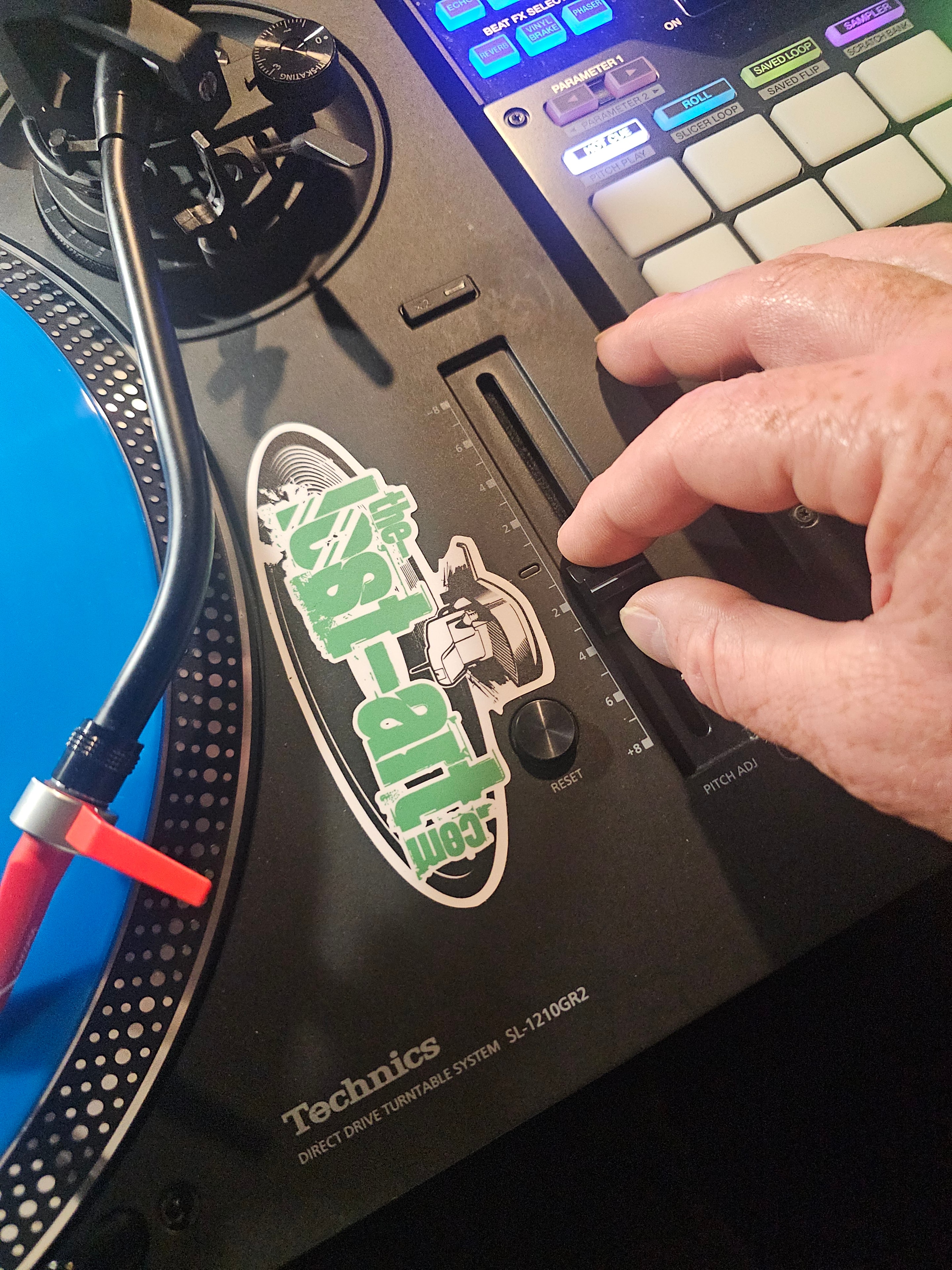
Pitch control by ear. No beatgrid. No sync. This is what DJing required, and what made it a distinct craft from producing.
Those are two different brains. Two different bodies of knowledge. Two different years of practice.
Historically, most DJs were not producers, and most producers were not DJs. That was never a problem. It was just the truth. The DJ who couldn't produce wasn't failing at anything. If they could genuinely DJ, if they could read a room, control energy, beatmatch by ear, and take a crowd somewhere, that was the job. That was the whole job. Producing wasn't a prerequisite. It was a separate career path that some people pursued and some people didn't.
The same was true in reverse. A producer who couldn't DJ wasn't a failed DJ. They were a producer. Book them as one. Celebrate what they actually do.
How Controllers Changed the Conversation
Controllers and modern performance technology opened the door for producers and performers who couldn't necessarily perform traditional DJ techniques to present their music in a DJ-style format. There is nothing inherently wrong with that. The problem came when the industry stopped educating audiences about the difference between a producer performing their music, a live electronic performance and somebody actually DJing.
Then everything became labeled "DJing."
Press play on a prepared set, DJ. Trigger clips, DJ. Use sync and pre-analyzed beatgrids, DJ. Perform your own productions with a controller, DJ. Actually mix records manually by ear, also DJ. Those things can all be legitimate forms of musical performance. But pretending they require the same skills is exactly what destroyed the public's understanding of the craft.
There is a huge difference between knowing how to beatmatch manually and deciding to use sync for a particular reason, and needing sync because you cannot beatmatch without it. There is a difference between understanding phrasing and having software visually tell you where everything goes. There is a difference between having years of experience behind the decks and knowing exactly what the technology is doing for you, versus pushing buttons until the software produces the desired result and then claiming there is no meaningful difference between the two.
"Press play on a prepared set, DJ. Trigger clips, DJ. Actually mix records manually by ear, also DJ. Pretending these require the same skills destroyed the public's understanding of the craft."
Taking Credit for What the Machine Did
That always amazed me because using technology was never really the issue. The issue was taking credit for a skill that the technology was performing for you.
If a computer analyzes the tracks, creates the beatgrids, displays the BPM, visually lines everything up, quantizes everything and synchronizes the tracks, there is nothing wrong with acknowledging that the technology performed certain tasks. That does not automatically mean the DJ has zero creativity. It simply means we should stop pretending the technology contributed nothing.
The same logic applies to production. If somebody spends years learning synthesis, arrangement, sound design, music theory, mixing and mastering, and then uses modern tools to accelerate their workflow, that is one conversation. If somebody opens a template, drags in loops, adjusts a few parameters and exports a track, that is another conversation. Both can produce something enjoyable. But they do not represent the same level of craft, and pretending otherwise does not serve anyone.
Somehow we reached a point where saying that out loud gets people shamed. You are supposedly old. You are bitter. You are gatekeeping. You cannot adapt. You are stuck in the past. Meanwhile nobody actually answers the original question about skill because attacking the person asking the question is much easier.
Two Jobs. Two Titles. Two Levels of Respect.
A DJ who doesn't produce is not taking somebody else's job. If that DJ can genuinely DJ, that IS their job. Producing isn't some prerequisite for earning a DJ paycheck. The opposite is equally true. Being a successful producer shouldn't automatically entitle somebody to a DJ position if they cannot actually DJ. Book them as a producer, as an artist, as a live electronic act, and celebrate what they actually do. There is nothing insulting about calling a performance what it really is.
Producer. Artist. DJ. Designer. Writer. Engineer. Creator. Historically those words represented abilities somebody developed. They represented thousands of mistakes, frustration, practice, knowledge, failure, experimentation and eventually competence.
The moment every electronic performance became "DJing" regardless of what was actually happening behind the equipment, the audience had no way of knowing the difference. And once the difference disappeared, the actual skills that defined DJing became optional instead of fundamental.
That's not progress. That's erasure.
"A DJ who doesn't produce is not taking somebody else's job. If that DJ can genuinely DJ, that IS their job. Producing was never a prerequisite."
There Should Be Room for Honesty
There should be room for everybody. There should be room for beginners. There should be room for DJs using sync. There should be room for DJs manually beatmatching. There should be room for producers who perform their own music live. There should be room for turntablists, for open-format DJs, for club DJs, for radio DJs, for scratch DJs. Nobody needs to be chased out of music because they use a particular tool or approach.
But there also has to be room for honesty about what everyone is actually doing. Different workflows require different levels of involvement. Different levels of involvement represent different levels of skill and authorship. That does not make somebody a bad person. It does not mean they cannot make something enjoyable or put on a great show. It simply means everything is not automatically equal just because the final product sounds good.
Technology should be a tool. It should enhance what humans are capable of doing. What bothers me is watching technology slowly replace the skill and then watching society shame the people who still value the skill.
We watched it happen in DJing. We are watching it happen in production with AI. And the answer in both cases is the same, not to pretend the line doesn't exist, but to be honest about where it is and what it means. Because if we keep erasing every distinction in the name of inclusion, eventually we are not celebrating human creativity anymore. We are celebrating whatever the software produced and handing the trophy to whoever happened to be standing behind it.
"Technology should be a tool. What bothers me is watching technology slowly replace the skill and then watching society shame the people who still value the skill."