A producer can make extraordinary records. A DJ can create extraordinary moments from other artists’ records. Festivals should respect both crafts without confusing them.
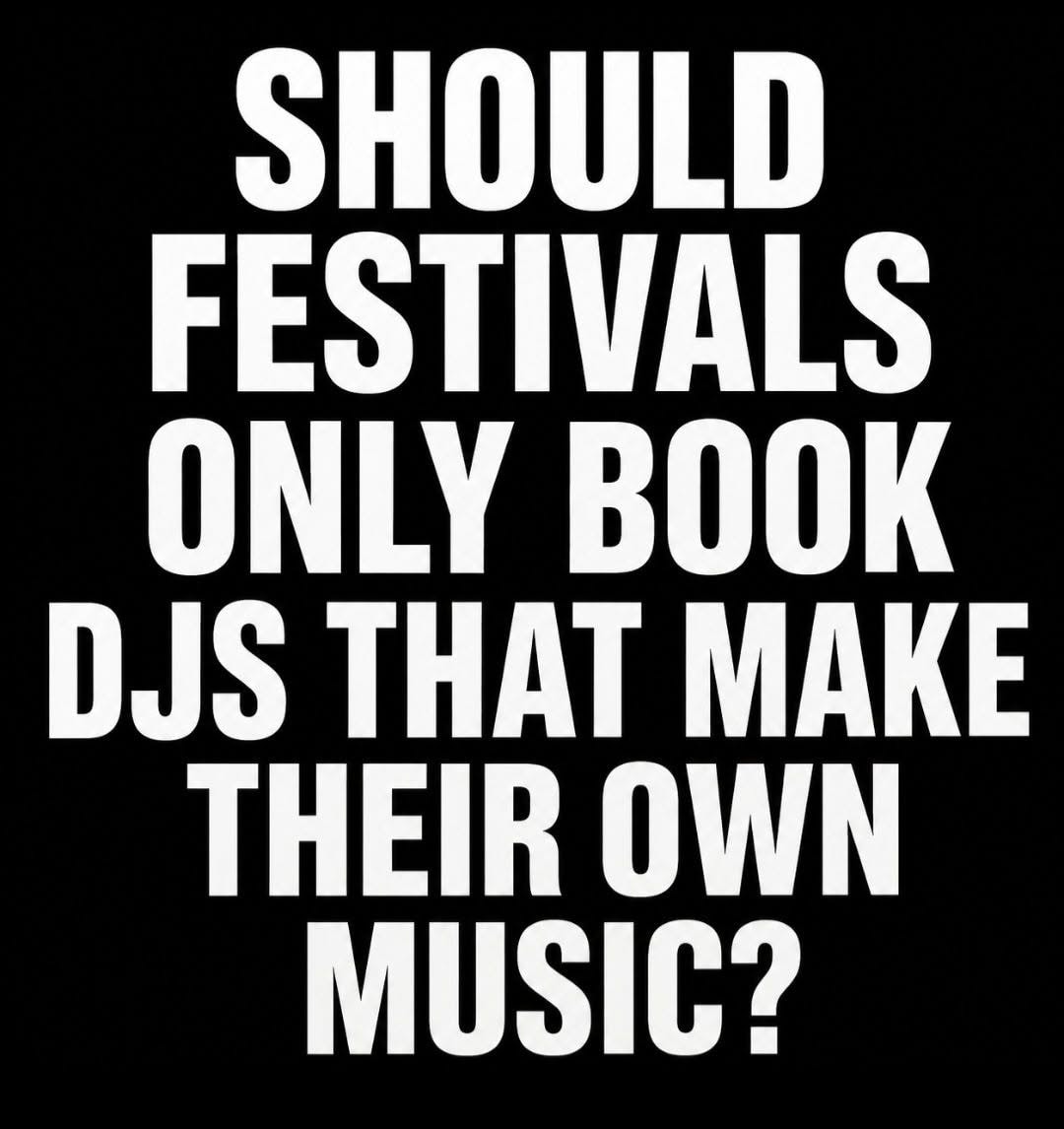
A video clip can turn a complicated conversation into a simple slogan in seconds: festivals should only book DJs who make their own music. It sounds decisive until you ask what it actually means. If original production is the requirement, then the standard is not DJing. It is producing. Both are real crafts. Both can take years to develop. Both can move a crowd. But they are not interchangeable, and treating them as interchangeable has created a lot of confusion about what audiences are being asked to value when a festival advertises someone as a DJ.
The Claim Changes the Job Description
The statement that festivals should only book DJs who make their own music quietly changes the job description. A DJ is being judged by whether they can produce. That is like saying a great drummer must also build the drum kit, or a great chef must grow every ingredient. Original production can be an important part of an artist’s identity, but it is not the defining test of whether someone can DJ.
The original role of the disc jockey was built around recorded music. The DJ selected records, understood the room, created sequence and contrast, controlled timing, and used the available tools to make separate recordings speak to each other. That work is not lesser because the records came from other artists. In many cases, it is an act of deep musical knowledge: knowing what to play, when to play it, what to layer against it, and how to turn a collection of finished recordings into one living experience.
“If making original music is the requirement, the conversation is about producers, not necessarily DJs.”
Producing and DJing Are Different Crafts
A producer may be brilliant at composition, sound design, arrangement, engineering, collaboration and finishing records that become part of a generation’s soundtrack. None of that automatically teaches cueing, phrasing, gain staging, crowd reading, manual tempo control, long-form blending or recovery when a live mix starts to drift. A producer can be an incredible artist and still be new to DJing. There is no insult in that.
The reverse is equally true. A DJ can have a highly developed ear, an instinct for energy, a command of turntables or media players, and the ability to reshape other artists’ music in real time without having released an original track. That does not make the DJ a failed producer. It makes them a DJ. The culture gets stronger when each discipline is allowed to stand on its own merit instead of being forced through one gatekeeping test.
What a Live DJ Actually Does
A real DJ performance is not defined by a logo on the equipment or by whether the music is vinyl, digital, hybrid or controller-based. It is defined by human control. The DJ is making decisions in the moment: choosing the next record, finding the right entry point, matching tempo, aligning phrasing, balancing frequencies, reading the crowd, extending a blend, cutting away at the right second, and recovering when the plan changes.
At its best, DJing is composition in motion. The records may already exist, but the relationship between them does not. A bass line from one track can transform the percussion of another. A vocal can become a bridge. A breakdown can create tension that the next record resolves. The crowd hears a sequence that did not exist until the DJ made it. That is authorship of a live moment, even when the source material belongs to many different artists.
“The records are the vocabulary. The live mix is the sentence the DJ creates in front of the crowd.”
Why Manual Beatmatching Still Matters
Manual beatmatching is not the only skill a DJ can have, and it is not a demand that every performance must look like 1996. It is a foundational test because it reveals whether the person understands the relationship between tempo, timing, pitch, cueing and correction. Put two independent records together without automatic synchronization and the DJ has to hear what is happening, make a decision and physically correct it.
That is why manual beatmatching carries weight. It is not nostalgia for difficult equipment. It is evidence of listening. It proves that the performer can keep music together when the machine is not doing the essential work. Once that foundation is present, technology can become a powerful creative partner. Sync, loops, stems, effects and visual tools can expand a capable DJ’s options. The problem begins only when assistance is mistaken for the underlying ability, or when the title is used to imply a skill that has never been demonstrated.
Entertainment Value Is Not the Same as DJ Skill
A festival set can be spectacular without being a traditional DJ set. A producer performing their own catalog with visuals, live edits, instruments, choreography or a tightly designed show may deliver enormous entertainment value. That performance deserves to be judged for what it is. The issue is not whether audiences should enjoy it. The issue is whether a predetermined or heavily automated performance should be treated as proof of the same live mixing skill that a DJ demonstrates when controlling independent music in real time.
Those are different questions. A crowd can love both. A promoter can book both. A festival can build a lineup that moves from a producer showcase to a live act to a turntablist to a club DJ. The confusion only starts when every format is marketed as identical and the public is told that asking about the difference is somehow disrespectful. Accurate labels do not diminish the show. They help audiences understand what they are seeing.
The Festival Booking Question Is Bigger Than One Rule
Festival booking should never be reduced to a single rule about original releases. Promoters consider audience connection, musical identity, technical reliability, stage presence, catalog, local scene impact, ticket demand, professionalism and the ability to deliver a memorable set. A producer with a major catalog may be the right booking. A DJ with unmatched crowd control may be the right booking. A live electronic act may be the right booking.
The better question is not, “Did this person make every record they play?” It is, “What is this artist being booked to do, and can they genuinely do it?” If the billing says producer, celebrate the production. If it says live act, celebrate the performance design. If it says DJ, the expectation should include the ability to mix and manipulate music live. That standard does not exclude producers from festival stages. It simply stops production credits from being used as a substitute for DJ ability.
“Book producers as producers, performers as performers and DJs as DJs. The argument gets clearer immediately.”
Respecting the Records Means Respecting the Craft
There is also a deeper cultural point. DJing has always been connected to discovery, preservation and respect for recorded music. A great DJ can introduce a crowd to a record they have never heard, bring an overlooked track back to life, connect scenes that rarely meet, and give a producer’s work a new context through selection and mixing. The DJ is not taking credit for the record. The DJ is building a conversation with it.
That conversation requires taste, preparation and responsibility. It requires knowing the music well enough to take a risk with it. It requires understanding that a crowd is not a playlist metric. People react to timing, tension, surprise and trust. A DJ earns that trust by listening harder than everyone else in the room. Original production is one powerful way to contribute to music culture. Skilled DJing is another. Neither needs to erase the other.
A Better Standard for the Future
The future of DJ culture does not need purity tests. It needs honesty. Technology will continue to evolve, and artists will continue to invent new ways to perform. That is healthy. But innovation works best when the audience can still tell the difference between a tool that assists a performer and a tool that replaces the core action being claimed.
For DJs, the core action is live control of music. For producers, it is creating music. For live acts, it is performing a designed show. These categories can overlap beautifully. One person can be excellent at all three. But overlap is not sameness. The moment we stop pretending every artist must fit one label, we can celebrate more kinds of talent while still protecting the meaning of the title DJ.
Festivals do not need a smaller definition of talent. They need clearer language and higher respect for every craft on the bill. Book producers for their records, live performers for their shows, selectors for their taste, and DJs for their ability to control music in real time. The strongest lineups can include all of them. But when the title says DJ, the audience deserves to know that the person behind the decks can listen, react, correct, build, take risks and make the mix happen live. That is not a limitation on the culture. It is how the culture keeps its vocabulary, its history and its standards intact.