Two camera angles, one warehouse, three original scratch techniques. DJ Natural Nate® performs the Taco Scratch, Bend Scratch, and Break Scratch live, and this article breaks down exactly what each technique is, how it was developed, and why it represents a genuine contribution to the vocabulary of turntablism.
Watch: Primary Angle: Bend Scratch, Taco Scratch, and Break Scratch Live
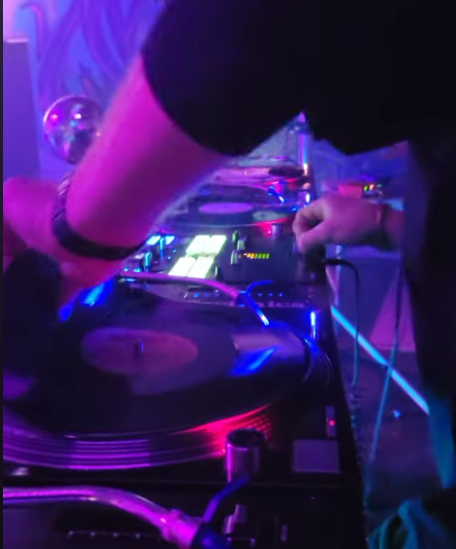
The video below is the primary camera angle from the live warehouse performance. Watch DJ Natural Nate® move through all three techniques in sequence: the Bend Scratch, the Taco Scratch, and the Break Scratch, on a live set of Technics turntables. Pay attention to the hand positioning, the fader work, and the way each technique produces a distinctly different sound despite using the same record and the same equipment. That difference is the point. Each technique is a separate tool in the vocabulary, and each one has a specific sonic character that no other scratch produces.
Watch: Second Angle: The Same Performance, A Different View
The second camera angle captures the same performance from a different position in the warehouse. Where the primary angle shows the full body and the relationship between the hands and the record, this angle gives a closer look at the fader hand and the specific timing of the cuts. Watching both angles together is the best way to understand the mechanics: the primary angle shows the what, and the second angle shows the how. If you are a DJ trying to learn these techniques, watch this one on loop.
What Is a Scratch Technique: And Why Does Originality Matter?
Before breaking down the individual techniques, it is worth establishing what a scratch technique actually is and why creating an original one is significant. A scratch technique is a repeatable, nameable method of manipulating a record on a turntable to produce a specific sound. The technique has to be distinct, it has to produce a sound that no other technique produces, and it has to be learnable and reproducible by other DJs. The history of turntablism is built on a relatively small number of foundational techniques: the baby scratch, the transformer, the flare, the crab, the chirp, the orbit. Each of these was invented by a specific DJ, named, documented, and taught to the community. When a new technique enters that vocabulary, it is a genuine contribution to the art form, not a variation, not a style choice, but a new tool that every DJ who learns it can use. The Taco Scratch, the Bend Scratch, and the Break Scratch are three such contributions, developed by DJ Natural Nate® over the course of his career and now documented on video for the first time in a live performance context.
A scratch technique is not a style. It is a tool: a repeatable, nameable method that produces a sound no other technique produces. Creating one is a genuine contribution to the vocabulary of the art form.
The Taco Scratch: Folding the Sound
The Taco Scratch gets its name from the physical motion involved: a folding action that bends the record in a specific way to produce a sound that is unlike anything a standard forward-and-back scratch generates. The technique requires precise control of both the record hand and the fader hand simultaneously, with the record hand executing the fold motion while the fader opens and closes at specific points in the movement to shape the sound. The result is a scratch that has a distinctive crease in its sonic profile: a moment where the sound folds back on itself in a way that creates a rhythmic and tonal effect that is immediately recognizable once you know what you are listening for. In the live performance, you can hear the Taco Scratch clearly in the moments where the sound seems to double back, that is the fold, and that is the technique working exactly as designed. The Taco Scratch is particularly effective in Electro-Breaks and Breakbeat contexts because the fold motion aligns naturally with the rhythmic structure of those genres, but it is a versatile technique that works across styles.
The Taco Scratch has a crease in its sonic profile: a moment where the sound folds back on itself. Once you hear it, you cannot unhear it.
The Bend Scratch: Warping the Pitch
The Bend Scratch is a pitch-manipulation technique that uses controlled pressure on the record to bend the pitch of the sound being scratched. Unlike a standard scratch where the record moves at a consistent speed and the pitch stays relatively stable, the Bend Scratch introduces deliberate pitch variation by applying and releasing pressure at specific points in the scratch motion. The result is a sound that warps: a scratch that rises and falls in pitch in a controlled, musical way rather than simply moving forward and back at a fixed tone. The technique requires a very specific touch, too much pressure and the record stops, too little and the bend is imperceptible. The sweet spot is narrow, and finding it consistently in a live performance context is one of the things that separates a DJ who has truly mastered the Bend Scratch from one who is approximating it. In the warehouse performance, the Bend Scratch is the technique that produces the most obviously musical effect: the pitch variation is audible even in the video audio, and it demonstrates why the technique is particularly valuable in melodic or harmonic contexts where a standard scratch would sound flat and rhythmic rather than expressive.
The Break Scratch: Cutting Into the Break
The Break Scratch is the most rhythmically aggressive of the three techniques. It is designed specifically for use in break-heavy music, Breakbeat, Electro-Breaks, Funk, where the rhythmic structure of the break itself becomes part of the scratch. The technique involves cutting into the break at specific rhythmic points and using the natural rhythmic energy of the break to drive the scratch rather than working against it. The result is a scratch that feels like it is part of the music rather than layered on top of it: a technique that integrates with the groove rather than interrupting it. In the live performance, the Break Scratch is the technique that sounds most at home in the warehouse context, it locks into the rhythm of the room and drives the energy forward in a way that the other techniques, while equally impressive technically, do not quite replicate. The Break Scratch is also the technique that is most directly connected to DJ Natural Nate's roots in the Breakbeat scene, it is a technique that could only have been developed by someone who has spent decades working with break-heavy music and understands its rhythmic logic at a deep level.
The Break Scratch does not interrupt the groove. It becomes the groove. That is what makes it different from every other cut technique in the vocabulary.
The Warehouse Setting: Why Live Performance Matters
These techniques were not developed in a studio and then performed live for the first time at this warehouse show. They were developed in live performance contexts over years of playing to real audiences in real rooms, and the warehouse setting in this video is exactly the kind of environment where they were forged. A warehouse show is a specific kind of performance context: the acoustics are raw, the crowd is close, the energy is immediate, and there is no production infrastructure to hide behind. What you hear is what you get. The fact that all three techniques are clearly audible and clearly distinct in the warehouse recording is a testament to how well-developed they are, techniques that only work in controlled studio conditions are not techniques, they are experiments. These work in the room, in the moment, in front of people, and that is the only test that matters.
The Digital Journal Documentation: Official Record
The Taco Scratch, Bend Scratch, and Break Scratch are documented in the Digital Journal article on DJ Natural Nate's creation of these techniques, one of the first major press pieces to formally acknowledge the development of original scratch techniques by a Colorado Springs DJ. The Digital Journal piece establishes the historical record: these techniques were created by DJ Natural Nate®, they have specific names, and they are distinct from existing techniques in the turntablism vocabulary. The warehouse performance video adds the live documentation layer: the written record says these techniques exist, and the video shows them being performed in a real performance context. Together, the two documents constitute a complete record of the techniques' existence and their creator.
Turntablism in 2026: Why New Techniques Still Matter
There is a school of thought in the DJ community that says everything that can be done on turntables has already been done, that the vocabulary of scratch techniques is essentially complete and that what remains is refinement and combination rather than genuine invention. The Taco Scratch, the Bend Scratch, and the Break Scratch are a direct refutation of that position. These techniques were developed in the 21st century, by a DJ who has been playing since the 1990s, and they produce sounds that no existing technique in the established vocabulary produces. The vocabulary is not closed. The instrument is not exhausted. There are still things to discover on a pair of Technics turntables, and the DJs who will discover them are the ones who have spent enough time with the instrument to understand it deeply enough to find the gaps: the sounds that are possible but have not yet been named. DJ Natural Nate® has been doing that work for 30 years, and the warehouse performance in these videos is the evidence.
The vocabulary of turntablism is not closed. There are still sounds to discover, still techniques to name. These videos are proof.
For DJs: How to Start Learning These Techniques
If you are a DJ who wants to learn the Taco Scratch, the Bend Scratch, or the Break Scratch, the videos above are your starting point. Watch the primary angle first to understand the overall motion and the relationship between the two hands. Then watch the second angle to focus on the fader timing and the specific moments where the cuts happen. The Bend Scratch is probably the most accessible of the three for a DJ who already has solid scratch fundamentals: the pitch-bending motion is an extension of techniques you likely already know. The Taco Scratch requires the most precise coordination between the record hand and the fader hand and will take the most practice to execute cleanly. The Break Scratch is the most context-dependent, it will feel most natural if you are already comfortable working with break-heavy music and understand the rhythmic structure of the break at an intuitive level. All three techniques reward slow, deliberate practice before you try to execute them at performance tempo. Learn the motion first, then add the fader, then add the speed.