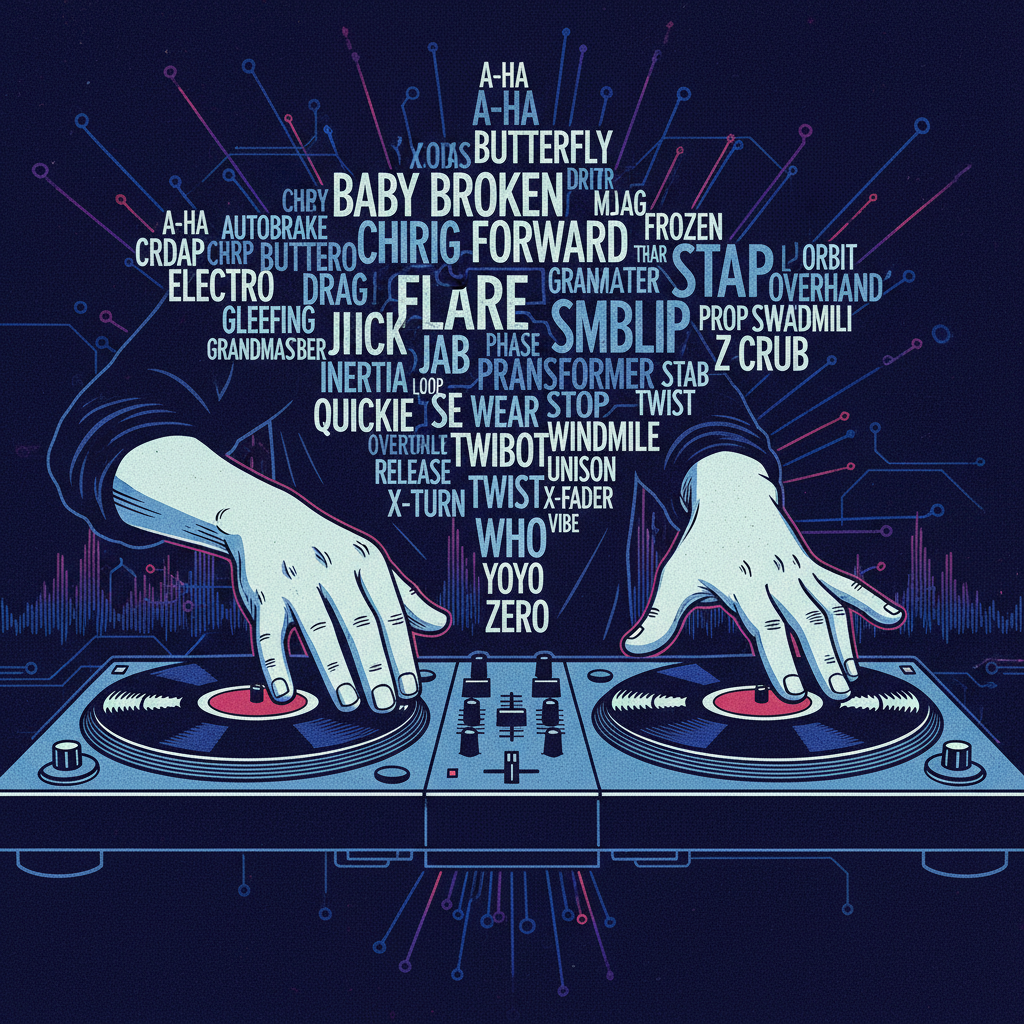
The vocabulary of turntablism is larger than most people realize, and it is still growing. This is the most complete reference guide to named scratch techniques available anywhere: every technique from the foundational baby scratch to the advanced crab and orbit, plus the original techniques developed by DJ Natural Nate®: the Taco Scratch, the Bend Scratch, and the Break Scratch, with descriptions, origins, and difficulty ratings for each.
Why a Scratch Glossary Matters
A scratch technique is a repeatable, nameable method of manipulating a record on a turntable to produce a specific sound. The name matters because it is how the technique is taught, discussed, and transmitted through the culture. When a DJ says "I'm working on my flares" or "that's a crab scratch," every other DJ who knows the vocabulary understands exactly what is being described. The vocabulary is the infrastructure of the art form, it is how knowledge is shared, how techniques are documented, and how the history of the craft is preserved. This glossary is an attempt to compile that vocabulary in one place, from the foundational techniques that every DJ learns first to the advanced techniques that take years to master, to the original techniques that represent genuine additions to the vocabulary. It is organized alphabetically for reference, with descriptions of the motion, the sound, the origin where known, and a difficulty rating from beginner to advanced.
The name is how the technique is taught, discussed, and transmitted. The vocabulary is the infrastructure of the art form.
Foundational Techniques: Where Every DJ Starts
The Baby Scratch is the foundation of everything. It is a simple forward-and-back motion of the record with no fader manipulation: the record moves forward, producing the sound, then moves back, producing the sound in reverse. No cuts, no complexity. The baby scratch is where every DJ begins, and mastering it, truly mastering the control and consistency of the motion, takes longer than most beginners expect. The Forward Scratch is a variation where only the forward motion is heard: the fader closes on the back motion so only the forward push produces sound. The Backward Scratch is the reverse, only the back motion is heard. These three techniques form the absolute foundation of the vocabulary. Every other technique builds on them. The Scribble Scratch is a rapid, loose version of the baby scratch: the hand moves quickly back and forth in a loose, scratchy motion that produces a rough, textured sound. It is one of the first techniques that sounds immediately impressive to non-DJs and one of the first that beginners learn after the baby scratch.
Intermediate Techniques: Building the Vocabulary
The Transformer Scratch was one of the first techniques to demonstrate that the fader was as important as the record hand. The transformer uses rapid fader cuts to chop the sound of a forward scratch into a staccato rhythm: the record moves forward while the fader opens and closes rapidly, producing a machine-gun effect. It was named after the Transformer toy because of the mechanical, robotic quality of the sound it produces. The Chirp Scratch combines a forward or backward record motion with a single fader cut timed to produce a specific tonal effect: the sound "chirps" as the fader opens and closes at a precise point in the record motion. The Tear Scratch divides a single record motion into two or more distinct sounds by changing the speed of the record mid-motion: the hand accelerates or decelerates during the scratch, producing a tearing quality in the sound. The Stab Scratch is a short, sharp forward motion with a quick fader cut: a single, percussive hit rather than a flowing scratch motion. It is used primarily as a rhythmic accent rather than a melodic technique.
Advanced Techniques: The Upper Vocabulary
The Flare Scratch is one of the most significant advances in the vocabulary after the transformer. Where the transformer uses the fader to cut into a scratch, the flare uses the fader to cut out: the fader starts open and closes briefly during the record motion, producing a different tonal and rhythmic character. The number of clicks in a flare, one-click, two-click, three-click, determines the complexity and the sound. The Crab Scratch takes the flare to its logical extreme, instead of using the thumb and one finger to operate the fader, the crab uses all four fingers in a rolling motion across the fader, producing extremely rapid cuts that no two-finger technique can match. The crab is one of the most physically demanding techniques in the vocabulary and one of the most immediately impressive to watch. The Orbit Scratch combines the flare and the transformer in a specific way: the fader opens and closes on both the forward and backward motions of the record, producing a continuous, orbiting sound that gives the technique its name. The Hydroplane Scratch uses the palm of the hand to slow the record to a near-stop while the fader stays open, producing a pitch-bending, slowing effect that is distinct from any other technique.
The crab uses all four fingers in a rolling motion across the fader, producing cuts that no two-finger technique can match. It is one of the most physically demanding techniques in the vocabulary.
Original Techniques: New Additions to the Vocabulary
The Taco Scratch was developed by DJ Natural Nate® and gets its name from the folding motion involved. The record hand executes a specific fold action while the fader opens and closes at precise points in the movement, producing a sound with a distinctive crease in its sonic profile: a moment where the sound folds back on itself in a way that no standard forward-and-back scratch produces. The Taco Scratch is particularly effective in Electro-Breaks and Breakbeat contexts. The Bend Scratch is a pitch-manipulation technique that uses controlled pressure on the record to bend the pitch of the sound being scratched. Unlike a standard scratch where the pitch stays relatively stable, the Bend Scratch introduces deliberate pitch variation by applying and releasing pressure at specific points in the scratch motion. The result is a scratch that rises and falls in pitch in a controlled, musical way. The Break Scratch is designed specifically for use in break-heavy music. It involves cutting into the break at specific rhythmic points and using the natural rhythmic energy of the break to drive the scratch rather than working against it. The result is a scratch that feels like part of the music rather than layered on top of it. All three techniques are documented in the Digital Journal and demonstrated on video in live performance.
Specialty and Context-Specific Techniques
The Boomerang Scratch uses a specific fader pattern to make the sound appear to travel away from and return to the listener: a spatial effect that is more about the fader timing than the record motion. The Tweak Scratch applies pressure to the record at specific points to alter the pitch in a controlled way: a simpler version of the pitch-bending principle that the Bend Scratch develops into a full technique. The Autobahn Scratch is a high-speed technique that uses rapid alternating forward and backward motions with precise fader cuts to produce a continuous, flowing sound at high tempo. The Laser Scratch uses a very short, precise record motion with a single fader cut to produce a sharp, laser-like sound: a technique that is more about precision than speed. The Swipe Scratch uses the back of the hand or the wrist to move the record in a sweeping motion rather than the fingertips: a technique that produces a different quality of motion and a different sound character.
How to Use This Glossary
This glossary is a reference, not a curriculum. The techniques are not listed in the order you should learn them, they are listed alphabetically for easy lookup. If you are a beginner, start with the baby scratch, the forward scratch, and the backward scratch. Master those before moving to the transformer. Master the transformer before attempting the flare. The crab and the orbit come after the flare is solid. The original techniques: the Taco Scratch, the Bend Scratch, the Break Scratch, are intermediate-to-advanced techniques that require solid fundamentals before they will work correctly. The best way to learn any scratch technique is to watch it performed by someone who has mastered it, then practice the motion slowly and deliberately before adding speed. The videos of DJ Natural Nate® performing the Taco Scratch, Bend Scratch, and Break Scratch live at a warehouse show are available on this site and on YouTube, they are the best reference for those three techniques that currently exists.
Master the baby scratch before the transformer. Master the transformer before the flare. Speed comes after control, not before it.