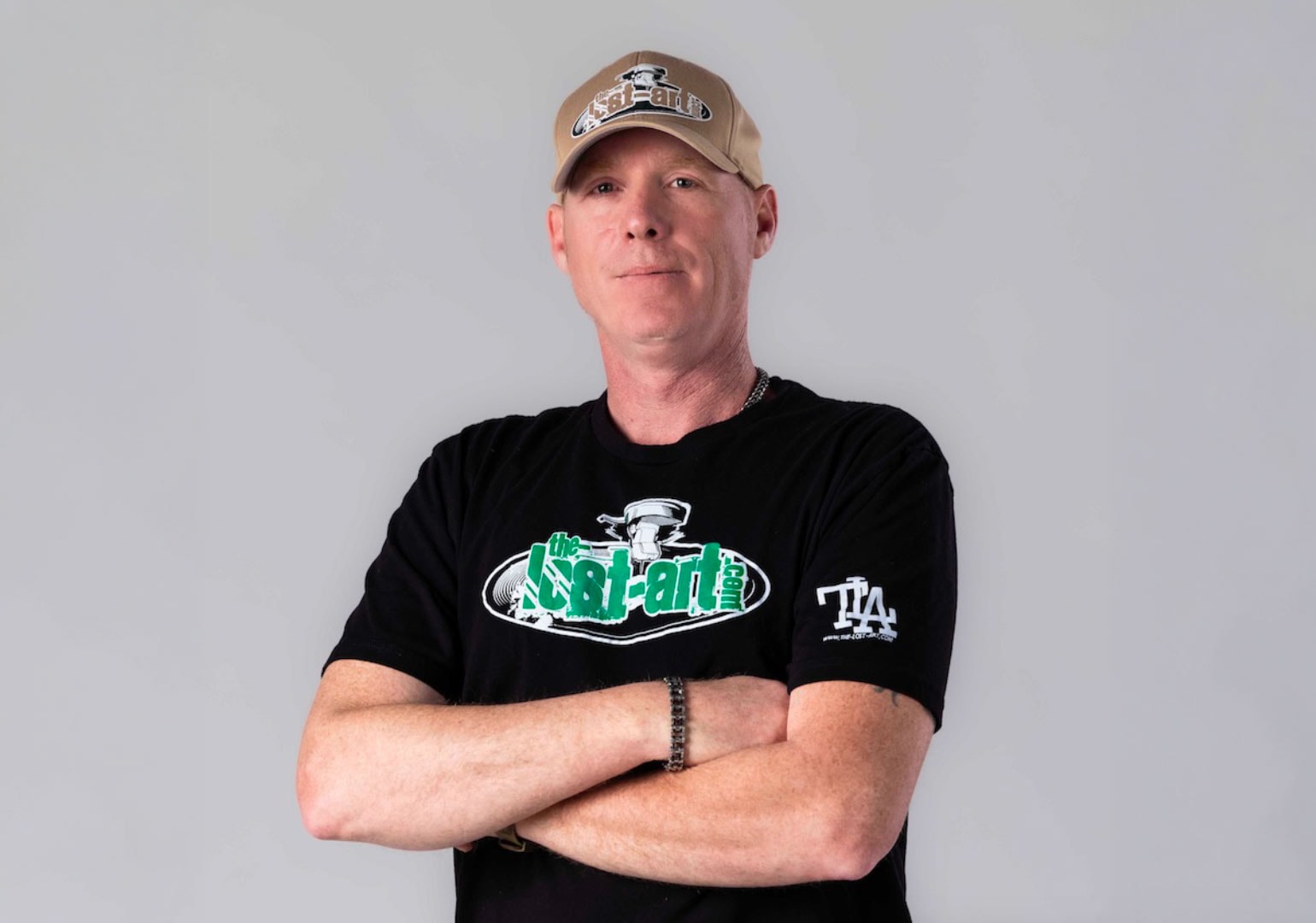
Digital Journal has published a major feature article documenting the creation of three original vinyl techniques invented by DJ Natural Nate®: the Bend Scratch, the Taco Scratch, and the Break Scratch. This is the full story behind the story: the musical saw that sparked an idea, the years of experimentation that followed, and why these techniques represent something far larger than a DJ trick. They represent a philosophy: that turntables are instruments, not just playback devices, and that vinyl still has sounds inside it that nobody has found yet.
The Question That Stayed With Him for Years
Every great invention starts with a question that refuses to go away.
For DJ Natural Nate®, that question arrived the moment he watched a musician play a musical saw.
Not a power saw. Not a carpenter's tool. A musical saw: a long, flexible blade held between the knees and bowed like a violin, its pitch controlled entirely by the degree of bend in the metal. As the musician curved the blade, the tone shifted, rising and falling in a way that no fixed-pitch instrument could replicate. It was haunting. It was expressive. It was unlike anything a standard instrument could produce.
And it planted a question in Nate's mind that he could not shake:
*What if a vinyl record could be manipulated like a musical instrument instead of simply being played?*
"What if a vinyl record could be manipulated like a musical instrument instead of simply being played?": The question that started everything.
That question seems simple. But the implications of it are enormous. Because the entire history of DJing, from the earliest hip-hop block parties to the most technically advanced turntablism competitions, had been built on a fundamental assumption: that a vinyl record is a playback medium. You put it on the platter. You play it. You scratch it. You blend it. You loop it. But the record itself, the physical object, the disc of pressed vinyl, that was always treated as a fixed thing. A container for sound, not a source of new sound.
What DJ Natural Nate® was asking was something different. He was asking: what happens if you treat the record the way a musician treats an instrument? What happens if you apply physical force to the vinyl itself, not just to the platter, not just to the needle, but to the record, and see what sounds come out?
Nobody had seriously pursued that question. Not in the way he was about to.
And the answer, it turned out, would take years to fully develop, and would eventually produce three original techniques that have now been documented in a major feature article by Digital Journal.
The Digital Journal Feature: What Was Published and Why It Matters
On July 3, 2026, Digital Journal published a feature article titled *"DJ Natural Nate and the creation of the Bend Scratch, Taco Scratch, and Break Scratch."*
Digital Journal is not a niche outlet. It is one of the most widely read independent digital news and media platforms in the world: a publication that covers technology, culture, science, and human interest stories at a global scale. When Digital Journal publishes a feature about a DJ's original techniques, it is not speaking to the converted. It is introducing a story to a mainstream audience that may never have heard of turntablism, vinyl manipulation, or the underground electronic music world that produced these innovations.
The article does something that has never been done before in a publication of this reach: it takes the Bend Scratch, the Taco Scratch, and the Break Scratch seriously as inventions. Not as party tricks. Not as novelty moves. Not as the kind of flashy technique that gets a reaction at a show and then disappears. It treats them as what they actually are, original contributions to the vocabulary of turntablism, developed through years of experimentation, rooted in a coherent philosophy about what a turntable can and should be.
For DJ Natural Nate®, who has spent decades documenting his history, proving his techniques, and building a record that could survive the passage of time, this is not just a press moment. It is a validation of the entire approach: the belief that if you do the work, document the truth, and keep building, the mainstream will eventually find its way to the story.
Digital Journal found its way to the story. And it told it right.
The Bend Scratch: When a Musical Saw Changed Everything
The Bend Scratch is the first of the three techniques, and in many ways the most philosophically significant, because it is the one that started the entire line of inquiry.
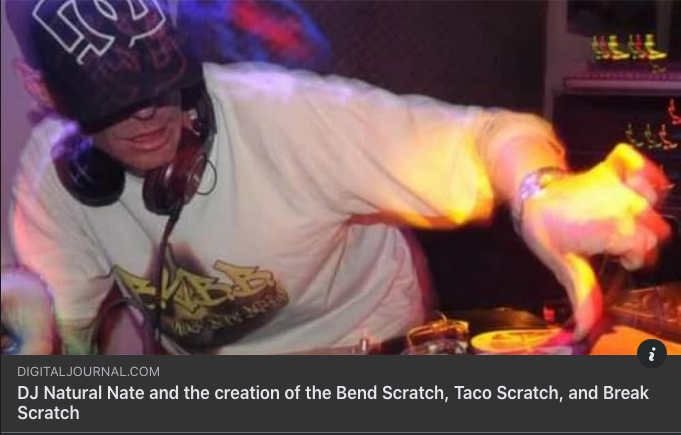
DJ Natural Nate® behind the decks. The Bend Scratch, Taco Scratch, and Break Scratch were developed through years of hands-on experimentation with vinyl and turntables.
The inspiration, as described in the Digital Journal feature, came directly from watching a musician play a musical saw. The saw's pitch is controlled by bending the blade: the more you curve it, the higher or lower the tone. The musician is not playing notes that are built into the instrument. They are creating pitch by applying physical force to a flexible object and listening to what happens.
That is exactly what the Bend Scratch does, but with vinyl.
The technique involves applying controlled physical pressure to a vinyl record while it is playing, causing the record to flex slightly. That flex changes the relationship between the needle and the groove, and that change produces a pitch shift. Not a pitch shift created by slowing or speeding the platter. Not a pitch shift created by a digital effect or a hardware processor. A pitch shift created by physically bending the record itself, in real time, while the music is playing.
The result is a sound that no other technique produces. It is organic. It is unpredictable in the best possible way. It has the quality of a live instrument: the slight imperfection, the human touch, the sense that the sound is being shaped by a hand rather than programmed by a machine.
The Bend Scratch creates pitch not by slowing the platter or adding an effect, but by physically bending the vinyl record itself, in real time, while the music plays.
It is also technically demanding in ways that are not immediately obvious. Vinyl is not designed to be bent. Apply too much pressure and you risk damaging the record. Apply too little and the effect is imperceptible. The technique requires a precise, calibrated touch: the kind of touch that only comes from years of practice and a deep understanding of how vinyl behaves under physical stress.
DJ Natural Nate® developed that touch. And in doing so, he created a technique that had never existed before.
The Bend Scratch is not a variation on an existing move. It is not a refinement of something someone else invented. It is an original contribution to the art form, one that came directly from asking a question nobody else had thought to ask, and then spending years finding the answer.
The Taco Scratch: Folding the Record, Folding the Rules
If the Bend Scratch came from watching a musical saw, the Taco Scratch came from pushing the logic of vinyl manipulation one step further.
The name is exactly what it sounds like. The technique involves folding a vinyl record, bending it into a shape that resembles a taco, while it is on the platter and in contact with the needle. The fold creates a dramatic, sustained pitch shift that is fundamentally different from anything the Bend Scratch produces. Where the Bend Scratch is subtle and expressive: a gentle curve that creates a smooth pitch glide: the Taco Scratch is bold and percussive. The fold is more extreme. The pitch shift is more pronounced. The sound is more aggressive.
It is also, by any conventional standard, something you are absolutely not supposed to do to a vinyl record.
Vinyl is a fragile medium. It warps in heat. It scratches under a misaligned needle. It degrades with repeated play. Every DJ knows this. Every DJ treats their records with a certain degree of care, not because they are precious objects, but because a damaged record is a record that no longer plays correctly.
The Taco Scratch requires you to set that caution aside. It requires you to take a record: a physical object that represents music, history, and craft, and deliberately fold it in a way that pushes the material to its limits. It requires you to trust that the vinyl will hold, that the needle will track, that the sound that comes out will be worth the risk.
The Taco Scratch requires you to fold a vinyl record, deliberately, precisely, and repeatedly, while it plays. It is something you are absolutely not supposed to do. That is exactly the point.
That trust is not blind. It is earned through experimentation. Through dozens of attempts. Through understanding exactly how much stress vinyl can absorb before it fails. Through developing a technique that is repeatable, controllable, and musically useful, not just a stunt, but a tool.
The Taco Scratch is a tool. A strange, unconventional, physically demanding tool, but a tool that produces sounds that no other technique can produce. And it exists because DJ Natural Nate® was willing to ask what would happen if he folded the record, and then actually did it, and then kept doing it until he understood what he had found.
The Break Scratch: When the Record Itself Becomes the Instrument
The Break Scratch is the third technique, and in many ways the most extreme, both in its physical demands and in what it represents philosophically.
The name refers not to a "break" in the musical sense, not a drum break, not a breakdown in a track, but to the act of pushing a vinyl record to the literal edge of its physical tolerance. The Break Scratch involves applying force to the record in a way that creates a sound at the boundary between music and destruction. It is a technique that lives in the space between playing a record and breaking one.
That space, it turns out, is full of sounds.
When vinyl is stressed to its limits, when the material is pushed to the point where it is about to fail but has not yet failed, it produces sounds that are unlike anything in the standard vocabulary of turntablism. Sounds that are raw, textural, and deeply physical. Sounds that carry the weight of the material itself: the density of the vinyl, the tension of the groove, the resistance of the record against the force being applied to it.
These are not sounds you can program. They are not sounds you can sample and replay. They are sounds that exist only in the moment of their creation, only when a specific record, under a specific amount of force, in the hands of a specific DJ who knows exactly how far to push it, produces something that has never been heard before and will never be heard in exactly the same way again.
The Break Scratch lives in the space between playing a record and breaking one. That space, it turns out, is full of sounds.
That is what the Break Scratch is. It is a technique that treats the physical limits of vinyl as a musical resource. It is a technique that says: the record is not just a container for sound. The record itself: the material, the object, the thing, is an instrument. And like any instrument, it has a range. And at the edge of that range, there are sounds that nobody has explored.
DJ Natural Nate® explored them. And in doing so, he completed a trilogy of techniques that together represent something larger than any individual move: a coherent philosophy of what turntablism can be when you stop treating the record as a fixed object and start treating it as a living, responsive, manipulable instrument.
The Philosophy Behind the Techniques: Turntables Are Instruments
In the Digital Journal feature, DJ Natural Nate® articulates the philosophy that underlies all three techniques with a clarity that cuts through everything else:
*"I've always believed that turntables are more than playback devices. They're instruments. There are still unexplored ways to express music through vinyl, and I've spent decades trying to discover some of them."*
That statement is not a marketing line. It is not a soundbite designed to generate attention. It is a genuine description of how DJ Natural Nate® has approached his craft for his entire career, and it explains why the Bend Scratch, the Taco Scratch, and the Break Scratch exist at all.
The dominant paradigm in DJing, even in turntablism, which is the most technically demanding and artistically ambitious branch of the art form, has always treated the turntable as a sophisticated playback device. The DJ's job, in this paradigm, is to control the playback: to blend tracks, to scratch rhythmically, to manipulate the speed and direction of the record in ways that create musical effects. The record is the source material. The turntable is the tool. The DJ is the operator.
DJ Natural Nate® rejected that paradigm. Not loudly, not with a manifesto, not with a public declaration of intent, but quietly, through years of practice and experimentation, by asking what would happen if the record itself became the instrument. If the physical object: the vinyl, the groove, the material, was not just a container for someone else's music but a source of new music. Music that didn't exist until the moment the DJ's hands created it.
"I've always believed that turntables are more than playback devices. They're instruments. There are still unexplored ways to express music through vinyl, and I've spent decades trying to discover some of them.", DJ Natural Nate®
That is a fundamentally different relationship with the art form. It is the relationship of a musician, not an operator. It is the relationship of someone who is not just playing music but making it, in real time, with their hands, through a process that is irreversible and unrepeatable and entirely their own.
The Bend Scratch, the Taco Scratch, and the Break Scratch are the physical expression of that philosophy. They are what happens when you take the question seriously, when you actually pursue the idea that vinyl has unexplored sounds inside it, and you spend years finding them.
And the fact that Digital Journal has now published that philosophy in a major feature article means that it is no longer just an underground truth. It is part of the mainstream record. It is documented. It is permanent. It is there for every DJ, every producer, every music fan, and every researcher who wants to understand where these techniques came from and what they mean.
Years of Experimentation: The Work Behind the Techniques
It is easy, in retrospect, to describe a technique as if it arrived fully formed. As if the inventor simply had an idea, tried it once, and it worked. That is almost never how invention actually happens.
The Bend Scratch, the Taco Scratch, and the Break Scratch were not born in a single session. They were developed over years, through hundreds of attempts, through failed experiments, through gradual refinements, through the slow accumulation of understanding that comes only from doing something over and over until you truly know it.
The experimentation required to develop these techniques was not casual. It was systematic. It required understanding vinyl at a physical level, knowing how the material behaves under stress, how much flex it can absorb before it warps permanently, how the needle tracks through a groove that is being actively deformed, how the pitch shifts that result from physical manipulation differ from the pitch shifts produced by slowing or speeding the platter.
It required developing a touch: a precise, calibrated, repeatable physical technique, that could produce the desired effect consistently. Not just once, in a controlled environment, with a specific record. But reliably, in performance, under pressure, with whatever records were available.
It required building a vocabulary. Understanding not just how to execute the technique but when to use it, what musical contexts it serves, what emotional effects it produces, how it interacts with the other elements of a DJ set. A technique that sounds impressive in isolation but has no musical application is a trick. A technique that can be deployed in service of the music, that can add something to a performance that no other technique can add, is a tool.
The Bend Scratch, the Taco Scratch, and the Break Scratch are tools. They were built through years of work. And that work is now part of the documented record, preserved in the Digital Journal feature, preserved on this site, preserved in the history of turntablism for every generation that comes after.
The underground has always known that DJ Natural Nate® did the work. The mainstream is learning it now.
The Community That Made It Possible
In sharing the news of the Digital Journal feature, DJ Natural Nate® said something that reveals as much about who he is as anything in the article itself:
*"A huge thank you to everyone who has supported my journey over the years, from the Bruise Your Body Breaks days to The-Lost-Art.com™, every DJ, producer, fan, and friend who believed in thinking outside the box. Your support has meant more than you know."*
That statement is not a formality. It is not the kind of generic acknowledgment that gets attached to every press release. It is a genuine recognition of the fact that no artist builds anything alone, and that the community of DJs, producers, fans, and collaborators who surrounded DJ Natural Nate® throughout his career was not just a backdrop to the work. It was part of the work.
The Bruise Your Body Breaks community: the DJs and fans who followed the label from its founding in 1998, who supported the releases, who came to the events, who watched the live broadcasts, created the environment in which experimentation was valued. In which trying something nobody had tried before was celebrated rather than dismissed. In which the question "what if you bent the record?" could be asked out loud without being laughed out of the room.
The-Lost-Art.com™ community: the 16 million monthly users who made the platform what it was, who watched the live DJ sets, who participated in the culture that Nate and his co-founders built, demonstrated that there was an audience for this kind of work. That people wanted to see real DJing. That they wanted to watch the hands, see the decks, understand what was actually happening in the performance.
"Every DJ, producer, fan, and friend who believed in thinking outside the box, your support has meant more than you know.", DJ Natural Nate®
The DJs who watched the techniques being developed, who asked questions, who pushed back, who demanded explanations, they sharpened the thinking. They forced the articulation of ideas that might otherwise have remained intuitive and unexpressed.
And the friends and family who believed in the work when the mainstream had not yet found it, who supported the journey through the years when the recognition was underground and the documentation was being built for a future that had not yet arrived, they made everything possible.
The Digital Journal feature is dedicated, in spirit, to all of them. Because the techniques it documents did not emerge from isolation. They emerged from a community that believed in thinking outside the box, and from an artist who was willing to act on that belief, year after year, until the mainstream finally caught up.
History Is Documentation: Why This Article Matters Beyond the Moment
DJ Natural Nate® closed his announcement of the Digital Journal feature with a statement that deserves to be read carefully:
*"History isn't only about preserving the past, it's about documenting the people who dared to try something different."*
That is not a casual observation. It is a philosophy of documentation that has driven every decision in his career: the PROVE THE MIX standard, the video archives, the press citations, the wiki entries, the blog posts, the world record documentation, the Breakspoll records, the label discography.
Everything has been documented. Not because documentation is glamorous. Not because building archives is exciting. But because DJ Natural Nate® understood, from early in his career, that the history of underground music is fragile. That the people who do the most original work are often the least visible. That the innovations that shape an art form are frequently uncredited, undocumented, and eventually forgotten, not because they weren't real, but because nobody wrote them down.
He wrote them down. He filmed them. He archived them. He built platforms specifically designed to make the documentation permanent and accessible. He created a record that could survive the passage of time, that would be there when the researchers came looking, when the journalists came asking, when the next generation of DJs wanted to understand where their art form came from.
"History isn't only about preserving the past, it's about documenting the people who dared to try something different.", DJ Natural Nate®
The Digital Journal feature is the latest entry in that record. It joins the Forbes Georgia feature, the Electric Kingdom Magazine coverage, the Juno Download catalog, the RecordSetter world record documentation, the Breakspoll archives, the Wikitia and EverybodyWiki entries, and the 86+ press citations on this site.
Together, they form a body of evidence that is now impossible to ignore. A record that says: this happened. This person did this work. These techniques exist. This history is real.
The Bend Scratch, the Taco Scratch, and the Break Scratch are now part of the permanent mainstream record. Digital Journal put them there. And they will be there for every DJ, every producer, every music fan, and every researcher who comes looking, for as long as the internet exists.
That is what documentation does. That is why it matters. That is why DJ Natural Nate® has spent decades doing it.
And that is why, when a publication like Digital Journal publishes a feature that gets it right, that tells the story accurately, that treats the techniques seriously, that places them in the context of a career built on genuine innovation, it is not just a good press moment.
It is the whole point.
A Closing Statement
For years, people have asked where the Bend Scratch, the Taco Scratch, and the Break Scratch came from.
Now they can read the answer. In Digital Journal. In a major publication. In the mainstream record.
The techniques are real. The history is documented. The philosophy is clear: turntables are instruments, vinyl has unexplored sounds inside it, and the people who dare to try something different deserve to have their story told.
DJ Natural Nate® dared. For decades, in the underground, with the support of a community that believed in the work before the mainstream knew it existed.
Digital Journal told the story. And the story is now permanent.
The techniques are real. The history is documented. The legacy lives on.
The legacy lives on.