Every DJ who has ever grabbed a spinning record to drag it back into time has announced their mistake to the room. DJ Natural Nate® spent decades eliminating that announcement entirely, and the answer was never in the vinyl. It was in the pitch slider the whole time. Tip #5 is the technique that made his world record performance of 86 live vinyl mixes in a single hour not just possible, but inevitable. Once you stop fighting the record and start steering the speed, your corrections become invisible, your transitions become faster, and the audience stops hearing a DJ working. They hear something far more powerful. They hear music that sounds like it is playing itself.
The Moment I Stopped Fighting the Record
Watch a DJ grab the record and you already know something went wrong. That hand reaching for the vinyl is not a technique. It is a confession. It means the beat drifted far enough that the pitch slider alone could not save the moment quietly, and now the correction has to happen in public, in real time, with the stylus still cutting through a groove that was never designed to be dragged backward by a human finger. Sometimes the correction is smooth. Sometimes it is not. Sometimes only another DJ hears it. Sometimes the entire room does. Either way, the moment that hand touches the spinning vinyl, the illusion is broken. The audience is no longer hearing music. They are watching someone fix a mistake.
I spent years refusing to accept that as the only option. The pitch slider was already in my hand. I just had to learn to trust it completely.
Every time you physically grab a spinning record to correct its speed, you are introducing a variable that your ears cannot fully predict and your hands cannot fully control. The stylus might skip. The groove might catch differently than expected. The platter might respond with a lurch instead of a glide. The audience might hear a wobble, a stutter, or a sudden lurch in the music that no amount of confidence can disguise. I wanted to eliminate that risk entirely, not reduce it, not manage it, but eliminate it, and the only path to that was to stop touching the record and start treating the pitch slider as the only correction tool that mattered.
That single decision changed everything about how I mix. And it is the foundation of everything that follows in this tip.
Your Pitch Slider Is a Gas Pedal: Not a Set-and-Forget Switch
Most beginner DJs treat the pitch slider like a light switch. They set it to a position and leave it there, assuming the records will magically stay locked together forever. They will not. Vinyl is a living, breathing medium. Platters have microscopic variations in speed. Styluses track differently at different points in a groove. Temperature affects motor performance. The records will drift. They always drift.
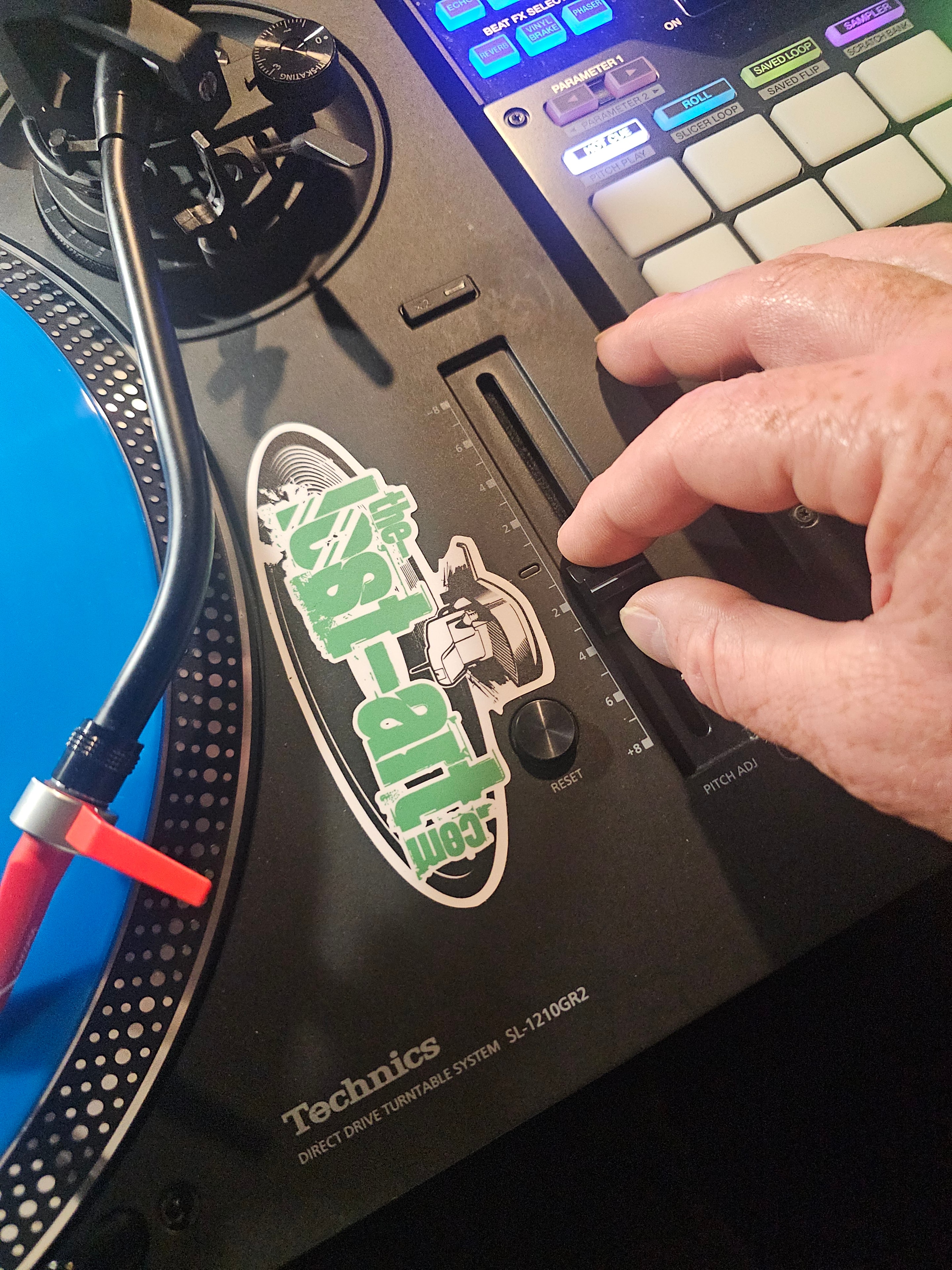
The pitch slider on a Technics SL-1210GR2, The-Lost-Art.com™ sticker on the body. This is the control that does the real work. The record itself should rarely need to be touched once you learn to steer with pitch alone.
The real skill is not finding a perfect pitch setting. The real skill is making constant, tiny corrections so smoothly that the drift is corrected before anyone hears it.
Think about driving on the highway next to another car at exactly the same speed. You are not holding the gas pedal in one fixed position. You are making dozens of tiny adjustments every minute, pressing slightly, releasing slightly, compensating for hills, wind, and the other driver's own subtle speed changes. Your foot is always moving, even when it feels like you are doing nothing. Pitch control works exactly the same way. Your hand should almost never be completely still.
Once you understand that comparison, the turntable stops feeling like a machine you are operating and starts feeling like a vehicle you are piloting. That shift in thinking is everything.
How to Correct Without Touching the Vinyl
When the incoming record is running too fast, getting ahead of the beat, most DJs instinctively drag it back with a finger. Instead, pull the pitch slider down farther than you think you need to. Let the record slow enough to fall back into the correct position, then smoothly return the pitch toward center as the beats lock together. You are overcorrecting slightly, then recovering. It is the same motion as steering through a curve or correcting a skid on ice. You turn into the skid, not away from it.
When the incoming record is too slow, falling behind, do the exact opposite. Push the pitch up enough to let it catch up quickly, then gently pull it back once it reaches the proper position. The key word in both cases is gently. Large, sudden pitch movements are audible. Small, fluid ones are invisible.
As your ears develop, those corrections become smaller and smaller. Eventually they are so subtle that even another DJ standing next to you cannot see them happening. That is the goal. Not perfection, invisibility.
The audience should never hear your corrections. They should only hear the music. Every correction you make with the pitch slider is a secret between you and the turntable.
Why This Made My World Record Possible
People ask constantly how I was able to perform 86 live vinyl mixes in a single hour during my world record attempt on April 29, 2010. The answer is not complicated. My hand was already where it needed to be.
When you are constantly moving back and forth between the record and the pitch slider, you are losing time on every single transition. Your hand has to travel. Your focus has to shift. Your ears have to recalibrate. All of that costs fractions of seconds that add up over the course of a performance. When your hand stays on the pitch slider and your corrections come from there instead of from the vinyl, you eliminate all of that wasted movement.
Less hand movement means faster reactions. Faster reactions mean quicker transitions. Quicker transitions mean more mixes per hour. It is not a trick. It is not a shortcut. It is the natural result of developing a technique that removes unnecessary steps from the process.
This is also why I can hold much longer blends than most DJs expect. Instead of rushing through every transition, I can keep two songs playing together for extended periods while making microscopic pitch adjustments that nobody hears. Ironically, I am working harder during those long blends than a DJ who is constantly twisting knobs and triggering effects. I am making hundreds of tiny corrections that sound like nothing because they are designed to sound like nothing. That is exactly how it should be.
The Foundation Before the Flash
There is enormous pressure today for DJs to look busy. Twist knobs. Trigger effects. Wave your hands. Build a visual performance that photographs well and fills a social media feed. I understand the appeal. Visibility matters. Presentation matters. But I would rather actually be busy doing the thing that truly matters.
Mix. Mix. Mix. Mix.
Not perform mixing. Not simulate mixing. Not suggest mixing while a laptop does the actual work. Mix, with your hands, your ears, your pitch slider, and thirty years of muscle memory that nobody can download, nobody can shortcut, and nobody can fake in front of a crowd that has been dancing long enough to know the difference.
Master the foundation before you worry about tricks, effects, or showmanship. Beatmatching by ear, controlling pitch, understanding musical phrasing, and developing the ability to guide two records together without ever needing to touch the vinyl, that is one of the greatest skills a turntable DJ can ever build. It takes years. It may take a lifetime to truly master. I have been doing this since 1996 and I still do not consider myself finished learning it. Every session teaches me something. Every record surprises me. Every crowd demands something I have not given before.
But once pitch control mixing finally clicks, once your hand stops chasing the vinyl and starts steering the speed, everything else becomes easier. Your mixes become cleaner. Your transitions become smoother. Your sets become faster, longer, and more musical. The audience stops hearing a DJ working and starts hearing something they cannot explain: music that sounds like it is simply happening on its own, flowing from one record to the next without seams, without hesitation, without the sound of effort.
The audience stops hearing a DJ working and starts hearing something they cannot explain, music that sounds like it is simply happening on its own. That invisible quality is the highest compliment a vinyl DJ can ever receive. It means the technique disappeared. It means the music won.
That invisible quality is the highest compliment a vinyl DJ can ever receive. It means the technique disappeared. It means the music won.
That is what real vinyl DJing has always been about. Not the flash. The foundation. Not the performance of skill. The actual possession of it.
This is Tip #5. The series continues. And it is only getting deeper from here.