Every second you spend searching for a track in a live set is a second you are not performing. DJ Natural Nate® developed a visual star system using metallic reward stickers that transformed thousands of records into an instantly readable library, even in the darkest warehouse parties with nothing but a strobe light overhead. This is Tip #4. It is almost embarrassingly simple. It is also one of the most effective things he ever did behind the decks.
The Question I Have Been Asked More Than Almost Any Other
How do you mix so fast and know your records so well?
I have heard that question hundreds of times over the course of my career. And the honest answer: the one that surprises people every single time, is that in many cases, I did not know my records all that well. Not in the way most people assume.
That is not a confession of laziness. It is the result of something I spent years building: a technical foundation so solid that the records almost play themselves once you lock them together. After developing proper headphone discipline, mastering beat counting and phrasing, and learning to guide transitions like a pilot performing mid-air refueling, the mechanical side of DJing stopped requiring conscious thought. My ears took over. My hands followed. And my eyes were free to do something else entirely.
What they were looking for was stars.
Why I Stopped Memorizing Records
Early in my career I tried to memorize everything. Track names, BPMs, which side had the better cut, where the breakdown hit, when the vocal came in. It was exhausting and ultimately unnecessary. The moment I trusted my technical ability over my memory, everything changed.
I reached a point where I could grab records I barely knew, mix them together naturally, and create a completely original performance every single time. The audience had no idea what was coming next. In many cases, neither did I. We were both experiencing something brand new together: a performance that existed only in that exact moment and would never happen again in exactly that way. That is one of the greatest feelings a turntablist can experience.
But that freedom created a practical problem. If I was not memorizing records, how was I supposed to know which tracks were on which side, especially when many records contained three or four completely different songs?
The Problem That Built the System
Vinyl DJs know the nightmare. You are in the middle of an incredible mix when the record jumps backward or locks into a damaged groove and loops the same two seconds over and over. It destroys the moment completely. Because of that, whenever I received a shipment of brand-new records, I avoided playing them repeatedly before taking them to clubs or warehouse parties. I wanted to keep them as fresh as possible.
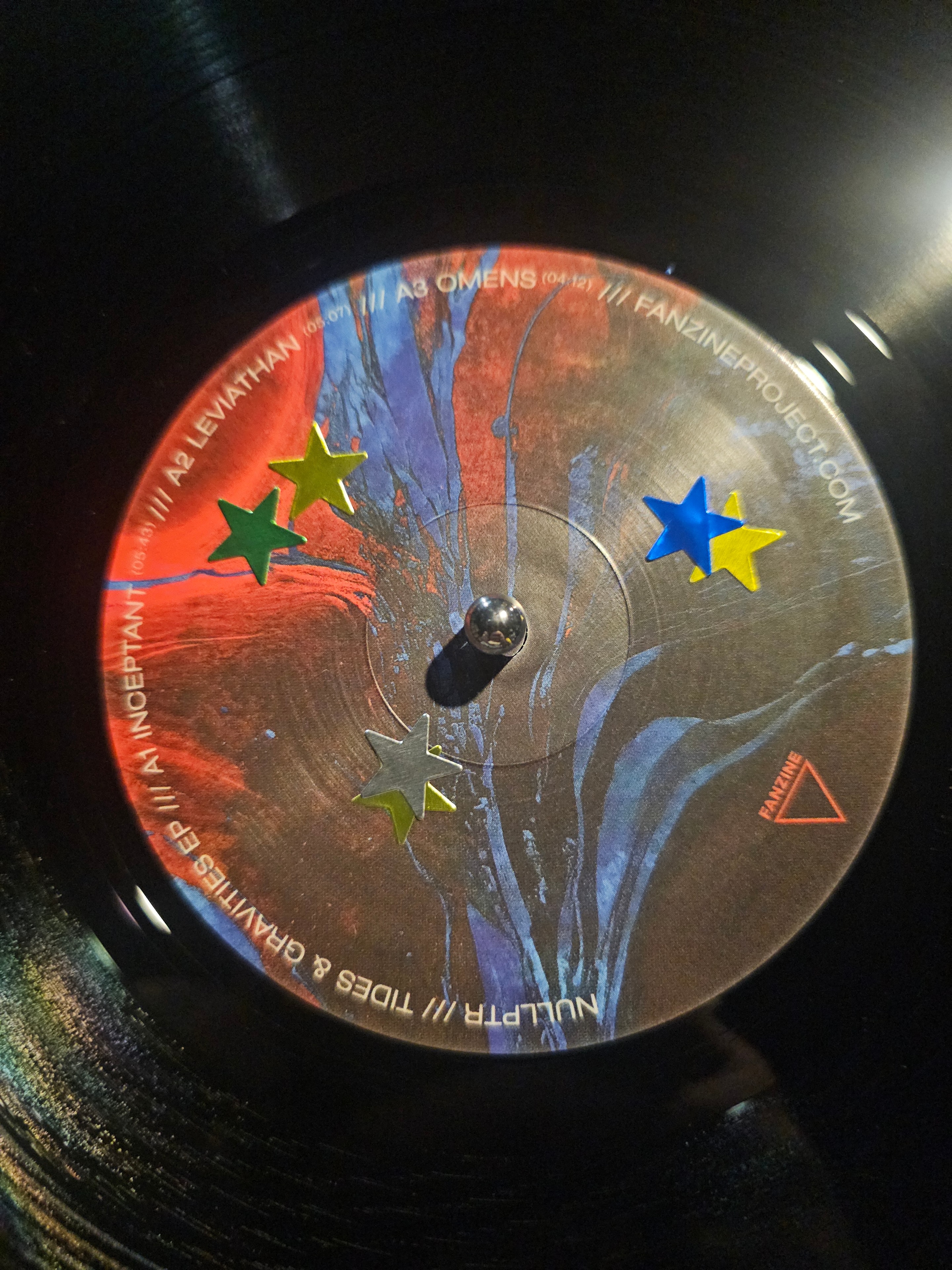
The star system in action, metallic reward stickers marking favorite tracks directly on the vinyl label. Gold for the best cut. Silver for second. Each color and position tells a story at a glance.
That meant I often showed up to gigs with records I had only listened to once or twice. Which created another problem: how do you find your best tracks fast when you barely know what is on the label?
The answer became one of the simplest systems I have ever created, and one of the most effective.
Gold, Silver, Blue, Green, Red: A Language Only I Understood
I bought small metallic reward stars. The kind teachers used to stick on school assignments. Gold, silver, blue, green, and red. Those little stickers completely transformed the way I organized my record collection.
Back in the warehouse party days, lighting was almost nonexistent. Strobe lights. Dim red bulbs over the turntables. Sometimes nothing at all. You could not always read record labels or tiny printed track listings. But those metallic stars reflected whatever light was available. They would shine back at me instantly, and in many cases I could recognize their colors without ever reading a single word.
Gold always represented my absolute favorite track on that side of the record. Silver was my second favorite. Blue was my third choice. Green indicated another solid record worth playing. Red often meant a slower groove, a deeper track, or one I wanted to save for the right moment. The colors were not locked into rigid rules. They became my own language: a private shorthand that only I understood.
The placement of each star was just as important as the color. If there were four songs on one side of a record, the first star sat near the top of the label beside the first track listing. The next favorite sat slightly lower. The third lower still. The fourth near the bottom. Without reading a single word, I immediately knew which track corresponded to which position.
Those metallic stars reflected whatever light was available. In the darkest warehouse parties, they would shine back at me instantly. I no longer had to waste precious seconds searching. I could find my best tracks almost immediately.
When Every Track Was Gold
Sometimes every song on a record was incredible. In those situations, every track received a gold star. Then I created another level of ranking. I would stack stars together, two or even three gold stars beside my absolute favorite cut. Instantly I knew not only that every song was excellent, but exactly which one I wanted first if I needed a guaranteed crowd reaction. The more stars I saw, the more excited I became to play that record.
This visual system made my record selection unbelievably fast. Instead of flipping records over, reading tiny print, trying to remember track names, or guessing which side contained my best material, I simply looked for shining stars. Within seconds I knew exactly where my strongest tracks were located. The stars became shortcuts directly to the music that inspired me most.
Over time, this system blended naturally with everything else I had learned. My ears controlled the mixes. My hands controlled the pitch. My eyes only searched for stars. Instead of thinking about what record came next, I focused entirely on creating energy and building a journey for the audience. That freedom allowed me to mix faster than most DJs because I had eliminated unnecessary decisions. Every second saved searching through records became another second available for creativity.
Speed Is Not Talent. Speed Is Organization.
Many people assume speed comes from talent alone. I disagree completely. Speed comes from organization, preparation, experience, and developing systems that work under pressure. Every professional in every industry builds shortcuts that make them more efficient under live conditions. This was one of mine.
Very few people have ever known about this technique because it was something I shared only with close DJ friends. It seems almost too simple to matter. A handful of tiny metallic stars. And yet it became one of the biggest time-saving tools I ever developed, transforming thousands of records into an organized visual library I could read almost instantly, even in the darkest clubs and warehouse parties on the planet.
Today, when people ask how I can walk up to unfamiliar records and perform long, completely improvised sets that feel planned from beginning to end, this is one of the answers. It is not magic. It is not memorization. It is years of developing simple systems that allow creativity to happen naturally. When the technical side becomes second nature, you stop worrying about mechanics and start telling stories with music.
That, to me, is what being DJ Natural Nate® has always meant.
This is Tip #4. The series continues.