The DJ title covers radically different disciplines. The-Lost-Art.com™ explains what separates wedding, club, vinyl, battle, radio, festival and Mixologist DJs, and why the distinction protects every legitimate craft.
The word DJ has been stretched so far beyond its original meaning that it now covers completely different jobs, completely different skill sets and completely different disciplines. A wedding DJ, a DMC battle champion, a six-hour underground techno resident, a radio mixshow host, a scratch turntablist, a festival EDM headliner and a bedroom selector can all call themselves DJs without any one of them being wrong. Yet none of them is automatically capable of doing what the others do. That is not a minor distinction. It is the entire problem. When one word means everything, it eventually means nothing, and people who spent years or decades mastering a specific discipline get thrown into the same category as someone who downloaded software last Tuesday. This is the conversation the DJ industry has avoided, deflected and argued around for twenty years. The-Lost-Art.com™ is having it now.
One Title, Many Different Jobs
The DJ title is not a single job description. It is a broad umbrella covering event service, musical selection, technical mixing, turntablism, radio presentation, live construction and large-scale entertainment. The mistake is not that these disciplines exist. The mistake is pretending they are interchangeable.
A DJ can be excellent at one discipline and unprepared for another. A wedding professional may command a room, coordinate a timeline and guide a mixed-age crowd through a once-in-a-lifetime event. A battle DJ may build a three-minute routine that requires months of practice. An underground resident may hold a room for six hours through patient programming and seamless blends. Each deserves respect for the work they actually do. Respect begins when the job is named honestly.
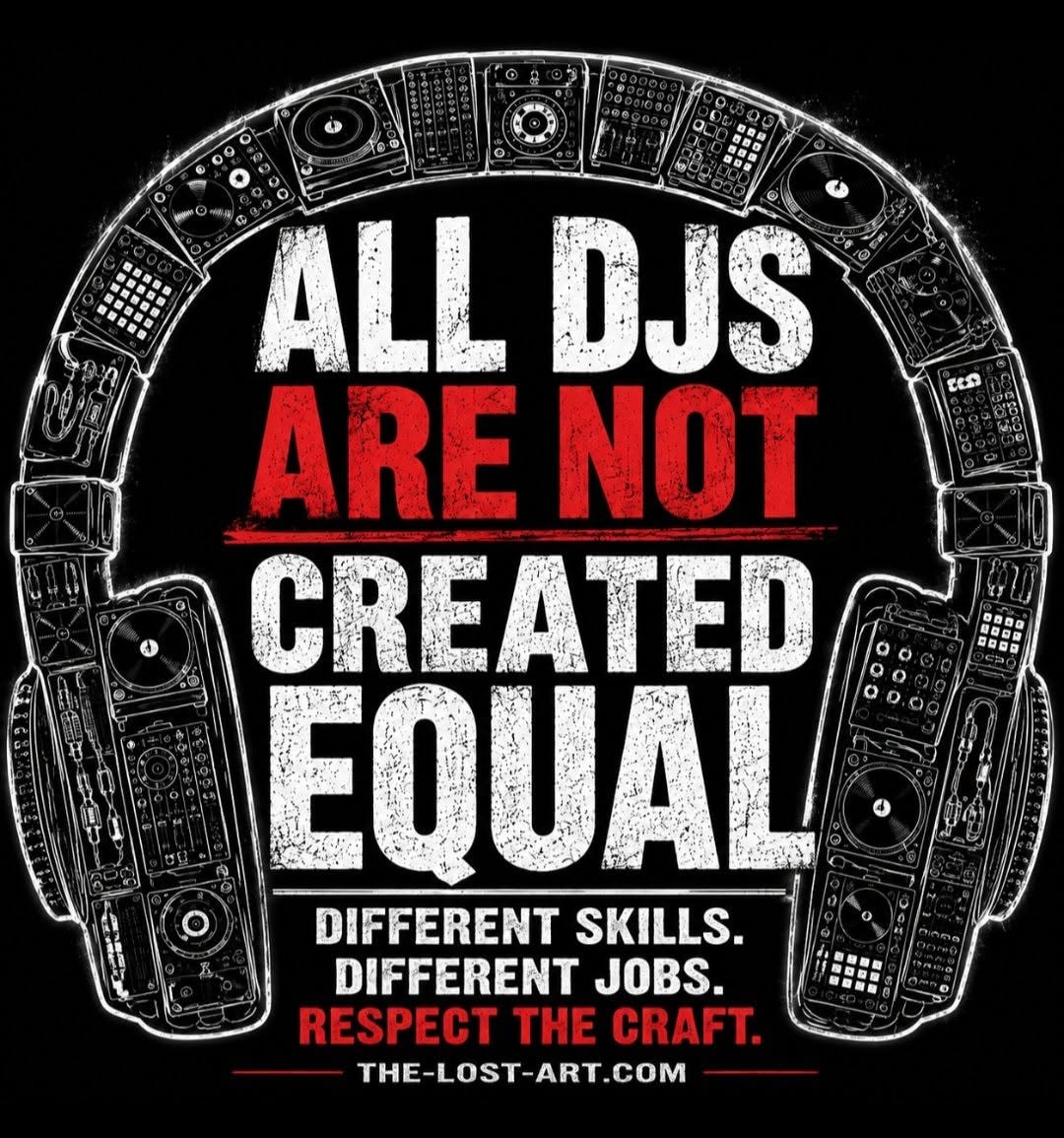
“Different skills. Different jobs. Respect the craft.”
Wedding, Mobile and Private Event DJs
Wedding DJing is primarily an event service. A great wedding DJ understands broad audiences while handling requests, announcements, microphones, introductions, first dances, speeches, schedules and coordination with clients and vendors. Their musical knowledge can be enormous because they may move through five decades and several genres in one event.
Mobile DJs work birthdays, corporate events, school dances, reunions and private parties, often bringing the entire production with them. Sound systems, lighting, cables, backup equipment, setup, teardown and direct client communication are part of the job. Reliability and professionalism can matter more than demonstrating an elaborate transition. A mobile DJ can be outstanding at running an event while possessing moderate technical mixing ability. That does not make them bad at their job. It means technical mixing is one part of a different job.
Open-Format and Commercial Club DJs
Open-format DJing can be extremely difficult when it is done properly. These DJs may move between hip-hop, funk, disco, rock, house, pop, Latin music, old-school records and current hits in the same performance. The differences in tempo, structure and rhythm create challenges that do not exist inside one narrow genre. Skilled open-format DJs use cuts, scratches, breakdowns, loops, wordplay and carefully chosen transition records to move a room without losing it.
Commercial nightclub DJs work under different expectations again. The audience may expect recognizable songs quickly, management may expect certain music and requests may matter. A beautiful three-minute transition may accomplish nothing if the objective is immediate energy. A dancing crowd proves that a DJ successfully entertained that particular crowd. It does not automatically prove every other DJ skill, and it does not need to.
Underground Club and Rave DJs
This is closer to the world The-Lost-Art.com™ was built around. Traditional underground club and rave DJing places greater emphasis on continuous mixing and constructing a musical journey. The audience may specifically want records they have never heard before, and the DJ may have several hours to develop an atmosphere.
Selection, phrasing, timing, EQ control, transitions, layering and energy progression become central parts of the performance. The DJ is not simply delivering individual songs because the relationship between those records becomes part of the performance. A great underground DJ can take tracks created by different producers and make them feel like pieces of one continuous musical experience. The order matters. The timing matters. The transitions matter. Knowing when not to play the biggest record matters. There may be no microphone and no requests because the mix itself is the performance.
“The records are not just played in sequence. Their relationship becomes the performance.”
Vinyl DJs and the Physical Test
Traditional vinyl DJing requires direct physical interaction with the music. You manually cue the record, find the starting point, control the pitch, hear the records drift, determine which record is ahead or behind and physically correct it. Vinyl provides no waveform showing exactly where everything happens, no beatgrid keeping everything aligned and no sync button correcting the timing relationship between records.
Vinyl also introduces worn records, different pressings, turntable feedback, needle problems, different recording levels and pitch limitations. The DJ has to listen, interpret and correct constantly. That is why turntables remain one of the clearest demonstrations of traditional manual DJ ability. They expose what somebody can actually hear and control.
Hip-Hop DJs, Scratch DJs and Turntablists
The DJ is foundational to hip-hop culture, and hip-hop DJing transformed record playback into performance. Cutting, scratching, doubles, backspinning, break manipulation and beat juggling became major elements of the craft. A skilled hip-hop DJ can select records, mix, scratch and manipulate sections of recordings rhythmically at the same time.
Scratch DJs specialize in the relationship between record movement and fader movement. At advanced levels, scratching becomes improvisational, with timing, coordination, muscle memory and rhythmic understanding working together like another musician joining the performance. Turntablism pushes this further by treating turntables and the mixer as instruments. The original recordings become raw material rather than simply songs being played. This is one of the most technically demanding branches of DJ culture, but it is still its own discipline.
Battle DJs and DMC Competition
Battle DJs are strongly associated with DMC-style competition because the DMC World DJ Championships became one of the defining institutions of competitive turntablism. This is DJing under competitive pressure, where technical execution, originality, difficulty, timing and musicality matter. DJs can spend months constructing and practicing routines lasting only a few minutes because every movement has to work.
A world-class DMC DJ might destroy an ordinary nightclub DJ in a battle, while that same nightclub DJ might be considerably better at controlling a dance floor for eight hours. There is no contradiction. They are different disciplines requiring different abilities.
Mixologist DJs: When the Decks Become an Instrument
There is another type of DJ that deserves its own category because this is where continuous mixing becomes closer to live musical construction. The-Lost-Art.com™ calls them Mixologist DJs. A Mixologist does more than transition from one complete record into another. They deliberately place records on top of other records for extended periods and use individual elements to create something that does not exist on either original track.
The drums from one record may run beneath the bassline of another while vocals or percussion from another source enter the mix. Two records may remain together for several minutes. With three or four decks, the possibilities become more complex. EQ becomes part of the construction because the DJ decides which frequencies from each record remain. Faders become part of the arrangement. Timing and phrasing become critical because the records are no longer passing each other during a transition. They are temporarily becoming one piece of music.
This is fundamentally different from playing a mashup or remix somebody constructed beforehand. If the combination was produced before the performance and somebody presses play, the creative construction occurred during production. With live mixology, constructing that combination is part of the DJ performance itself.
“The decks become individual musical sources. The mixer becomes part of the instrument.”
Genre Specialists and Long-Form DJs
House, techno and trance DJs each face different musical demands. House rewards groove, phrasing, programming and flow. Techno can take layering further, with tracks functioning like components as DJs use multiple decks, loops, EQ and percussion to transform the music gradually. Trance requires long progression, extended breakdowns, tension and release.
Breakbeat, drum and bass and jungle add rhythmic complexity. Two tracks can be perfectly matched in tempo while their percussion still fights against each other. Disco, funk and soul DJs may bring extraordinary knowledge of obscure records, original pressings, breaks, samples and relationships between artists. Reggae, dancehall and Latin DJs work inside traditions where selection, dubplates, exclusives, crowd interaction and cultural knowledge carry enormous importance.
Long-set DJs deserve their own category too. Playing eight, ten, fifteen or twenty hours requires an enormous amount of music, concentration, endurance, pacing and somewhere to actually go musically. A DJ who can create an incredible 45-minute performance is not automatically capable of constructing a ten-hour journey.
Radio, Festival, Streaming and Celebrity DJs
A radio DJ may select records, introduce songs, interview guests, talk to listeners and develop an on-air personality, while beatmatching may have nothing to do with being excellent at that job. Radio mixshow DJs are different again because they perform mixes for broadcast while dealing with programming and timing restrictions.
Modern festival EDM DJing must be separated from traditional underground club and rave DJing because the giant mainstage production can become the primary show. LED walls, lasers, pyrotechnics, CO2, fireworks, confetti, video sequences and lighting cues may all need to happen at specific moments. There are festival DJs who really mix live, improvise and possess serious technical ability. They deserve to be distinguished from somebody performing gestures over premixed material.
Streaming, social media and celebrity DJing create another environment where the DJ may be performing as much for a camera or a name as for a dance floor. Fame gets somebody onto a stage. It does not tell us what they can actually do once they are behind the equipment.
Controllers, CDJs, Sync and Automation
Using a controller does not make somebody a fake DJ. Controllers can provide multiple decks, effects, loops, stems, samplers and performance pads that create real possibilities. The same principle applies to CDJs and digital DJing. A DJ can manually control pitch, cue tracks, mix by ear and largely ignore visual assistance, while another can depend heavily on analyzed BPM values, stacked waveforms, beatgrids and synchronization.
The distinction is between using automation and depending on automation. A DJ who can manually beatmatch but chooses synchronization while performing a complicated multi-deck technique still possesses the underlying ability. Somebody who cannot maintain two tracks without beatgrids, synchronization and visual waveforms does not possess that same skill set. Digital media is not the issue. The question is whether technology expands what somebody already knows how to do or replaces fundamental skills they cannot perform themselves.
Technical Skill Is Not the Only Skill
Possessing an advanced DJ skill does not automatically mean somebody knows when or how to use it musically. Scratching can take years to master. That does not mean scratching continuously for thirty minutes makes a set better. Knowing when not to use a technique is also part of mastering it. Scratching should serve the performance. Effects should serve the performance. Loops should serve the performance.
Four decks do not automatically make somebody better than a DJ using two, and touching more controls does not automatically demonstrate more talent. Selection is a real skill. Crowd reading is a real skill. Programming is a real skill. Technical execution is a real skill. The honest conversation begins when we stop pretending they are all the same skill.
Why the Industry Keeps Fighting
Once these different types of DJs are separated, the reason there is so much fighting inside DJ culture becomes easier to understand. Everybody wants the same title. The problem is that one title now represents an enormous collection of abilities that no single person automatically possesses simply because they call themselves a DJ. When somebody says DJ skill, everybody can be talking about something completely different.
People also want credit for skills associated with the DJ title even when they have never developed those particular skills. That is where much of the defensiveness comes from. People hear recognition of another DJ's ability as subtraction from their own, but it does not have to work that way. Saying a DMC champion possesses abilities another DJ does not possess does not make the other person worthless. It means all DJs are not created equal, and different disciplines require different skills.
The-Lost-Art.com™ has never argued that every DJ needs to be a turntablist, scratch DJ, DMC competitor, Mixologist or underground marathon DJ. Our argument is simpler and stronger. Know what you do. Respect what other disciplines require. Stop pretending every person carrying the title possesses every skill associated with it. Saying somebody is a DJ is only the beginning of the conversation, because we want to know what kind of DJ they are, what their discipline actually requires, what abilities they actually possess and what they can actually demonstrate. Followers, branding, lasers, production, choreography, beatgrids and automation cannot answer those questions. Strip them away and the same question remains, the one The-Lost-Art.com™ has asked since 2009: can you actually DJ?