Several years ago I made a post about the importance of obtaining a registered trademark. At the time I had already started running into some major issues, and what I began seeing in Google searches absolutely blew me away. There were five different DJs using the name DJ Natural Nate online. One reggae DJ's fan page had become so prominent that Google was displaying his photographs when people searched for my name. This is the full story of what happened, what I learned, and why protecting your name is one of the most important business decisions you will ever make.
The Day I Realized My Name Was No Longer My Own
Several years ago, I made a post about the importance of obtaining a registered trademark. At the time, I had already started running into some major issues, and what I began seeing in Google searches absolutely blew me away.
Like many people, I never gave much thought to fan pages or branding because I assumed most people knew DJ Natural Nate through my friends, the DJ community, my performances, and the work I had built over the years. During Facebook's early days, your personal profile could simply be your DJ name, so I never created a separate fan page. Later, Facebook changed its platform and essentially pushed everyone toward business and fan pages. I never made the switch because I honestly was not concerned about it and never imagined the problems it would eventually create.
As the years passed, Google started displaying other people using the name DJ Natural Nate, many of them through fan pages that had absolutely nothing to do with me. At one point, there were five different DJs using that same name online. One reggae DJ's fan page had become so prominent that Google was displaying his page and even his photographs when people searched for my name.
It was frustrating beyond words. I had years of documented history, performances, flyers, photographs, releases, and online content that clearly established my identity, yet social media platforms were unwilling to help because much of my history existed before fan pages became the standard. Watching years of hard work become buried behind someone else's content was one of the most discouraging experiences I have ever dealt with.
There were five different DJs using the name DJ Natural Nate online. One reggae DJ's fan page had become so prominent that Google was displaying his photographs when people searched for my name.
Understanding the Difference Between Copyright and Trademark
That entire situation forced me to begin researching how to legally protect my identity and my brand. What I discovered changed the way I think about business, branding, and the creative industry entirely.
I learned there is a significant difference between copyright and trademark law, and most artists, musicians, and DJs have no idea this distinction exists until they desperately need to understand it.
Copyright protects original creative works. If you record a mix, write a song, produce a track, or create an original piece of content, copyright law gives you certain automatic protections over that specific work. However, copyright does not protect your name, your brand, or the identity people associate with your business.
A trademark, on the other hand, protects the name, brand, logo, or identity that people associate with your business or services. If your name is your reputation, your livelihood, and your brand, which it absolutely is for any working DJ or artist: a registered trademark is one of the strongest legal protections you can have.
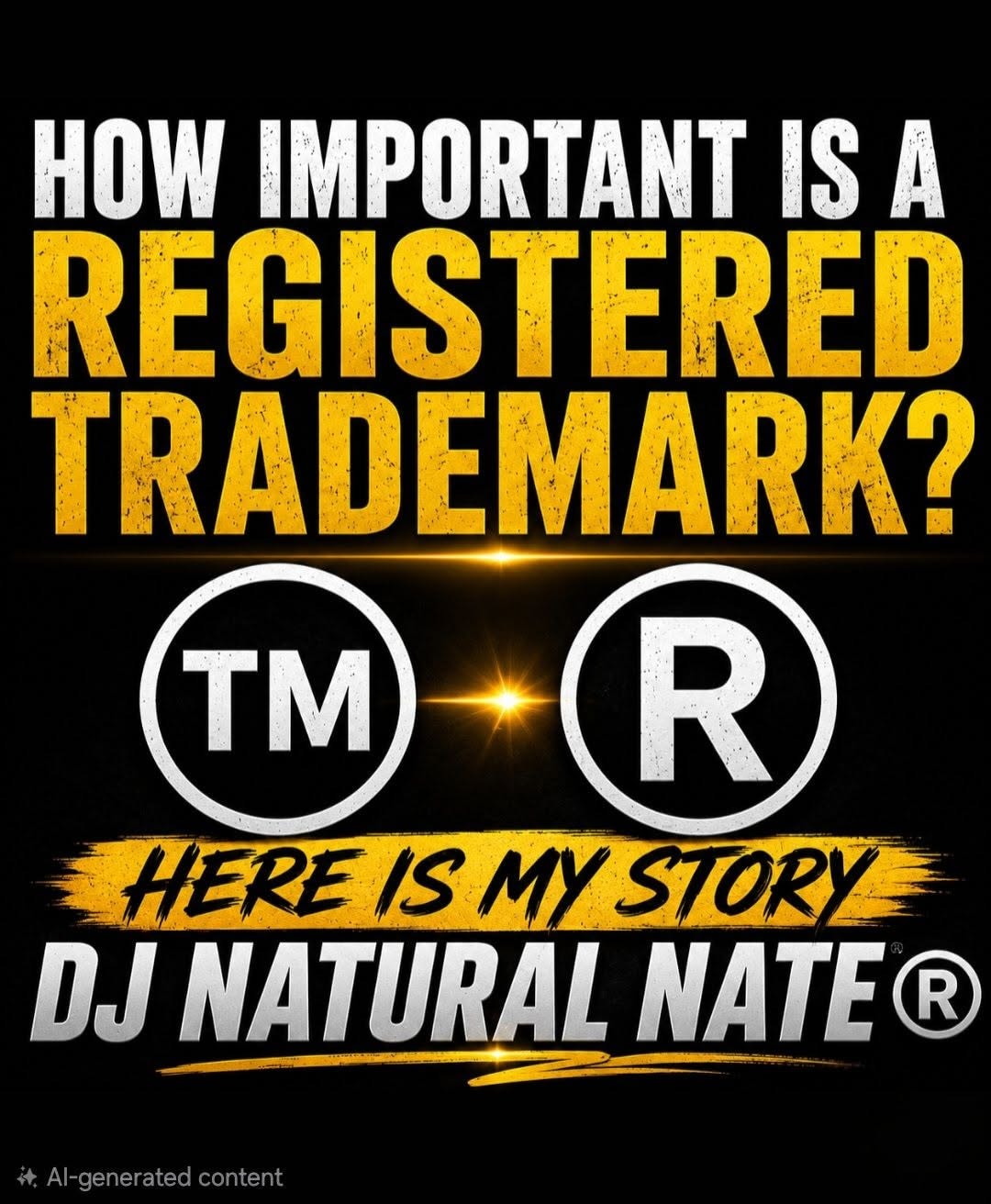
The TM symbol (™) can be used by anyone who claims rights to a name or mark, even without formal registration. It signals that you are asserting ownership, but it carries limited legal weight on its own. The ® symbol, however, can only be used after the United States Patent and Trademark Office officially grants your registration. That registration gives you nationwide legal presumption of ownership, the right to use federal courts to enforce your rights, and the ability to block infringing imports through U.S. Customs.
Copyright protects your creative works. A trademark protects your name, your brand, and the identity people associate with you. Most artists do not understand this distinction until they desperately need to.
For a DJ, musician, or artist whose name is their entire brand, the difference between TM and ® is the difference between hoping people respect your claim and having the legal authority to enforce it.
Why Getting a Trademark Is Harder Than Most People Think
I also learned that obtaining a trademark is not easy, especially when your brand includes common industry terms like "DJ." The United States Patent and Trademark Office does not simply hand out registrations. The process requires research, patience, documentation, and proving that your mark is distinctive and legitimately associated with you and your services.
The examination process involves a USPTO attorney reviewing your application and potentially issuing what is called an Office Action: a formal objection that requires a legal response. Common objections include claims that your mark is too descriptive, too similar to an existing registered mark, or that you have not provided sufficient evidence of use in commerce.
The word "DJ" is considered a generic or descriptive term within the music industry, which means the USPTO scrutinizes applications that include it very carefully. You have to demonstrate that your specific combination of words has acquired what trademark law calls "secondary meaning", meaning that when people in your industry hear that name, they associate it specifically with you and your services, not with the general concept of a disc jockey.
Proving secondary meaning requires evidence. Lots of it. Flyers, event advertisements, photographs, recordings, business documents, websites, merchandise, interviews, articles, and years of consistent public use can all become incredibly valuable. I spent nearly three years working through the process before finally receiving my registered trademark. It required persistence, patience, and a tremendous amount of documentation, but in the end, it was one of the best business decisions I have ever made.
First Use in Commerce: Why Your History Is Your Most Powerful Asset
One of the most important lessons I learned throughout this entire process was that your trademark rights can often rely on when you actually began using your name in commerce, provided you have the evidence to prove it.
In the United States, trademark rights are generally granted to the party who can demonstrate the earliest legitimate use of a mark in commerce. This is why documentation is so critical. If you have been performing under a name since 1996, but you cannot prove it, that history may as well not exist in a legal dispute.
I had been performing as DJ Natural Nate since 1996. I had show flyers, event photographs, recordings, online content, articles, and a documented history that stretched back nearly three decades. That history became the foundation of my trademark application and, more importantly, the foundation of my ability to reclaim my identity once the registration was granted.
The lesson here is simple but profound: save everything. Save your flyers. Save your photographs. Archive your websites. Keep your business records. Document your performances. Every piece of evidence that demonstrates your consistent, public use of your name in connection with your services is a potential asset in any future legal dispute.
If you are an artist, musician, DJ, content creator, or business owner who has been building a brand for years, you may already have more legal ammunition than you realize. The question is whether you have preserved it.
I had been performing as DJ Natural Nate since 1996. That documented history became the foundation of my trademark application, and the foundation of my ability to reclaim my identity once the registration was granted.
The Day Everything Changed: Reclaiming My Identity
The difference after receiving my registered trademark was remarkable. I finally had the legal authority to begin cleaning up years of confusion surrounding my name.
Initially, Facebook treated many of the impersonating profiles as though they had more authority simply because their fan pages existed within their system. The platform's internal processes were not designed to easily resolve disputes where the legitimate owner had never created a formal fan page. Without a registered trademark, I was essentially arguing my case based on reputation and history alone, and platforms like Facebook were not equipped or motivated to make judgment calls based on those factors.
Once I presented the legal documentation and demonstrated that my trademark rights traced back to my documented first use dating to 1996, everything changed. The conversations became much different because they were no longer looking only at when the trademark registration was issued. They were looking at the documented history of my use of the name.
One by one, the impersonating accounts disappeared. The incorrect images associated with Google searches were removed. I was finally able to regain control over my own identity online.
It took years to fix something that never should have happened in the first place. But the experience taught me something that I carry with me every single day: protecting what you have built is not optional. It is a responsibility.
The Scams, the Threats, and the Harassment That Never Stops
Unfortunately, this story does not end there. Receiving a registered trademark does not mean the threats disappear. In some ways, it means they evolve.
Recently, I have started receiving another type of threat that every business owner should be aware of. I have been getting harassing text messages and emails claiming that people are attempting to register trademarks or business entities associated with The-Lost-Art™ and threatening that I will receive cease-and-desist letters unless I take action. These messages are designed to create panic and pressure people into paying money.
While some of these are simply scams targeting business owners and trademark holders, they also serve as a reminder that there are people who constantly look for opportunities to profit from someone else's hard work, reputation, and years of dedication. These bad actors monitor trademark registrations, business filings, and public records specifically to identify targets they can intimidate.
The reality is that I have years of documented history behind The-Lost-Art™, including business records, public use, websites, logos, event flyers, photographs, articles, interviews, and countless examples demonstrating that the brand has been established for many years. If someone attempted to unlawfully claim ownership of something I have spent decades building, I would have substantial evidence to defend my rights.
However, that does not erase the fact that defending what is rightfully yours can still require time, legal expenses, and unnecessary stress. Honest people should not have to spend their lives fighting off individuals looking to exploit legal systems or intimidate business owners for financial gain, yet that is the unfortunate reality we live in today.
Honest people should not have to spend their lives fighting off individuals looking to exploit legal systems or intimidate business owners for financial gain, yet that is the unfortunate reality we live in today.
That experience is exactly why I chose to register The-Lost-Art™ as well. It was never about collecting paperwork or displaying a registration certificate. It was about protecting years of sacrifice, history, relationships, and a community that has been built through passion and dedication. When you invest countless hours building something meaningful, you eventually realize that protecting it is just as important as creating it.
What You Need to Do Right Now: A Practical Guide for Artists and Business Owners
I cannot stress enough how important it is to protect your name before someone else forces you into a position where you have to defend it. Whether you are an artist, musician, DJ, business owner, content creator, entrepreneur, or anyone building a recognizable brand, do not assume that because you have been using a name for years that everything will automatically work itself out.
Here is what I recommend based on my own experience:
Research your name thoroughly before you invest years building it. Search the USPTO's TESS database (Trademark Electronic Search System) to see if your name or something confusingly similar is already registered. Search Google, social media platforms, and domain registrars. If someone else is already using your name in your industry, you need to know that before you build a brand around it.
Understand the difference between copyright and trademark. Copyright protects your creative works automatically upon creation. Trademark protects your brand identity and requires active registration to receive the full benefits of federal protection. Both matter. Neither replaces the other.
Start using TM immediately. Even before you file a trademark application, you can use the TM symbol to signal that you are claiming rights to your mark. This does not give you the legal authority of a registered trademark, but it puts the public on notice that you are asserting ownership.
Document everything from day one. Save your flyers. Archive your websites. Keep your business records. Preserve your photographs. Every piece of evidence that demonstrates your consistent, public use of your name in connection with your services is a potential asset in any future legal dispute. The earlier your documented history, the stronger your position.
File your trademark application as soon as you are serious about your brand. The USPTO process takes time, often a year or more from filing to registration. The sooner you file, the sooner you establish your priority date. You do not need to wait until you are famous or financially successful. File early and protect your investment from the beginning.
Work with a qualified trademark attorney if you can. The USPTO process is navigable on your own, but an experienced trademark attorney can help you avoid common mistakes, respond to Office Actions effectively, and build the strongest possible application. The cost of professional help is almost always less than the cost of fixing a rejected application or defending against an infringement claim later.
Monitor your trademark after registration. Trademark rights require active enforcement. If you discover someone using a confusingly similar name in your industry, you may need to send a cease-and-desist letter or take legal action to protect your rights. Failure to enforce your trademark can weaken or even invalidate it over time.
Be aware of trademark scams. After you register a trademark, you will likely receive official-looking letters and emails from companies claiming you need to pay fees to maintain your registration or warning you about competing filings. Many of these are scams. Your only official obligations are to the USPTO, and those requirements are clearly documented on the USPTO website. When in doubt, verify directly with the USPTO or your attorney.
The Certificate on the Wall: Reg. No. 6,742,940
This is the actual document. Not a scan. Not a digital copy. The original United States Patent and Trademark Office certificate, framed and hanging on the wall: the same wall that holds the vinyl records, the world record certificate, and the show memorabilia that document nearly three decades of this career.
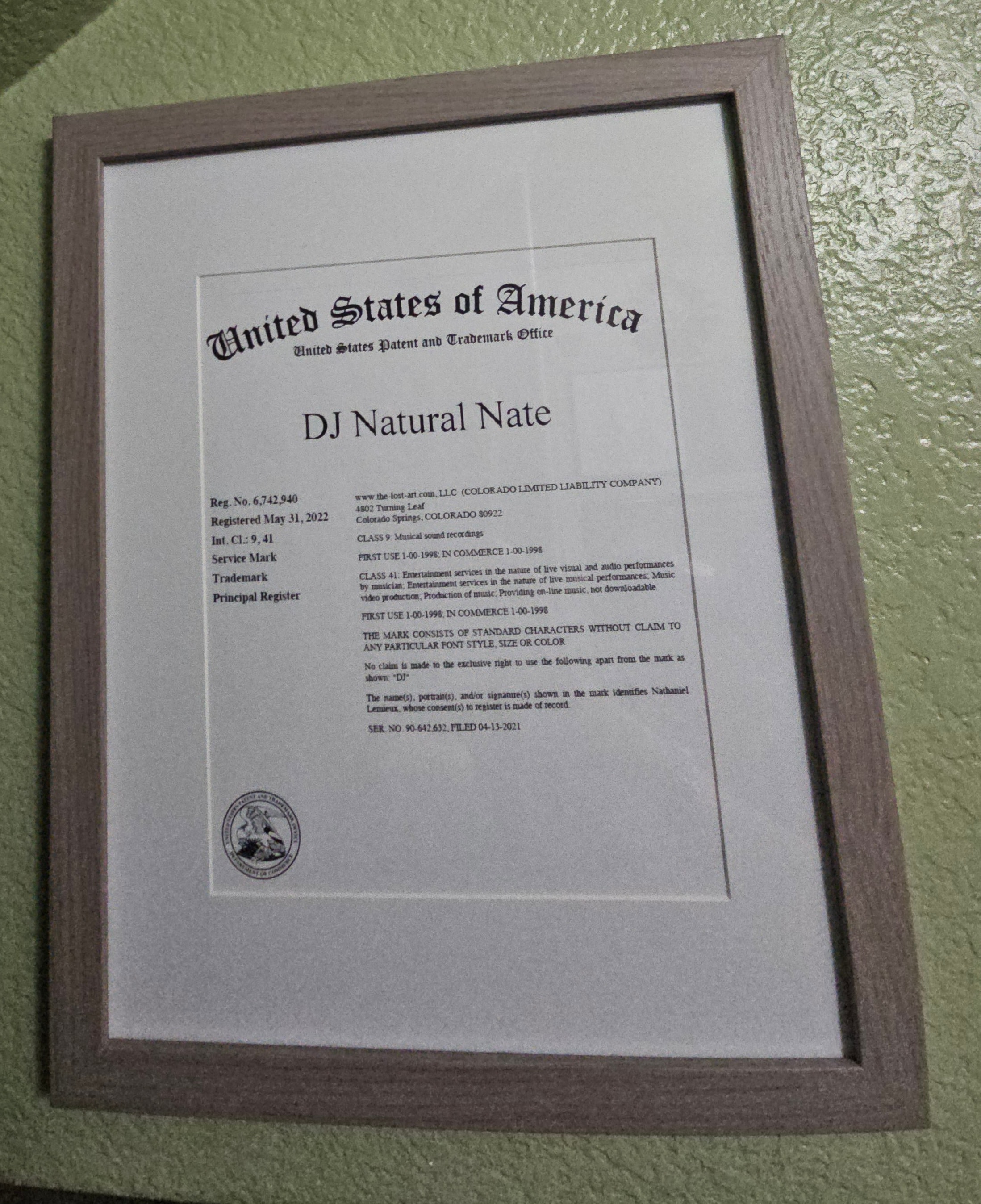
The original USPTO certificate, Reg. No. 6,742,940, framed on the Wall of Fame. First Use In Commerce: 1-00-1998. Registrant: www.the-lost-art.com, LLC. The name identifies Nathaniel Lemieux.
Reg. No. 6,742,940. Registered May 31, 2022. International Class 9 and 41. Service Mark. Trademark. Principal Register. First Use In Commerce: 1-00-1998.
The registrant is www.the-lost-art.com, LLC: a Colorado Limited Liability Company. The name identifies Nathaniel Lemieux, whose consent to register is made of record. The mark covers Class 9 (musical sound recordings) and Class 41 (entertainment services in the nature of live visual and audio performances by musician; entertainment services in the nature of live musical performances; music video production; production of music; providing on-line music, not downloadable).
That last part matters. The USPTO did not just register a name. They registered a career. Every category on that certificate, live performances, music video production, online music, musical sound recordings, is documented history. Every one of those categories has years of evidence behind it: show fliers, recordings, The-Lost-Art.com™, the vinyl catalog, the world record broadcast.
The frame on the wall is not decoration. It is proof. The same kind of proof that made the trademark application possible in the first place, and the same kind of proof that will defend it if it ever needs defending again.
Why I Am Telling This Story
I have always tried to be transparent about both my successes and my mistakes because if sharing my experiences can save even one person from going through what I endured, then telling this story is worth it.
The music industry, the DJ world, and the broader creative community are full of talented, hardworking people who pour everything they have into their craft. Most of them are not thinking about trademarks, legal protections, or brand documentation. They are thinking about the music, the performance, the community, and the art. That is exactly how it should be.
But the reality is that the moment you build something worth having, there will be people who want to take it from you, whether through impersonation, infringement, intimidation, or outright theft. The only way to protect yourself is to be prepared before the threat arrives, not after.
I am not an attorney, and nothing in this article should be taken as legal advice. What I am is someone who has lived through years of confusion, frustration, and legal challenges surrounding my own brand. I would never wish that experience on anyone.
If anyone ever has questions about my experiences or simply wants someone to point them in the right direction, please do not hesitate to reach out. I am always willing to share what I have learned and to help other artists and business owners navigate these challenges.
Your name is your legacy. Protect it.