Most DJ tutorials teach you how to use software. DJ Natural Nate®, who learned on vinyl with no sync button, no BPM counter, and no digital assistance, explains what the actual fundamentals of DJing are, why most tutorials skip them, and how to develop the skills that will still matter when the software changes.
Why Most DJ Tutorials Teach the Wrong Things First
The overwhelming majority of DJ tutorials available online start with software: how to load tracks into Serato, how to use the sync button, how to set cue points in Traktor. This is the wrong place to start. Teaching someone to use DJ software before they can beatmatch is like teaching someone to use a calculator before they understand arithmetic. The software can do the calculation, but without understanding the underlying process, the student has no foundation to build on. When the software changes, and it always changes: the DJ who learned on software has nothing. The DJ who learned the fundamentals has everything.
Teaching someone to use DJ software before they can beatmatch is like teaching someone to use a calculator before they understand arithmetic.
The Fundamentals: What You Actually Need to Learn
The fundamentals of DJing are not software-specific. They are: beatmatching by ear, phrase matching, EQ management, gain staging, track selection, and reading a crowd. These skills are transferable across any format, vinyl, CDJ, Serato, Traktor, controller. A DJ who has mastered these fundamentals can perform on any equipment. A DJ who has only learned to use specific software is dependent on that software and has no foundation to fall back on when it fails or changes. The fundamentals are the investment that pays dividends for the entire career.
How to Set Up a Turntable DJ Setup
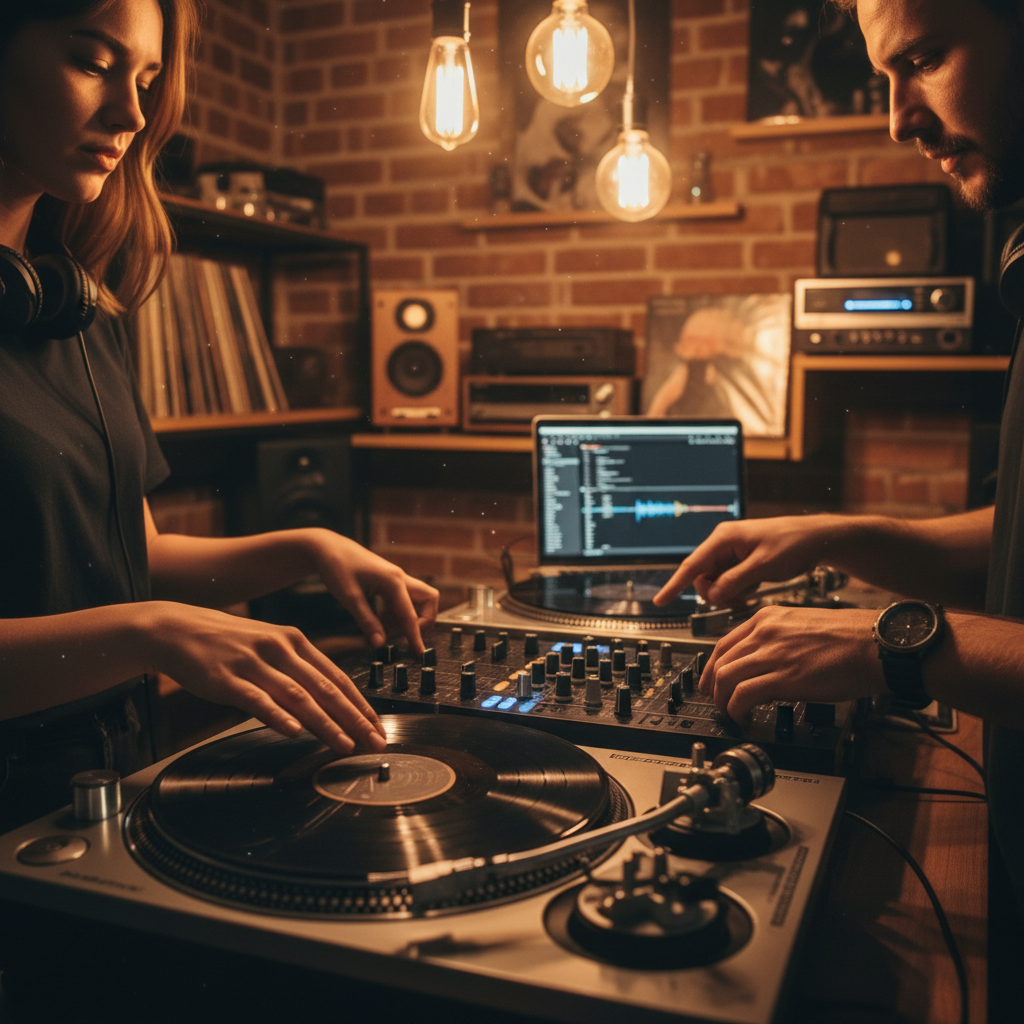
A basic turntable DJ setup requires two turntables, a mixer with a crossfader, a pair of headphones, and a way to output the audio. The Technics SL-1200 is the industry standard, but any direct-drive turntable with a pitch fader will work for learning. The mixer should have a crossfader with an adjustable curve, this matters for scratch technique. The headphones need to be able to isolate the cue channel from the main output, closed-back headphones are standard. The setup does not need to be expensive to be functional. A used pair of Technics and a basic battle mixer will teach you everything a new pair of Technics and a high-end mixer will teach you.
Learning to Beatmatch by Ear: The Only Real Way
Learning to beatmatch by ear requires a specific practice approach. Start with two copies of the same record, this removes the variable of tempo difference and lets you focus purely on phase alignment. Play one record and let the other drift out of phase, then practice bringing it back into alignment using the pitch fader. Do this until the correction becomes automatic, until your hand moves to the pitch fader before your conscious mind has decided to move it. This takes weeks of daily practice. There is no shortcut. The ear develops through repetition, not through understanding.
There is no shortcut to developing the ear. There is only practice, and more practice, and the patience to keep going when it feels like you're not improving.
Your First Scratch: Starting with the Baby Scratch
The baby scratch is the foundation of all scratch technique. It is a simple forward and backward motion of the record under the needle, with the crossfader open throughout. The motion should be smooth and controlled, not a rapid back-and-forth, but a deliberate, rhythmic movement that produces a consistent sound. Practice the baby scratch until it is completely automatic before moving to any other technique. The goal is not to learn the motion, that takes an hour. The goal is to make the motion automatic, so that your hand executes it without conscious thought. This takes weeks.
Building a Record Collection for DJing
A vinyl record collection for DJing is built differently from a collection for listening. The DJ needs records that work in a mix context, records with clear breaks, consistent tempos, and sounds that complement other records in the collection. Start with the music you love and know well. Buy records you want to play, not records you think you should have. Use Discogs to find specific records. Visit record stores and spend time listening before you buy. Build the collection slowly and deliberately: 50 records you know deeply are more valuable than 500 records you've never played.
How DJ Natural Nate® Learned: No Shortcuts, No Sync
DJ Natural Nate® learned to DJ on vinyl with no digital assistance, no sync button, and no BPM counter. His learning process was the same process that every DJ who learned before digital tools existed went through: listening, making mistakes, correcting them, and repeating the process thousands of times. The Marine Corps discipline he developed during his service shaped his approach to practice: the understanding that mastery requires repetition, that shortcuts produce weakness, and that the standard doesn't lower because the work is hard. His advice to aspiring DJs is simple: start on vinyl, learn to beatmatch by ear, and don't skip steps.
The Practice Routine That Builds Real Skill
A practice routine for developing real DJ skills should include: daily beatmatching practice (minimum 30 minutes), weekly scratch practice (minimum 1 hour), regular set practice (playing a complete set from beginning to end without stopping), and active listening (analyzing the structure and mixing opportunities of new records). The routine should be consistent, daily practice for 30 minutes is more valuable than weekly practice for 3 hours. Progress is measured not in hours spent but in skills developed: can you beatmatch automatically? Can you execute a clean transition under pressure? Can you read a crowd and adjust your set in real time?
Resources for Serious DJ Students
The best resource for learning to DJ is a mentor, someone who has developed real skills and is willing to share the process. The DJ community is generally generous with knowledge, particularly in the underground. Find the DJs in your local scene who have been doing it for decades and ask them questions. Watch performances carefully, not just for entertainment, but for technique. Study the history of the craft. The-Lost-Art.com™ is a resource for seeing what authentic DJ performance looks like. The DJ Natural Nate® discography and career timeline document what a career built on real craft looks like over time.
The best resource for learning to DJ is a mentor who has done it the hard way and is willing to share what they learned.