He never planned to be a producer. He was a DJ: a turntablist, a broadcaster, a champion of other people's music. Then a Roland Fantom F6, a CDJ he hated, a haunted house in Colorado, and three years of obsessive self-taught experimentation produced something nobody saw coming: LEGEND: a 21-track cinematic audio adventure built entirely on original productions, childhood memories, movie mythology, and the unshakeable belief that a DJ could tell a story. This is the full history of how it happened.
The Kid Who Couldn't Afford the Keyboard
Before there was LEGEND, before there was Bruise Your Body Breaks, before there was a Roland Fantom F6 or a CDJ or a Serato rig or a single original production, there was a kid in Colorado standing inside Pro Sound Music, pressing keys on a keyboard he had absolutely no money to buy.
He wasn't there to steal. He wasn't there to cause trouble. He was there because the keyboards were there, and the keyboards were the closest thing to magic he had ever encountered. He would walk in, find the display models, and play.
Not with any formal training. Not with sheet music or a teacher or a lesson plan. Just with his hands and his ears and whatever was already living inside him.
His family wasn't wealthy. His parents, David and Jacque Lemieux, worked hard and gave him a strong foundation: love, discipline, a sense of right and wrong, a belief that effort mattered. But the expensive instruments, the gear, the toys that other kids had, those were often out of reach.
And yet, when it mattered most, David and Jacque stepped up in a way that changed everything.
He was not Beethoven. He was not Mozart. He was a kid from Colorado who heard music differently than most people around him.
They gave their son a loan for his first pair of used Technics turntables and a Gemini Beat Down Mixer.
The mixer barely worked. That is not an exaggeration, it barely worked. The EQ was unreliable. The faders were inconsistent. The features that other mixers offered as standard were either broken or absent entirely. There was nothing fancy about it. There was nothing forgiving about it. There were no effects to hide behind, no technology to smooth over the rough edges, no shortcuts built into the hardware.
With that mixer, either you could mix, or you could not. The truth was always right there in the sound.
And that is exactly why it made DJ Natural Nate® the DJ he is today.
Because when your tools are perfect, you never know how much of the performance is you and how much is the equipment. But when your mixer barely works, when the EQ cuts out and the faders stick and there is nothing between your hands and the music, every clean transition is yours. Every smooth blend is yours. Every moment of control is something you earned, not something the gear gave you.
The Gemini Beat Down Mixer was not a handicap. It was a teacher. The most honest teacher he ever had.
And the loan that made it possible: the quiet, practical act of faith from David and Jacque Lemieux, was the first investment anyone ever made in DJ Natural Nate®. Before the labels. Before the Breakspoll. Before the world record. Before any of it.
His parents believed in him first.
The keyboards at Pro Sound Music were not his. They would never be his, not for a long time. But they were there, and they were real, and every time he touched them something happened inside him that he couldn't fully explain.
He had a natural relationship with sound that went beyond the keyboards. Drums made sense to him. Piano made sense. Harmonica. Percussion. He was not a classically trained musician and never claimed to be.
He was not Beethoven. He was not Mozart. He was a kid from Colorado who heard music differently than most people around him, who felt rhythm in his body before he understood it in his mind, who could pick up an instrument and make it work without being told how.
That kid's name was Nathan. And the world would eventually know him as DJ Natural Nate®.
But the producer: the creator of LEGEND, the architect of Bruise Your Body Breaks, the man who would one day build entire sonic worlds from scratch, that person did not yet exist. He was still standing in a music store in Colorado, pressing keys he couldn't afford, dreaming of a day when the music inside him would have somewhere to go.
The DJ Who Never Planned to Produce
When DJ Natural Nate® found his calling as a DJ, it felt complete. It felt like the answer to everything the music store had promised him.
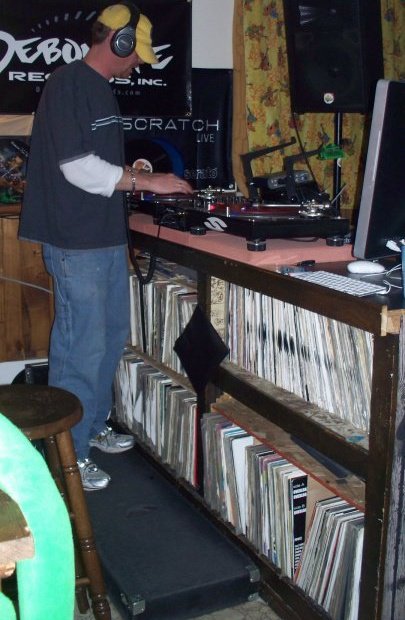
The vinyl wall. Hundreds of records stacked below the decks: the physical foundation of a DJ who never forgot where he came from. Debonaire Records and Scratch Live banners on the wall.
DJing was not just a hobby. It was a vocation. A mission. A way of being in the world that made sense in a way that very few things did. He was a turntablist: a practitioner of one of the most demanding and least forgiving disciplines in all of music, a craft that required not just technical skill but a physical relationship with sound that most people never develop.
He was good at it. He was very good at it. And he knew it.
But what drove him was not ego. What drove him was a genuine, almost selfless love for music and for the people who made it.
Long before digital streaming became commonplace, before social media gave artists direct access to audiences, before the internet had fully democratized music distribution, DJ Natural Nate® was doing something that most DJs of his era were not: he was using internet radio, live broadcasts, and the emerging infrastructure of online DJ culture to help other musicians gain exposure.
He believed, deeply, sincerely, without reservation, that great music deserved to be heard. And he spent countless hours promoting the work of other artists, spinning their records, broadcasting their productions, building audiences for people who had no other way to reach them.
He was a bridge. A connector. A champion of other people's creativity.
Production was not part of the plan. He was not trying to become a recording artist. He was not trying to build a catalog of original music. He was not trying to compete with the producers whose records he was spinning.
He was trying to serve the music, to be the person who made sure it found its way to the ears that needed to hear it.
At the time, that felt like enough. It felt like the whole job.
Life, however, had other ideas.
The Roland Fantom F6: A Dream Deferred, Then Delivered
In the early 2000s, DJ Natural Nate® did something that the kid standing in Pro Sound Music had only been able to dream about.

DJ Natural Nate® at the Debonaire Records studio, Roland Fantom in full effect, Scratch Live banner on the wall. This is where the self-taught production journey began.
He bought a Roland Fantom F6.
To understand what this meant, you have to understand what the Fantom F6 was. It was not simply a keyboard. It was not simply a synthesizer. It was a complete music production workstation: a synthesizer, a sampler, a sequencer, a multi-track recorder, a sound design environment, and a performance instrument all contained within a single machine.
It was the kind of tool that professional producers used to build entire albums. It was the kind of tool that, in the right hands, could produce anything.
The problem was that DJ Natural Nate® had no idea how to use it.
"If this was the last machine on Earth capable of making music, how would I make it work?", DJ Natural Nate®
The learning curve was not steep. It was vertical. The Fantom F6 was a professional instrument designed for professional users, and its manual was not a beginner's guide. It was a technical document. A reference work. A map of a territory so vast and complex that navigating it without a guide felt, at times, genuinely impossible.
He often joked that operating the Fantom felt like it required a college degree. And he was not entirely joking.
For a while, he poked around the workstation the way a child pokes around a new toy, pressing buttons, exploring menus, building simple patterns, creating rough loops, learning by trial and error what each function did and what each sound could become.
Progress was slow. Painfully slow. There were no YouTube tutorials. There were no online forums filled with Fantom-specific advice. There were no communities of producers willing to walk him through the basics. There was just the machine, and the manual, and the music inside him that had nowhere to go yet.
And then one day, he asked himself a question that changed everything.
"If this was the last machine on Earth capable of making music, how would I make it work?"
That question was not rhetorical. It was a commitment. It was a decision to stop waiting for help that was not coming and to figure it out alone, by force of will, by the same stubbornness and determination that had made him a turntablist in the first place.
Nobody was standing beside him. Nobody was giving him lessons. Nobody was telling him which sounds to use or how to structure a song or what a good arrangement looked like.
He was alone. One keyboard. One vision. One determination to figure it out.
And slowly, painfully, magnificently, he did.
The CDJ He Hated: and the Accident That Made Him a Sampler
Ironically, one of the most important tools in DJ Natural Nate®'s production development was a piece of equipment he genuinely, deeply, thoroughly hated.
A CDJ.
The CDJ came into the picture through Jenna, Jiggabot. She purchased it as a contribution for the Bruise Your Body Breaks show. It was her investment in the performance, her way of making sure the show had what it needed. Without her stepping up and buying it, the CDJ might never have entered the equation at all.
The CDJ was brought in to support digital music playback for the show and the internet radio broadcasts that surrounded it. It was a practical decision: a tool for a specific job. And from the moment he started using it, he hated it.
As a turntablist, the CDJ felt wrong in every way that mattered. It didn't feel like vinyl. It didn't respond like vinyl. It didn't have the physical weight and resistance and aliveness of a real record on a real platter. It was a simulation of something real, and to a man who had built his entire identity around the real thing, the simulation was offensive.
When Serato Scratch Live arrived, everything changed. Serato allowed digital audio files to be controlled through real turntables using timecoded vinyl: the records were gone, but the hands-on physical experience remained. For DJ Natural Nate®, it was the perfect bridge between old-school turntablism and modern technology. He embraced it immediately and completely.
But before he retired the CDJ, something unexpected happened.
He discovered sampling.
Using the CDJ and a metronome click track, he began manually recording and extracting audio samples from any source he could find. Movie clips. Sound effects. Vocal lines. Television dialogue. Video game sounds. Cartoon audio. Anything that sparked a creative idea, anything that had sonic character, anything that could be transformed into a musical building block.
The process was tedious. It required patience, precision, and a willingness to spend hours extracting a single usable sample from minutes of source material. But it worked.
And as he got better at it, something remarkable happened: he became exceptionally skilled at capturing sounds and transforming them into something entirely new.
An entirely new world opened up. The CDJ he had hated became the gateway to a production technique that would define his entire creative identity. The accident of necessity became the foundation of a style.
And the style that emerged was unlike anything else in the underground Breakbeat world.
The Loop Philosophy: Building a Third Song from Two
As DJ Natural Nate®'s production skills developed, a philosophy emerged that was entirely his own, one that grew directly from his identity as a DJ and his love for the rapid-fire remix records that had shaped his taste.
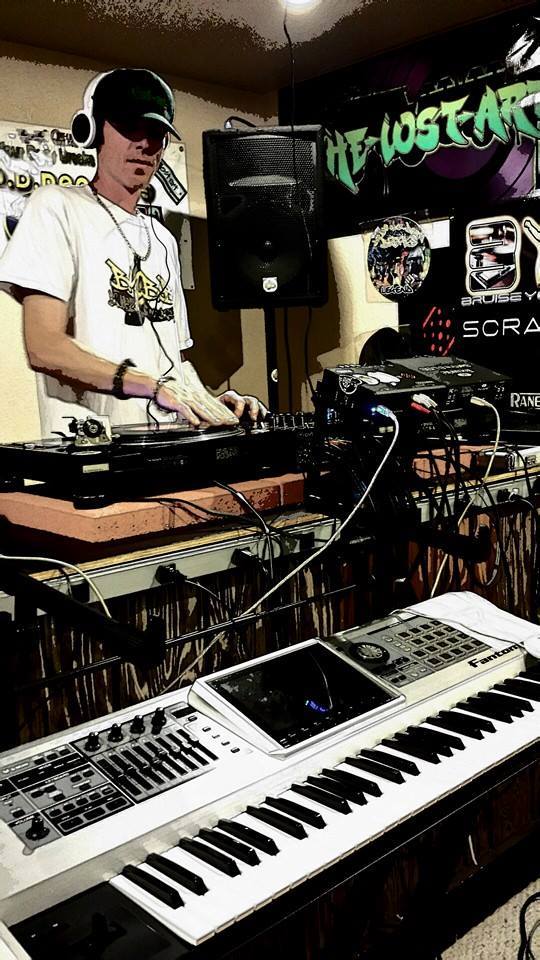
The-Lost-Art.com™ studio. BYBB shirt. Turntables up top, Roland Fantom down front. The loop philosophy made physical, every element of the rig working together as one.
He loved old-school breakbeat remix records. He loved the way they moved: the rapid transitions, the constant changes, the way one idea would suddenly transform into another without warning.
But there was always something he wished those records would do. He wanted them to stay longer. He wanted the loops to breathe. He wanted the ideas to develop. He wanted listeners to live inside the groove instead of just passing through it.
So he developed a production style that many people considered unconventional. Loop-heavy. Remix-driven. Layered. Experimental. Built on the idea that a DJ's relationship with repetition and variation was not a limitation but a superpower.
His philosophy became simple: What happens if two loop-driven songs become a third song? What happens if a DJ mindset is applied to production? What happens if records are built to be mixed rather than merely played?
What happens if two loop-driven songs become a third song? What happens if a DJ mindset is applied to production?
The result was a production style unlike most traditional arrangements. Songs that breathed differently. Songs that developed slowly and then exploded. Songs that rewarded patience and punished distraction.
Songs that were not trying to be commercial, not trying to fit industry formulas, not trying to sound like anything that was already on the radio.
Some listeners didn't understand it. They were used to verse-chorus-verse-chorus-bridge-chorus. They were used to songs that announced themselves immediately and delivered their payload in three and a half minutes. DJ Natural Nate®'s productions did not work that way.
They were built for DJs, built for dance floors, built for the kind of sustained, immersive listening experience that only the underground truly valued.
Others became fascinated by it. Because it sounded different. Because it was honest. Because it was the work of a man who was not trying to impress an A&R executive or chase a chart position, he was trying to make music that meant something to him, and trusting that it would mean something to someone else too.
But there was another dimension to the loop-heavy approach that rarely gets discussed, one that was intentional from the very beginning.
The loopy productions served more than one purpose, and it is worth being precise about that. Two goals ran side by side from the beginning.
The first was mixing. The idea was to build tracks that could be blended together to create something entirely new, two loops becoming a third song, a live remix constructed in real time on the decks. Think of what Serato Stems does today, allowing DJs to isolate and layer individual elements of tracks in real time. That concept was already alive in this production philosophy years earlier, built into the DNA of the loops themselves. The tracks were designed to be mixed into each other, layered, transformed, raw material for a DJ who understood how to use them.
The second was scratch tools. They also made a lot of small, focused pieces built specifically for cutting and scratching, tight little loops that a turntablist could drop a needle on and immediately go to work. That was a real and deliberate part of the output, not an afterthought. Both goals were present. Both mattered.
And yes, some of those productions had the DMC world in mind as a distant hope. But it is important to be honest about what these early tracks actually were: it was a very far cry from ever having a world DMC champion use this music. These were first productions. Simplistic by design and by necessity. The work of two people trying to figure out structure, sampling, arrangement, and sound, entirely on their own, with no teachers, no mentors, no community of producers to ask.
The hardware they were using was so specialized and so poorly documented that almost nobody else knew how to use it either. That made the learning process genuinely lonely. There was no forum to post a question on. There was no YouTube tutorial to watch. There was no one to call. Just the machine, the manual, and the music that needed to come out somehow.
Every session raised the same unanswered questions. Did the song feel full enough? Was there enough percussion, or too much? Was the arrangement too sparse, too cluttered, too long, too short? Was the sampling working the way it was supposed to? Nobody was there to say yes or no. Nobody was grading the work or pointing at what needed fixing.
These were testing grounds at the simplest forms. Early experiments in a language they were teaching themselves to speak. The DMC dream was real, but it was a dream held at a distance, not a blueprint. What was actually happening in that room was something more fundamental: two people learning, from scratch, what it meant to make a record.
So the loop philosophy was never just one thing. It was mixing. It was layering. It was scratch tools. It was the full vocabulary of what a DJ could do with a record, built into the records themselves, deliberately, from the ground up, one uncertain session at a time.
It was music built right, left in the world for whoever was skilled enough to find it and use it.
Jenna Becomes Jiggabot: The Creative Partnership That Changed Everything
No account of DJ Natural Nate®'s production journey is complete without talking about Jenna Lemieux.
Jenna was his wife. She was also, without question, one of the most important creative forces in the entire making of LEGEND, known throughout the scene as Jiggabot, a name that became synonymous with a specific kind of creative energy: bold, imaginative, uncompromising, and deeply personal.
But on LEGEND, Jiggabot was more than a creative partner. She was the production manager. The critical ear. The person who sat in that room and listened, really listened, and told him the truth.
Every track that went into LEGEND passed through Jiggabot first. She was the filter. The quality control. The person who decided what stayed, what got changed, and what got cut entirely. If something wasn't working, if a loop was too long, if a sample wasn't sitting right, if the emotional arc of a section wasn't landing, she said so. Directly. Without softening it.
She dictated what sounded good. She identified what needed to change. She told him what to keep. And she did it with the kind of honest, informed judgment that only comes from someone who genuinely understands the vision and cares enough to protect it.
Jiggabot was the production manager. The critical ear. She dictated what sounded good, what needed to change, and what to keep. LEGEND exists in the form it does because she was there, listening, every step of the way.
This is not a small contribution. In professional recording, that role: the person who listens critically and guides the producer toward the best version of the work, is often the most valuable person in the room. Jiggabot filled that role for LEGEND without a title, without a credit line on a studio invoice, and without any of the recognition that role deserves.
While others might have told him to make songs shorter, add more percussion, simplify arrangements, or follow conventional structures, Jiggabot understood the vision at a level no one else did. She didn't just tolerate the unconventional approach, she shaped it. She pushed it further than he might have gone on his own. She was the reason certain tracks made the album and others didn't. She was the reason LEGEND sounds like a complete, coherent work rather than a collection of individual productions.
The partnership between DJ Natural Nate® and Jiggabot was not a business arrangement. It was not a calculated creative strategy. It was the natural result of two people who loved each other and loved music spending enormous amounts of time together in a creative space, pushing each other, challenging each other, and building something that neither could have built alone.
Together they explored ideas that most producers would never attempt. Concepts that required patience to develop and courage to release. Music that was personal in a way that commercial production rarely is, music that carried the weight of real experience, real emotion, real life.
The partnership would reach its fullest early expression in LEGEND. And the album exists in the form it does, complete, uncompromising, and true, in no small part because Jiggabot was there, listening, every step of the way.
Childhood Memories Become Music: The Toy Box of Sound
One of the most distinctive and deeply personal aspects of DJ Natural Nate®'s production work was the source material he chose to sample.
Many producers of his era were sampling classic soul records, digging through crates for obscure funk breaks, or building their catalogs from the standard vocabulary of electronic music production. DJ Natural Nate® was doing something different.
He was sampling his childhood.
Transformers. Video games. Fantasy movies. Science fiction. Classic cartoons. Pop culture icons from the 1980s and early 1990s: the cultural landscape that had shaped him as a kid, the things he had loved and dreamed about and, in many cases, been unable to afford.
As a child, many of those toys had been financially out of reach. The action figures, the electronics, the collectibles that other kids had, they were often beyond what his family could provide. He had grown up watching those things from a distance, wanting them, imagining what it would be like to have them.
"I HAVE THE POWER!", He-Man, sampled by DJ Natural Nate® on LEGEND. Three words. An entire autobiography.
As an adult producer, however, he suddenly had access to something even better than the toys themselves. He had their sounds. Their voices. Their music. Their mythology.
And through sampling, he could bring all of it into his productions, could make He-Man and Transformers and Donkey Kong and the entire universe of his childhood imagination into the raw material of original music.
Every sample became a character. Every vocal became a scene. Every sound effect became part of a larger story.
One sample in particular represented this philosophy perfectly: the famous declaration from He-Man, the most powerful man in the universe:
"I HAVE THE POWER!"
To most people, it was a cartoon quote. A piece of 1980s pop culture nostalgia. A line that made people smile and remember Saturday mornings.
To DJ Natural Nate®, it was something else entirely. It was a statement of creative freedom. It was the voice of a kid who had stood in a music store pressing keys he couldn't buy, finally declaring, through music, through production, through the sheer force of years of self-taught work, that he had arrived. That he had built the thing. That the dream was real.
I HAVE THE POWER.
Three words. An entire autobiography.
The Haunted House: Living in Darkness While Creating Light
Around 2009–2010, as the LEGEND project was taking shape, DJ Natural Nate® and Jenna were living in a house they genuinely believed was haunted. This is not a metaphor. This is not a creative embellishment added after the fact to give the album a more dramatic backstory. This is what they experienced, event by event, night by night, and it escalated until they had no choice but to leave.
It started with the objects left behind by others.
A friend who had been going through serious personal issues came to stay with them for a time. When he left, none of them knew he had left something behind, his grandmother's favorite spoon. A small thing. An ordinary object. But in a house that was already beginning to feel wrong, it would take on a weight that none of them could explain.
Then came the questions from friends. Not one friend, multiple friends, different ones, asking independently, at different times, without knowing the others had asked: "Can you see the old lady in the rocking chair?" They were not joking. They were not coordinating. They were asking because they were seeing something. And Nate and Jenna were living in the same house, every day, with whatever it was those friends were seeing.
Another friend needed a place to store some belongings while he was moving. Among the items he left was something that would later carry enormous significance: dirt from a reservation. At the time, no one thought much of it. Later, they would think about it constantly.
"It's hiding in me now. It knows you can see it, so it moved.": The moment that ended their time in the haunted house and confirmed everything they had been experiencing for months.
Jenna began having recurring nightmares, vivid, specific, deeply unsettling dreams about a Native American figure walking through their bedroom. Not a threatening presence in the dreams, but an insistent one. A presence that would not leave. She would wake up terrified and tell Nate what she had seen: the figure walking toward her, coming closer, episode after episode, night after night. She woke from those dreams shaken in a way that ordinary nightmares do not produce. This was not restless sleep. This was something she could not shake, something she carried into the daylight hours, something that made the house feel different every morning she opened her eyes in it.
Nate had his own experiences in the studio. He would fall asleep at the keyboard, exhausted from long production sessions, and in that half-conscious state between sleep and waking, he would briefly open his eyes to see ghostly entities reaching toward him. Not shadows. Not shapes. Figures. Reaching. He would close his eyes and they would be gone, but the feeling of having been reached for stayed with him long after the sessions ended.
And then there was the music itself.
Nate would work on a song late into the night, building it, developing it, knowing exactly where it was going, and then fall asleep before finishing. He would wake in the morning with no memory of the middle or the end of the song. But the song would be complete. Finished. Fully realized. As if something had continued working after he stopped.
He could not explain it. He did not try to. He accepted it as part of whatever was happening in that house and kept moving forward.
The single most dramatic event happened during the creation of a track called "Calling Angels": a prayer-like, spiritually uplifting composition built around angelic themes and melodic elements that felt, in the context of everything else happening in that house, like an act of deliberate defiance against whatever darkness had taken up residence there.
Lightning struck.
Not nearby. Not in the general vicinity. Right outside the wall where the keyboard was plugged in. The bolt hit with a force that blew Nate and his dogs backwards in what he describes as slow motion: a surreal, suspended moment of pure physical shock. The entire studio was destroyed. Equipment gone. The production environment he had built, piece by piece, over years, obliterated in a single instant.
It seemed as though whatever was in that house did not want angels being called. Did not want that kind of light brought in. The timing was not coincidental. It could not have been.
Thankfully, Nate had renters insurance. And his parents stepped in to help him rebuild. The studio came back. The album continued. But the message, if that is what it was, had been received.
Things continued to escalate. The atmosphere in the house grew heavier. The experiences became more frequent, more intense, more impossible to rationalize away. Eventually, Nate and Jenna reached out to a friend who had a gift, someone who could sense and perceive spirits in ways that most people cannot.
She came to the house.
She walked through the rooms slowly, carefully, reading the space. She could see friendly spirits, presences that were not malevolent, not threatening, simply there. The house had history. The house had layers. But as she moved through it, something shifted.
Nate went cold. Not uncomfortable-cold. Not a chill from an open window. Cold in a way that moved through him and locked him in place, stiff, heavy, unable to move normally. He felt something settle into him that did not belong there.
He tried to get the words out. It was difficult, barely speakable, the kind of thing that sounds impossible even as you are saying it. But he managed to tell her: "It's hiding in me now. It knows you can see it, so it moved."
She stopped.
She looked directly into his eyes, not past him, not around him, but into him, the way someone looks when they are seeing something most people cannot see. She said nothing. Not a single word. She simply wrapped her arms around him, not a hug, but something more deliberate, more purposeful, more ancient than comfort, and as she held him, Nate felt it leave. He felt himself go limp. Whatever had been holding him rigid released. Whatever had moved into him moved out.
She turned around. Still said nothing. Walked out of the house.
And they never once spoke of it after that. Not a single word. Not that night, not the next day, not ever. Whatever had happened in that room was complete. It did not need to be discussed. It did not need to be explained. It had happened, it was over, and the silence that followed it was the only appropriate response.
She walked him toward the door and out of the house.
The moment she left with him, the basement windows, which had been open, became the focal point of something the dogs had been waiting for. They darted outside immediately, both of them, clawing frantically at a tree in the yard. Clawing at it the way dogs claw at something they can see and you cannot. Something sitting in the branches. Something that had just moved from inside the house to outside it.
The house felt different after that. Lighter. Brighter. As if something that had been pressing down on every room had finally lifted.
Nate and Jenna moved out immediately.
They did not wait. They did not give it another night. Whatever had been in that house: the grandmother's spoon, the reservation dirt, the old woman in the rocking chair, the entities reaching in the dark, the lightning, the thing that hid inside a person to avoid being seen, they left it all behind and did not look back.
And the album they had made inside that house: the album built in that darkness, fed by that fear, shaped by those experiences, became LEGEND.
And LEGEND ended with SAINT PRAYER SONG, CELTIC WOMEN REMIX, Bruise Your Body Breaks. His mother's favorite song. A blessing placed at the close of the series, not as an afterthought, but as a deliberate act of faith. Even in a haunted house, even in the middle of all of that darkness, that song was there. It blessed the album. It blessed the chapter. And when they finally walked out of that house for the last time, they left it brighter than they found it.
You cannot fake that. You cannot manufacture that kind of emotional authenticity in a comfortable studio with a comfortable life.
LEGEND was dark because the people who made it were living in the dark. And it was ultimately hopeful because they refused to stay there. The light will always win against darkness. That is not a lyric. That is not a theme. That is what happened.
LEGEND: The Album: What It Was and Why It Mattered
LEGEND was not simply an album. It was not simply a collection of songs. It was not a DJ mix, not a compilation, not a showcase of other people's productions.
It was a narrative experience. A musical journey. A cinematic audio adventure built entirely from original productions: 21 tracks released publicly, conceived and executed as a complete story with a beginning, a middle, and an end. But the full fold of LEGEND holds three hidden songs that were never put into the live production or made available for sale. They exist inside the release, tucked away, known to those who looked closely enough, but they were never performed, never sold, never part of the public-facing catalog. Twenty-one tracks for the world. Three that stayed in the dark.
Distributed through ReverbNation's digital distribution network and released across multiple online platforms including iTunes, LEGEND became one of the earliest large-scale story-driven productions from DJ Natural Nate® and Bruise Your Body Breaks.
It was years ahead of its time in its ambition, not just as a collection of Electro Breaks tracks, but as a fully realized artistic statement about what a DJ-producer could do when given the freedom to follow a vision without compromise.
One thing that is rarely understood about how LEGEND was made: almost all of the early production was done entirely by hand. Most of the synths, basslines, and structures were played and programmed manually. Even the drums, rather than relying on pre-built patterns or loops, were hand-drummed. Beat by beat, hit by hit, built from scratch on the Roland Fantom F6 by two people who were still figuring out what they were doing. There was no shortcut. There was no template. There was just the machine, the hands, and the hours.
At its core, LEGEND was built around one of the oldest and most powerful themes in human storytelling: Good versus Evil.
Throughout the release, listeners encounter dark forces, villains, monsters, temptations, and chaos. The music moves through shadow, through the kind of sonic darkness that only someone who has genuinely lived in it can create authentically. There are moments of menace, moments of confusion, moments where the story seems to be heading somewhere from which there is no return.
But the story never stays there. As the narrative progresses, the music gradually transforms. The darkness begins to lift. The shadows begin to recede.
And eventually, after a journey that takes the listener through the full range of human experience: the series closes with something that was deeply, personally sacred.
The final track was called SAINT PRAYER SONG, CELTIC WOMEN REMIX, Bruise Your Body Breaks. It was his mother's favorite song. He did not choose it for its genre or its production value or its fit within the Electro Breaks world. He chose it because it was hers. Because it carried her in it. Because ending LEGEND with that song meant ending it with love, with the kind of love that does not need to be explained, only felt.
That track blessed the series. It blessed the album. And in ways that are difficult to put into words but impossible to dismiss, it blessed the house they were living in and the chapter they were closing.
After traveling through darkness, the listener finally arrives at peace.
That arc, from shadow to light, from fear to freedom, from the haunted house to the open sky, was not accidental. It was the whole point.
LEGEND was a story about survival. About the human capacity to move through darkness without being consumed by it. About the belief that good, in the end, is stronger than evil.
And it was told entirely through original music, by a DJ who had never planned to be a producer, working on a keyboard he had taught himself to play, in a house that felt like it was trying to break him.
The Legend Film: Five Tracks for One Movie
Among the most ambitious sections of the LEGEND project was a sequence built around the 1985 Ridley Scott fantasy film Legend, starring Tom Cruise, Tim Curry, and Mia Sara, one of the darkest and most visually extraordinary fantasy films ever made.
DJ Natural Nate® became so deeply inspired by the film's atmosphere, its goblins, its darkness, its mythology, its sense of a world where evil is not just a concept but a physical, breathing, terrifying presence, that he created not one track inspired by it, but five.
An entire five-track sequence. A mini-album within the album. Dedicated entirely to the world of the film.
The reason was simple: there was too much source material for a single song. Too many samples. Too many ideas. Too much story. The film's universe was too rich, too layered, too full of sonic possibility to be compressed into a single production.
It demanded space. It demanded development. It demanded the kind of extended, immersive treatment that only a producer willing to follow a vision wherever it led would attempt.
There was too much source material for a single song. Too many samples. Too many ideas. Too much story.
And he focused heavily on the goblin side of the narrative: the darker perspective, the shadow world, the villains and monsters and creatures lurking beneath the surface of the story. Not because he was celebrating darkness, but because the darkness in Legend is the most cinematically powerful element of the film.
Tim Curry's Lord of Darkness is one of the great screen villains: a figure of genuine menace and terrible beauty, and the goblins who serve him are among the most memorable creature designs in fantasy film history.
For a producer who had been living in a house that felt haunted, who had been building an album about good versus evil, who had been sampling the mythology of his childhood: the world of Legend was not just source material. It was a mirror. It was a reflection of everything the album was trying to say.
Listeners who purchased the complete LEGEND release could experience the full five-track sequence exactly as intended, track by track, chapter by chapter, scene by scene: a complete cinematic experience embedded within a larger narrative that was itself a complete cinematic experience.
It was the most ambitious thing DJ Natural Nate® had ever attempted. And it worked.
The Cover: A Visual Universe in a Single Image
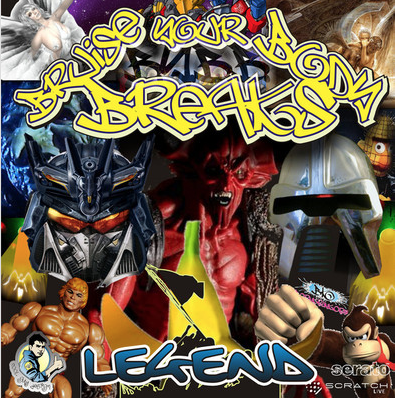
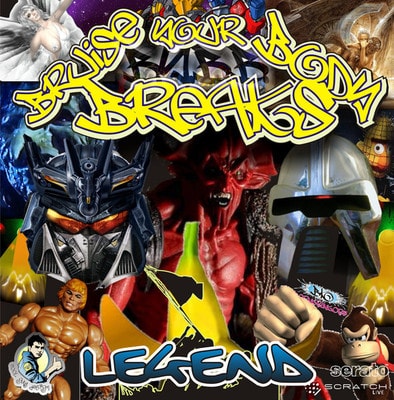
LEGEND, Official Album Artwork (2009). BYBB graffiti logo, Transformer, demon, Cylon, He-Man, Donkey Kong, Serato Scratch Live, the Banana Peel, and the Marines raising the flag.
The artwork for LEGEND is not a simple album cover. It is a visual manifesto: a dense, layered, deeply personal image that tells the entire story of who DJ Natural Nate® is and where LEGEND came from.
The LEGEND album cover, every element chosen by hand. BYBB graffiti logo, Transformer, demon, Cylon, He-Man, Donkey Kong, Serato Scratch Live, the Banana Peel, and the Marines raising the flag. A visual autobiography.
At the top, in massive graffiti lettering that commands the entire upper half of the image: BRUISE YOUR BODY BREAKS. The BYBB logo, bold, aggressive, unmistakably underground, announces the label and the culture in the same breath. This is not corporate. This is not polished. This is the underground, and it is proud of it.
Below the logo, three figures dominate the center of the image: a Transformer: the mechanical warrior of DJ Natural Nate®'s childhood imagination, the toy he dreamed about in the music store, now rendered in full cinematic detail. A demon, red-skinned, horned, the embodiment of the darkness that runs through the album's narrative. And a Cylon warrior: the silver-helmeted machine soldier from Battlestar Galactica, another piece of the science fiction mythology that shaped his creative universe.
Good and evil. Man and machine. Light and shadow. The entire thematic architecture of LEGEND compressed into three figures standing side by side.
At the bottom left: the DJ Natural Nate® logo: the man himself, represented in his own brand, claiming his place on the cover of his own creation. At the bottom right: the Serato Scratch Live logo: the technology that bridged his turntablist identity with his producer identity, the tool that made the live performance of LEGEND possible.
The Banana Peel was a childhood crew built like the Guardian Angels, to fight bullies and protect the less fortunate. That symbol on the LEGEND cover is not nostalgia. It is a statement of values that has never changed.
And between them: He-Man, fist raised. Donkey Kong, barrel in hand. The heroes of a childhood that had been full of imagination and short on resources, now immortalized on the cover of an album that proved, beyond any doubt, that the imagination had been enough all along.
But look closer. The cover holds two more symbols that most people will not immediately recognize, and both of them carry enormous personal weight.
The first is the Banana Peel. Not a random image. Not a joke. The Banana Peel was the name of a childhood gang, not a gang in the criminal sense, but in the truest, most original sense of the word: a crew of kids who banded together to protect their community. Modeled in spirit after the Guardian Angels, the Banana Peel was formed to do what adults sometimes failed to do, stand up for the kids who couldn't stand up for themselves. Fight school bullies. Protect the less fortunate. Look out for the ones who had nothing and no one. It was a code. A commitment. A childhood oath that said: we do not walk past someone getting hurt. We do not look away. We show up.
That symbol on the LEGEND cover is not nostalgia. It is a statement of values that has never changed.
The second is the Marines raising the American flag: the iconic image of soldiers planting the flag, rendered on the cover of a Breakbeat album made in Colorado by a man born in Bad Kreuznach, Germany and raised in the American West. It is there because it means something specific and personal: a commitment to this country, to the people in it, and to the idea that service, real service, the kind that costs something, is not just a military concept. It is a way of living. DJ Natural Nate® has carried that commitment his entire life, in his music, in his community, in the platforms he built to elevate other artists, and in the standard he has held himself to as a performer and a human being.
The cover is not designed by committee. It is not the product of a marketing meeting or a brand strategy session.
It is the visual autobiography of a man who grew up dreaming of keyboards he couldn't afford, who protected kids being bullied before he ever made a record, who carries the flag not as a decoration but as a declaration, who taught himself to produce on a machine that felt like it required a college degree, who made an album in a haunted house about good defeating evil, and who put everything he loved and everything he stood for, every toy, every movie, every piece of mythology, every oath he ever made, on the cover, because all of it was true, and all of it was his.
The Live Performance: The Night the Producer Was Born
When LEGEND was finally complete, one challenge remained. The biggest one.
Performing it live.
On NuBreaks.com. June 13, 2009. In front of a real audience. A performance with no association with The-Lost-Art.com™, this was NuBreaks.com's stage, NuBreaks.com's audience, and NuBreaks.com's moment. Using everything he had learned, everything he had built, everything he had become over years of self-taught work in a room by himself with a machine that felt impossible.
And here is what most people do not fully understand about what that live performance actually looked like: it was not simply a DJ set. It was not two turntables and a mixer. It was not a DJ pressing play on pre-arranged tracks and riding the faders.
It was two turntables, a mixer, and a keyboard, all running simultaneously. Live.
It was not two turntables and a mixer. It was two turntables, a mixer, and a keyboard, all running simultaneously. Live. He was playing live keys during the mixes and songs.
DJ Natural Nate® was not just spinning records and mixing tracks. He was playing live keys during the mixes and songs, integrating the Roland Fantom F6 into the performance in real time, layering original keyboard performances on top of the turntable work, building the music in the moment the way a band builds it on stage. The same keyboard he had taught himself to use alone in a room was now part of a live performance rig, and he was playing it while mixing, while scratching, while managing the entire sonic architecture of a 21-track album in front of a live audience.
That is not a DJ set. That is a one-man band with turntables.
But DJ Natural Nate® did not do it entirely alone. One person in particular played a critical role in making the live performance of LEGEND possible, and in shaping the album itself.
Mark Scurrah of Sun Mountain Music and Vision Laser.
Mark was not just a technical collaborator. He was a genuine creative partner in the LEGEND project. He helped with the mastering of tracks, bringing professional audio engineering expertise to the final stage of production, ensuring that the music that had been built in a haunted house in Colorado translated correctly to speakers, to broadcast, to the ears of an audience.
Beyond mastering, Mark contributed vocal samples for the live show, providing raw material that DJ Natural Nate® could work with in performance, extending the sonic palette of LEGEND beyond what the Roland Fantom alone could produce.
And then there was the recording.
Mark Scurrah did not just assist with LEGEND from the outside. He stepped inside it. He recorded a real vocal performance for one of the tracks in the series, his voice, captured and committed to the record, becoming part of the permanent fabric of the album. That is not a technical contribution. That is an artistic one. That is a person who believed in the project enough to put himself into it.
For months and years, DJ Natural Nate® had been known as a DJ. A turntablist. A broadcaster. A champion of other people's music. Now he was about to present himself as something more, as a producer, a creator, a storyteller, a risk-taker who had built something original and was willing to stand behind it in public, in real time, with no safety net.
The pressure was enormous. The fear was real.
The fear of mistakes. The fear of technical failures. The fear that the equipment would betray him at the worst possible moment. The fear that people might not understand the vision, that the loop philosophy, the cinematic arc, the five-track Legend sequence, the He-Man sample, the haunted house darkness, might not translate to an audience that had come expecting a DJ set and was about to receive something they had never heard before.
And then the night arrived. The show began.
And everything changed.
When LEGEND aired live, it was not just another broadcast. It was a revelation, for the audience, and for DJ Natural Nate® himself. Because in the moment of performance, all the fear and all the doubt and all the years of solitary work in a room with a keyboard that felt impossible collapsed into a single, undeniable truth:
It worked.
The story landed. The arc held. The darkness moved through the speakers and into the room and into the people listening, and then the light came, and the closing composition arrived, and the journey was complete.
And the audience: the people who had been there from the beginning, who had followed DJ Natural Nate® through his years as a DJ and broadcaster and champion of other people's music, understood that something had changed. That the person they were listening to was not just a DJ anymore.
He was a producer. A storyteller. A creator of worlds.
But there was one moment from that period, quiet, personal, and more meaningful than almost anything else, that has never been fully told until now.
One day, while DJ Natural Nate® was deep in the work, building tracks, refining the Tom Sawyer Scratch tool, pushing the production further, his father, David Lemieux, came over.
David heard what was playing. And he stopped.
"I know this song," he said.
He loved it.
For a son who had spent years building music in a world his parents had not grown up in, turntablism, Breakbeat, underground electronic music, a culture that existed far outside the mainstream, that moment landed differently than any industry co-sign ever could. His father, a man of a different generation, a different musical world, heard something in what his son had made and recognized it. Connected to it. Loved it.
DJ Natural Nate® was thoroughly surprised. And thoroughly honored.
Because what that moment meant was something deeper than musical taste. It meant that his father saw him, saw the work, saw the dedication, saw the years of pushing to be a better DJ, a better producer, and a better person through the power of music. David Lemieux had a deep admiration for his son's drive. Not just for the music itself, but for what the music represented: the refusal to stop growing, the commitment to craft, the belief that excellence was worth chasing.
And David was there for the live stream too. He watched the performance of LEGEND unfold in real time: a father watching his son step into something he had been building toward his entire life.
That is not a small thing. That is everything.
The Fear Before the Release: and the Call to Tommy Who
Before LEGEND was ever released to the world, there was a period of genuine, serious fear.
Not stage fright. Not the fear of criticism or rejection. Something more specific and more legally consequential.
Just about every song on LEGEND contained samples. Samples pulled from all over: the internet, cartoons, movies, classic rock remixes, television, film dialogue, sound effects, cultural artifacts from decades of American media. The album was built from this material the way a collage is built from torn magazine pages, deliberately, creatively, and with complete awareness that none of it had been cleared.
Because clearing samples costs money. Real money. The kind of money that a self-taught DJ in Colorado, working alone on a Roland Fantom F6 in a haunted house, simply did not have. The album was not a commercial venture. It was not a label project with a legal team and a budget for licensing. It was a personal artistic statement, made by hand, released into the world on faith. The full story of how <a href="/blog/bruise-your-body-breaks-the-origin-story" style="color:inherit;text-decoration:underline;">Bruise Your Body Breaks came to exist as a label</a> is its own chapter, but in this moment, it was simply the name on a record that had no money behind it and no legal safety net beneath it.
But faith does not protect you from a cease and desist letter.
He was ready for backlash. Ready for criticism. Ready for the worst. What he was not ready for was what actually happened.
So before the release, he picked up the phone and called Tommy Who.
Tommy Who was not just a friend. He was a legend in his own right: a magical and storied producer, the man behind Tommy Who Records, one of the most respected names in the underground Electro and Breakbeat world. He was also one of the most important figures in DJ Natural Nate®'s musical education. In the early 2000s, Tommy Who Records was a primary source for the freshest, most forward-thinking Electro and Breakbeat vinyl on the planet. DJ Natural Nate® bought most of his early records from Tommy, and those records, that music, that constant exposure to the absolute best the genre had to offer, helped shape and mold him into the DJ he became. The crates that built DJ Natural Nate® had Tommy Who's fingerprints all over them. (That formation, <a href="/blog/growing-up-in-colorado-the-making-of-a-turntablist" style="color:inherit;text-decoration:underline;">growing up in Colorado and building a crate from the ground up</a>, is documented in full elsewhere.)
So when the fear about LEGEND's samples became too loud to ignore, Tommy Who was the right person to call.
The advice Tommy gave was practical, honest, and grounded in the reality of how the music industry actually works at the underground level.
Don't worry too much, he said. As long as nobody is making a million dollars off it, the people who own those samples are not going to run straight to a courtroom. The first move is almost always a cease and desist letter: a warning, not a lawsuit. Because nobody wants the headache of a court case. Nobody wants the legal fees. And nobody wants to spend real money chasing a producer who has no money to begin with. The math doesn't work in their favor.
It was not a guarantee. It was not legal advice. But it was the voice of experience from someone who had lived inside this world for years, and it was enough to move forward.
DJ Natural Nate® was not releasing LEGEND to make money. He was not trying to profit from anyone else's work. He was not trying to do anything illegal, that was never the intent, not for a single second. The samples were used the way a painter uses color: as raw material in service of something larger, something personal, something that could not have existed any other way.
He wanted the world to hear what he had built: the story, the arc, the cinematic journey, the proof that a DJ from Colorado could construct something that had never existed before.
And there was one more hope underneath all of it. A quieter one. One he rarely said out loud.
He knew he was not a great producer. He knew that. The skills were developing, the ideas were real, but the execution was still finding itself, still working through the questions of structure and sampling and arrangement that had no easy answers. What he had, more than technical mastery, was vision. Ideas. A sense of what music could feel like and what it could mean, even when the tools to fully realize that feeling were still being learned. That process of self-teaching on hardware nobody else understood is explored in depth in the <a href="/blog/bruise-your-body-breaks-independent-label-no-compromise" style="color:inherit;text-decoration:underline;">story of what it meant to build an independent label with no compromise</a>.
So the other hope: the one that lived alongside the fear and the desire to simply be heard, was this: that some of the ideas on LEGEND would find their way to producers who were better equipped to take them further. That someone with more technical skill would hear what he and <a href="/blog/jiggabot-the-woman-behind-the-brand" style="color:inherit;text-decoration:underline;">Jiggabot</a> had started and be inspired to pick up those ideas and make them into something even greater. That the work would plant seeds in other people's imaginations and grow into things neither of them could have made alone.
It was not a small hope. It was, in many ways, the most generous one.
He was ready for backlash. Ready for criticism. Ready for the worst.
What he was not ready for was what actually happened.
The release turned heads. Not just a few, many. People heard LEGEND and responded to it in ways that nobody had predicted. The samples, the loops, the unconventional structures, the childhood mythology woven through the productions, all of it connected. All of it landed.
And in doing so, LEGEND became something larger than the album itself. It became proof of what music, samples, and simple productions could do in the right hands with the right vision. It transformed the word LEGEND from a title into a living thing: a term that came alive in multiple senses, for multiple reasons, through the work of the people who made it and the people who heard it.
The fear was real. The risk was real. And the result was something that neither fear nor risk could have predicted.
What LEGEND Proved: and Why It Will Never Be Forgotten
LEGEND proved things. Specific, documented, permanent things that cannot be undone by time or trend or the shifting tides of the music industry.
It proved that a DJ could be a producer, not in the diluted, laptop-assisted sense that the word "producer" had begun to acquire in the digital age, but in the full, original, demanding sense: a person who conceives, constructs, and executes original music from scratch, who builds sonic worlds from raw material, who tells stories through sound.
It proved that self-teaching works, that the absence of formal training, of industry mentors, of a studio budget, of a label advance, of any of the conventional resources that the music industry tells you are necessary, none of that is actually necessary.
What is necessary is the question: "If this was the last machine on Earth capable of making music, how would I make it work?" And the willingness to answer it alone, in the dark, for as long as it takes.
It proved that childhood matters, that the toys you couldn't afford, the movies that shaped your imagination, the cartoons that gave you your first mythology, the keyboards you pressed in a music store without any money to buy them, all of it is raw material. All of it is fuel. All of it is waiting to become something, if you are willing to do the work.
The kid who stood in Pro Sound Music pressing keys he couldn't afford had finally answered the question that had been waiting for him his entire life. Not with words. With music. With LEGEND.
It proved that darkness can be transformed, that a haunted house, a difficult period, a life that feels heavy and strange and charged with something you cannot explain, none of that has to stop you. It can feed you. It can become the emotional truth that makes your art real in a way that comfortable art never is.
And it proved that Bruise Your Body Breaks was not just a label name. It was a philosophy. A commitment to music that costs something, that requires something real from the people who make it, and gives something real back to the people who hear it.
LEGEND was released on iTunes and distributed across multiple digital platforms through ReverbNation. It was performed live on NuBreaks.com on June 13, 2009: a performance that stands entirely on its own, separate and distinct from The-Lost-Art.com™. It was heard by people who had never expected a DJ from Colorado to hand them a 21-track cinematic audio adventure built entirely from original productions and childhood mythology and the emotional residue of living in a haunted house.
And it changed them. The way real music always does.
The kid who stood in Pro Sound Music pressing keys he couldn't afford had finally answered the question that had been waiting for him his entire life. Not with words. Not with an explanation. Not with a press release or a marketing campaign or an industry co-sign.
With music. With LEGEND. With 21 tracks of original production that said, louder than any declaration could:
I HAVE THE POWER.
And the underground heard it. And the underground will never forget it. Because LEGEND is not just an album, it is proof that the dream was always real, that the music was always there, and that the only thing standing between a kid in a music store and a producer who builds entire worlds was time, determination, and the refusal to stop.
Photo Archive
Right-click any photo to save, or use the buttons below each image to download or copy the link for social media.
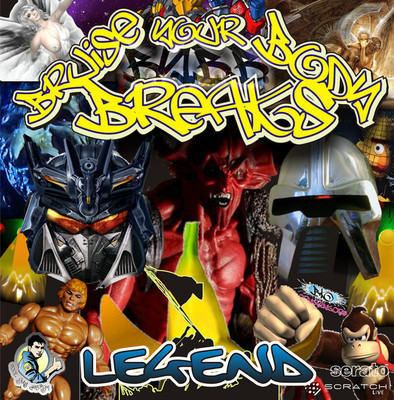
LEGEND, Official Album Artwork (2009). Transformers, He-Man, Donkey Kong, Serato Scratch Live, and the BYBB graffiti logo, every element chosen by hand.