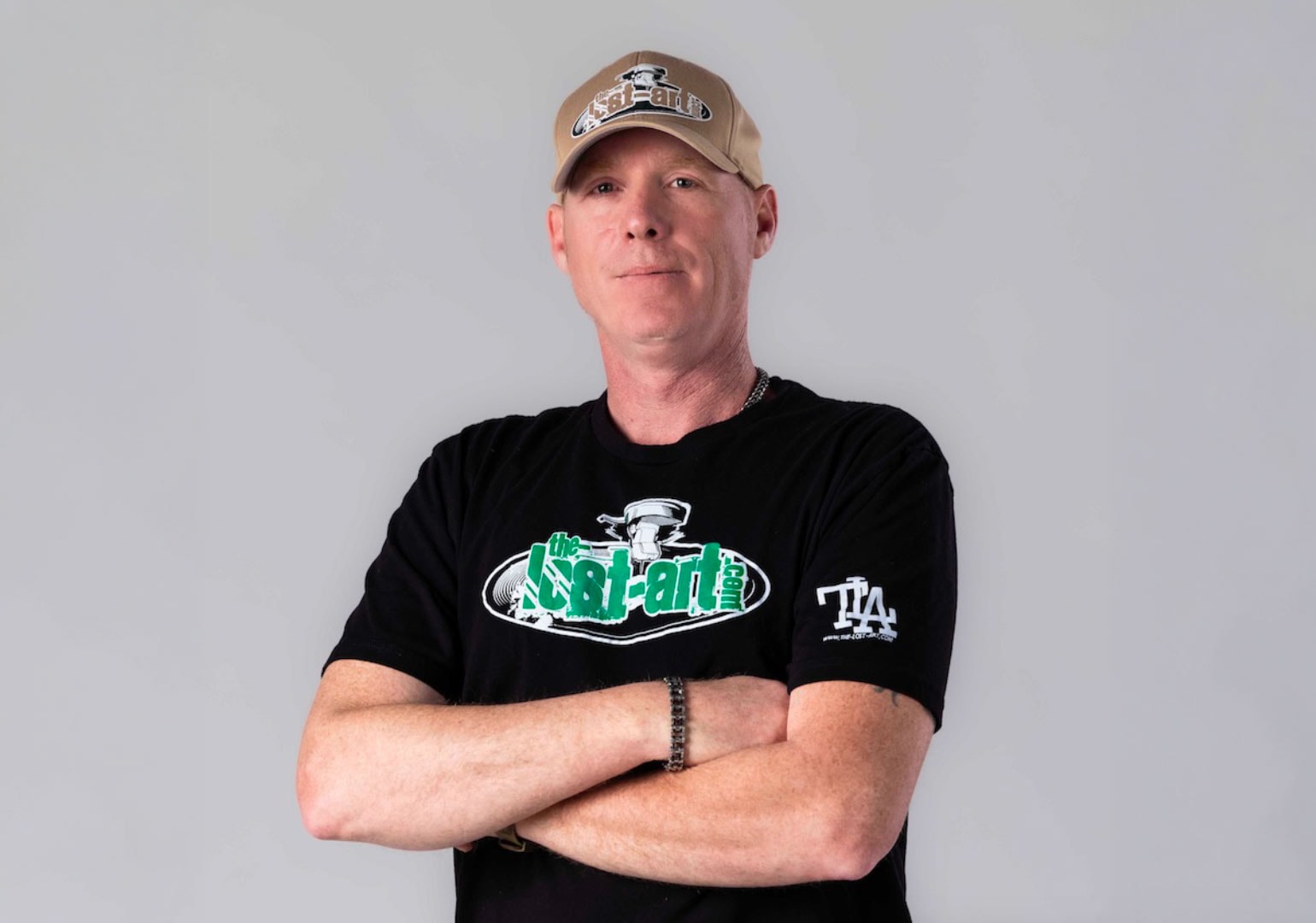
The world was introduced to this music through releases, radio, and live performances going back to the early 2000s, long before the Rave Cave became the intimate home base it has been for the last eleven years. This is the full story of the most personal catalog in Colorado underground history, music made for one person, heard by the world, and honed over decades in the private sanctuary of close friends and community.
A Note Before We Begin
There are some stories that resist being told in interviews. Some truths that cannot be extracted in a podcast, summarized in a press release, or reduced to a caption beneath a photo. Some things can only be said in music, and some music can only be understood when you know the full weight of what was happening in the room when it was made.
This is one of those stories.
What you are about to read is not a standard artist profile. It is not a discography breakdown or a production technique deep-dive. It is the story of two people, DJ Natural Nate® and Jiggabot, and the music they made together across years of love, life, and an extraordinary creative partnership that was never designed for public consumption. It is a story about what happens when two people trust each other completely, when the studio becomes the most honest room in the world, and when the music made in private turns out to be exactly what the world needed.
It is also, in every meaningful sense, a love letter. Because that is exactly what the music always was.
And it was always that, long before anything else entered the picture.
This Was Never About One Thing: It Was About Everything
Let us be absolutely clear about something before we go any further, because it matters enormously to understanding what this music is and where it came from.
The DJ Natural Nate® VS Jiggabot catalog was not born from a single event. It was not the product of one difficult period, one diagnosis, one crisis that needed to be processed through sound. That framing, however understandable, however easy to reach for when telling a story, would be a fundamental misrepresentation of what this music actually is.
This music was born from a relationship. From years of love, trust, creative partnership, and the kind of deep knowing that only develops between two people who have chosen each other completely. It was born in studio sessions that stretched into the early hours of the morning, in conversations that happened through bass lines and synths because some things are too large for words, in the accumulated weight of a shared life that kept finding its way into sound. The world was introduced to this music through releases, radio broadcasts, and live performances going back to the early 2000s, long before the Rave Cave existed. The Rave Cave came later, as a private sanctuary for the people Nate and Jiggabot trusted most, a room where the music could breathe before it went back out into the world.
The music was personal from the very beginning. Not because something went wrong. Because something went profoundly, beautifully right, because two people found each other and built something together that neither of them could have built alone, and the music was the most honest record of that.
Yes, there was a tinnitus diagnosis. Yes, it produced a period of fixation and processing that found its way into some of the tracks. That is part of the story, and it will be told honestly. But it is one chapter in a much larger book, and it would be a disservice to the music, to Jiggabot, and to the truth of what this catalog represents to let that one chapter define the whole.
"This music was not born from a crisis. It was born from a love so deep and a partnership so honest that the only language equal to it was sound."
This music is about love. About partnership. About releases that reached listeners across Colorado and beyond from the earliest days of the production career. About strangers who heard these tracks at after-parties and wept because the music said something they had been carrying alone. About close friends who recognized themselves in the sound. About a creative relationship so deep and so honest that it produced art that transcends the circumstances of its making.
That is the story. All of it. And it starts in the early 2000s, in a studio, with a Roland Fantom F6 and the woman who would become the final test for every track ever made.
The Rave Cave: Eleven Years of Trust, Community, and Honest Music
To understand the DJ Natural Nate® VS Jiggabot catalog, you have to understand the Rave Cave.
Not as a concept. Not as a metaphor. As a real, physical, intentionally built space: a room that Nate and Jiggabot created specifically for the people they trusted most in the world. Not a public venue. Not a club. Not a space designed for strangers or for spectacle. A private sanctuary, built for intimacy, for honesty, for the kind of musical experience that is only possible when everyone in the room has been chosen.
By the time the Rave Cave came into existence, the music had already been out in the world. Releases through Bruise Your Body Breaks. Radio broadcasts. Live performances. After-parties across Colorado. The world had been introduced to this catalog through the proper channels, through the work, through the grind, through years of production and distribution that started in the early 2000s. The Rave Cave was not where the world first heard this music. The world had already been listening.
What the Rave Cave became, over the last eleven years, was something different and something irreplaceable. A home base. A private room where the music could breathe among people who understood the full weight of what they were hearing. Where Nate and Jiggabot could test new productions and new DJ sets against the honest responses of close friends and community members who had been trusted with the music precisely because they were trusted with everything else.
What happened in that room was extraordinary.
"The Rave Cave was not where the world met the music: the world had already been listening. It was where the music came home. Eleven years of sessions, close friends, community, and honest sound."
Close friends who had known Nate for years heard tracks and felt something shift in their understanding of who he was, not because the music was confessional in an obvious way, but because it was honest in a way that most music is not. It said things that Nate could not say in conversation. It carried feelings that had no other outlet. It was the most direct communication he was capable of, and the people in the Rave Cave received it with the care and the love that it deserved.
But the Rave Cave was not just a listening room. It was a creative proving ground. A place where production was tested and refined against real human response. Where DJ skills were honed in front of people who knew the difference between good and great. Where Jiggabot could hear how a track landed on people she trusted, and use that understanding to push for the changes that would make it better. Where the feedback loop between creation and reception was as intimate and honest as it is possible for that loop to be.
Eleven years of that. Eleven years of sessions, of close friends, of community, of music tested and refined and sent back out into the world better than it arrived. The Rave Cave did not launch this catalog: the catalog was already moving when the Rave Cave was built. What it did was give the music a home. A room where it could always come back to be heard honestly, by people who loved it and the people who made it.
The Rave Cave is in every track made during those eleven years. The trust, the intimacy, the honesty of that room, it is woven into the fabric of the music. And that is why, when the music reached new listeners, they recognized something in it that they could not quite name but could not stop feeling.
The Fembot Coalition: How Jenna Marie Became Jiggabot: The Historical Record
The name Jiggabot did not come from a studio session. It did not come from a track title, a label release, or a marketing decision. It came from something far more significant: an act of recognition by one of the most respected female collectives in the history of the Heavy Electro Bass scene.
Jenna Marie (Jiggabot) with the Fembot Coalition: the community that recognized her and gave her the name she carries to this day. Heather Maree and Jason Williams (Phonotronix), from Florida, brought the southern underground energy that defined this scene.
To understand what that recognition meant, you have to understand who gave it.
Heather Maree and her husband Jason Williams are from Florida. They brought with them the deep, Florida-rooted energy and credibility of the southern underground: a scene with its own lineage, its own standards, and its own uncompromising relationship to the music. Jason was one half of Phonotronix, a group that stands among the most legendary Electro Bass acts in the history of the genre. Their sound was heavy, precise, and deeply rooted in the mechanical, futuristic aesthetic that defined Electro Bass at its best. The Williams household was, in every meaningful sense, a center of gravity for the underground, and when Heather and Jason brought that gravity into the Colorado scene, it landed with full force.
Heather channeled that force into the Fembot Coalition: a female collective she built at a time when female identity in the Heavy Electro Bass world was not always centered or celebrated. The scene was dominated by male DJs, male producers, male promoters. Women were present and valued, but the specific kind of recognition the Fembot Coalition offered was rare: a space where women who were genuinely embedded in the culture could be seen on their own terms, named on their own terms, and honored for their specific contributions to a world that was not always good at making that recognition visible.
To be included in the Fembot Coalition was not a given. It was an honor. It was recognition from the inside, from women who knew the scene, knew the music, and chose their members with the same seriousness that defined everything else they did.
"Jenna Marie, from Colorado, was chosen by the Fembot Coalition, led by Heather Maree and rooted in the Florida underground through Phonotronix. The name Jiggabot was not given lightly. It was recognition from the inside, earned, specific, and permanent."
Jenna Marie, from Colorado, was chosen.
Jenna was not a peripheral figure in the scene. She was present, active, and genuinely embedded in the Heavy Electro Bass world on her own terms. Her energy, her understanding of the music, her presence in the community, these were not borrowed from anyone else. They were hers. And the Fembot Coalition saw that clearly.
When they named her, they gave her the name that would follow her for the rest of her life in the underground: Jiggabot.
The name was not arbitrary. The "bot" suffix was the Coalition's signature: a nod to the robotic, mechanical, futuristic aesthetic that ran through the Electro Bass sound, the same aesthetic that gave the group its own name and that Phonotronix had helped define. To be named a "bot" by the Fembots was to be recognized as someone who belonged in that world completely, not as a guest, not as an accessory, but as a full and essential part of it.
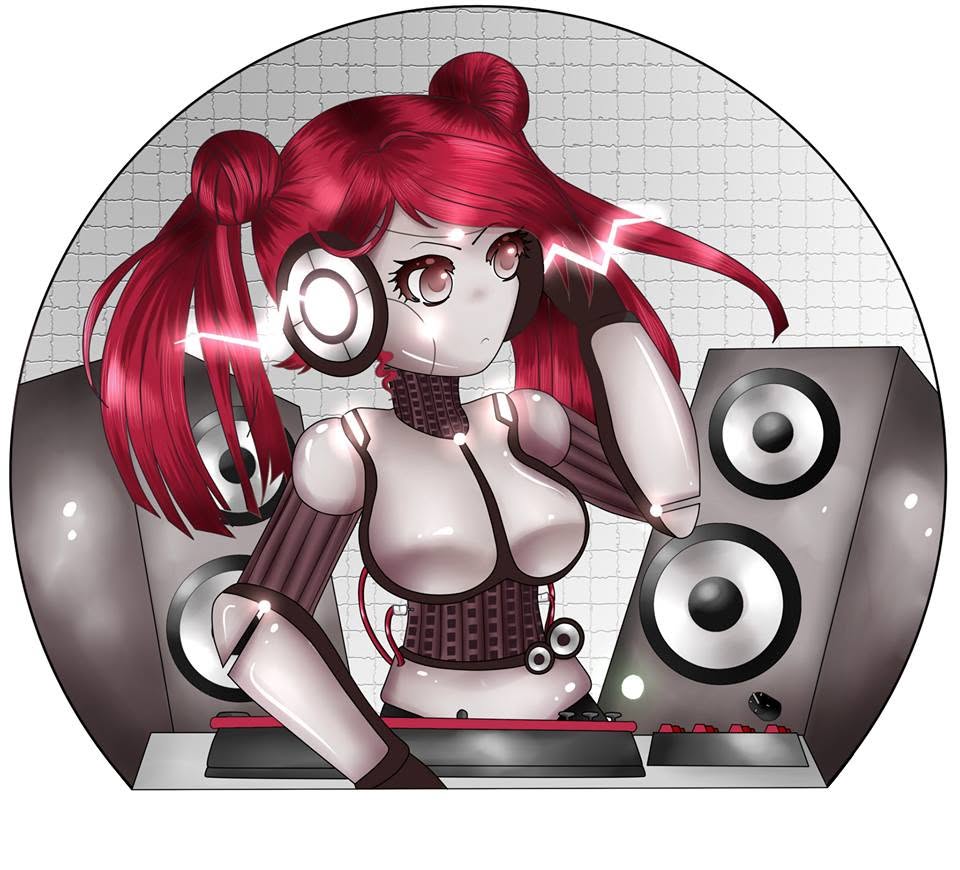
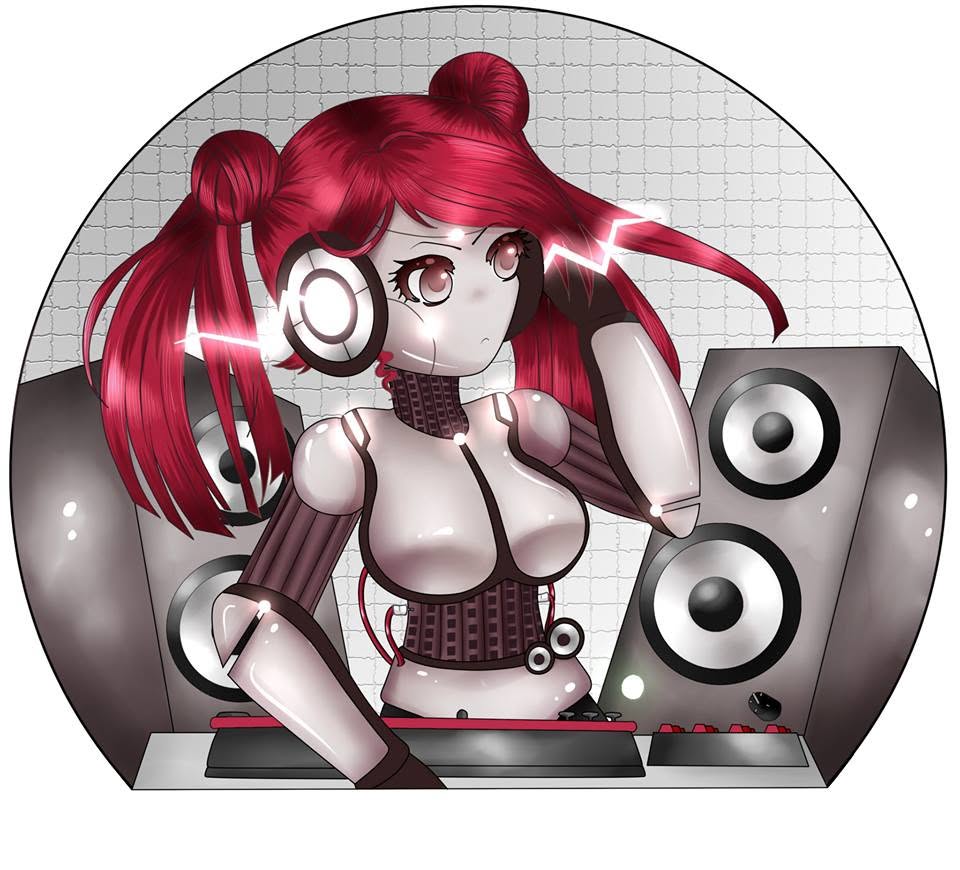
The Jiggabot logo: the robotic figure at the decks, the mechanical aesthetic rendered in the visual language of the underground, carries all of this history. It is not just a brand image. It is a visual record of a name that was given by a community, earned through presence and dedication, and carried forward into a production career that would eventually reach listeners around the world.
Every time the name Jiggabot appears on a release, on the VS Jiggabot catalog, on the Bruise Your Body Breaks label, on the charts in the Netherlands and the UK and beyond, it carries the weight of that moment when Heather Maree and the Fembot Coalition looked at Jenna Marie and said: you belong here. You are one of us. And this is your name.
Heather Maree. Jason Williams. Phonotronix. Florida roots, Colorado scene, a name given in recognition and carried into history. These are not footnotes in the Jiggabot story. They are the origin of it. And that origin belongs in the permanent record of underground music, because it is part of the permanent record of who Jiggabot is, where she came from, and what the name she carries actually means.
Jiggabot in the Scene: The Photo Record
History is not just written in words. It is documented in photographs, in the images that capture people in the moments that mattered, in the rooms where the culture was being made, with the people who were making it.

Heather Maree and Jiggabot, two pillars of the Heavy Electro Bass underground.
The photographs of Jenna Marie, Jiggabot, from the mid-2000s underground are part of that documentary record. They show a woman who was present. Who was there. Who was not watching the scene from the outside but living inside it, building relationships with the people who were defining what Heavy Electro Bass sounded like and felt like and meant.
Jenna is from Colorado. She was not imported into this scene. She was embedded in it, moved through it, and earned her place in it on her own terms, which is exactly why the Fembot Coalition, led by Heather Maree and rooted in the Florida underground through Phonotronix, recognized her as one of their own. You cannot fake that kind of belonging. The photographs are the proof.
The Fembot Coalition was not a background organization. It was a visible, active, recognized part of the scene, and Jiggabot was a visible, active, recognized part of the Coalition. This is what historical documentation looks like in underground music. Not press releases or official bios or industry profiles. Photographs. Moments captured in rooms where the music was playing and the people who loved it were together.
Jiggabot is in that record. She has always been in that record. And the name she carries, given to her by Heather Maree and the Fembot Coalition, backed by the credibility of Phonotronix and the Florida underground, is the thread that connects her presence in those photographs to her presence in the DJ Natural Nate® VS Jiggabot catalog, to the Bruise Your Body Breaks releases, to the charts in the Netherlands, to the after-parties where strangers wept without knowing why.
The name is the through-line. And the through-line starts here, in the underground, with a group of women who recognized something in a woman from Colorado and gave it a name that would last.
The Video That Inspired the Artwork: Years Before the Record Existed
Before the Notes to Jiggabot EP had a title, before it had a track listing, before it had a pressing plant or a label or a release date, it had a visual. A video that Nate made years earlier, long before the record was even conceived, that captured something so precisely about the feeling he was trying to put into music that it became the direct inspiration for the EP's artwork.
The video is called "Notes to Jiggabot." It predates the vinyl release by years. It was made in the same spirit as the music, not for an audience, not for a platform, not for a campaign. It was made because the feeling demanded to exist in a form that could be seen as well as heard. A private document of something real, created before anyone knew it would eventually become the visual identity of a vinyl record.
Watch it. Then listen to the EP. The connection is immediate and unmistakable: the same emotional register, the same intimacy, the same refusal to perform for anyone other than the person it was made for. The artwork did not come from a design brief or a mood board. It came from this video. From the feeling that was already there, years before the pressing plant ever received the lacquer.
Notes to Jiggabot: When Music Becomes a Love Letter
The project that would become known as DJ Natural Nate® VS Jiggabot was never conceived as a commercial release. It was not designed with a target audience in mind, not engineered for radio play, not built around a marketing strategy. It was built around one person: Jenna Marie, known to the world as Jiggabot: the woman who had become Nate's partner, co-creator, and the person he trusted most in the world.

DJ Natural Nate® and Jiggabot, two people, one sound, a lifetime of stories.
Every track in the catalog was, in its original intention, a message to her.
Nate is not a man who externalizes easily. He does not reach for conversation when the weight is internal. He does not perform vulnerability for an audience. He is private in the way that people who feel things deeply are often private, not because he is closed, but because the things he carries are too real and too large to survive the translation into casual speech. He reaches for the studio. He reaches for the decks. He reaches for the one language that has always been honest enough to hold whatever he needed to put into it.
And so, across years of shared life with Jiggabot, years of love and partnership and the accumulated weight of everything two people build together, he made music. Not about any single event or any single feeling, but about all of it. The gratitude. The love. The fear of loss. The wonder at having found someone who understood him completely. The desire to give her something that matched the scale of what she meant to him.
When he could not say those things out loud, and he often could not, because they were too large and too close and too tangled with each other to survive the translation into words, he built them into tracks. He layered synths and bass lines and rhythms until the feeling was there, until the music said what he could not.
These were love letters written in sound. Personal, intimate, raw, and never originally intended for anyone else to hear.
"Notes to Jiggabot" as a release was exactly what the title described: notes. Messages. Confessions. The kind of things you write in the margins of a journal at 2 in the morning when you are too overwhelmed to speak but too full to stay silent. Nate poured his love for Jiggabot, his gratitude for her steadiness, his deepest hopes and his most private fears into every single track on that record. Not one song was made without a true, specific, lived meaning behind it.
This was not music as product. This was music as communication. Music as therapy. Music as the only language that felt honest enough for what needed to be said.
Jiggabot's Role: The Soul Behind the Sound
It would be a fundamental misunderstanding to describe Jiggabot as simply a collaborator on these records. She was not a featured artist brought in to add a layer. She was not a co-writer in the traditional sense. She was something far more essential: she was the standard.
Jiggabot has an ear that is almost impossibly precise. She hears things in a mix that most producers would miss entirely: the slight imbalance in a mid-range frequency, the moment a track loses its emotional thread, the point at which a production stops feeling alive and starts feeling mechanical. She does not accept "good enough." She never has.
And in the context of these deeply personal records, that standard was not just a professional asset. It was a form of love.
There were tracks, many of them, that Nate wanted to abandon. Songs that had been difficult to complete, that had resisted finishing, that had sat in the project folder for weeks or months without resolution. The creative process, especially when you are making music that carries this much emotional weight, is not always clean or linear. Sometimes a track that means everything to you is the hardest one to finish, precisely because the stakes feel so high.
Jiggabot refused to let those tracks die.
"Jigga heard what the music was trying to say before it knew how to say it. She refused to let a single track die before it had spoken its truth."
Time and again, when Nate was ready to delete a project file and move on, Jiggabot would listen again. She would hear what the track was trying to become, not what it currently was, but what it was reaching toward, and she would insist on finishing it. Sometimes that meant rewriting sections from scratch. Sometimes it meant rebuilding the arrangement entirely. Sometimes it meant sitting with a track for another week, another month, until it finally revealed what it needed to be.
She was also, in the most literal sense, the subject of the music. She was the person the tracks were reaching toward. She knew what the music was trying to say, because she was part of what the music was trying to say. And she brought that knowledge to every production decision, every arrangement choice, every moment where the track needed to find its emotional truth.
The results of that insistence, that love expressed as uncompromising creative standards, are some of the most powerful productions in the entire DJ Natural Nate® VS Jiggabot catalog.
The Real Testing Ground Was Always Jenna: A Career's Worth of Tears He Was Never Supposed to See
People talk about the Rave Cave as the testing ground. And it was, for over eleven years, it was the most honest room in Colorado underground music. A private space built for the people Nate and Jiggabot trusted most, where the music could be played before it was ready for the world, where real human response could shape what a track became before any stranger ever heard it.
But the Rave Cave was never the first room.
The real testing ground was always Jenna.
This goes back further than the Rave Cave. It goes back to the early 2000s, to the very beginning of the production career, to the first tracks built on the Roland Fantom F6, to the earliest sessions in the studio when the music was still finding its shape and its language. From the moment Nate started making original music, Jenna was the final test. Not the first listener. The final one. The one whose response determined whether a track was truly finished or whether it still had something left to say.
Before the Rave Cave. Before the close friends. Before anyone else in the world had heard a single note, there was Jenna Marie sitting in a room, hearing a finished track for the first time, and Nate watching her without letting her know he was watching.
"When she cried, I felt it in my throat and my chest and I held it there. She was never supposed to see it. That is the love that does not show: the love that goes into the music instead, because the music is the only room large enough to hold it."
This is the part of the story that has never been told publicly. Not because it is a secret, but because it is so private that putting it into words feels almost like a violation of the moment. But it is the most important part of the story. Because it is where the music was always truly tested, not against a crowd, not against a room full of trusted friends, but against the one person it was made for.
When Jenna cried listening to the final tracks, something happened in Nate that he did not let her see.
A lump in his throat. A tightening in his chest. The particular kind of emotion that arrives when you have spent weeks or months building something in the private language of sound, something that was trying to say what you could not say out loud, and then you watch the person you made it for receive it, and you realize it worked. It said the thing. It reached her. It crossed the distance that words could never cross and landed exactly where it was meant to land.
And he could not let her see it.
This is the central tension of Nate's entire emotional life, and it runs through every track in this catalog like a current beneath the surface: he has always had to show the strong side. Always. From the time he was young, through the Marine Corps, through every hard thing that life brought, he was the one who held steady. The one who did not falter. The one who looked at the people around him, at the people he loved, and said with his presence and his composure: everything is going to be fine. I am going to be fine. We are going to be fine.
This is not a performance. It is not a mask. It is a form of love: the deepest, most demanding form of love that exists. The love that says: I will carry this so you do not have to. I will be the steady thing in the room. I will not let my breaking become your burden.
But it costs something. It always costs something.
Because the man who holds steady for everyone else still feels everything. He feels it more, perhaps, precisely because he cannot let it show, because the feeling has nowhere to go except inward, except into the studio, except into the architecture of a track at 2 in the morning when nobody is watching and the music can hold what the room cannot.
So when Jenna cried, when the music reached her in the way it was always trying to reach her, Nate felt it in his throat and his chest and his eyes, and he turned away, or he held very still, or he found some way to be in that moment without letting her see what it was doing to him. Not because he was ashamed of the feeling. Because he was the one who was supposed to be strong. Because she was already carrying the weight of receiving something that vulnerable, and he was not going to add his own breaking to her load.
A full production career of this. From the early 2000s through every session, every release, every finished track played for the first time in a private room, Jenna's response was always the truest measure of whether the music had done what it was supposed to do. And Nate feeling everything she felt, feeling it perhaps more intensely because he had built the thing and knew every layer of what it was trying to say, and holding all of that inside because that is what he does. That is who he is.
The Rave Cave was where the music met the world. But Jenna was where the music met the truth.
Every track that made her cry was a track that had succeeded at the only thing that ever mattered: it had said the unsayable. It had crossed the distance. It had taken the thing that lived below the reach of language and given it a frequency, a rhythm, a melody, and the person it was made for had felt it in her body before she could name it in her mind.
And every time that happened, Nate carried the weight of his own response alone. Not because he did not feel it. Because he felt it so completely that the only place large enough to hold it was the music itself: the same music that had just made her cry, the same music that was already carrying everything he could not say, the same music that was the most honest room he had ever built.
This is what it means to make music for someone you love when you are the kind of person who holds. You pour everything into the track. You give it all the feeling you cannot show in the room. And then you watch the person you love receive it, and you feel the lump in your throat and the sting behind your eyes, and you hold steady, because that is the promise. That is the love. That is the thing you do for the people who need you to be the strong one.
And the music holds the rest.
The Weight of Being the Strong One: And What It Costs
There is a particular kind of strength that the world does not fully understand because it does not announce itself. It does not ask for recognition. It does not break down in front of others and then rebuild visibly, giving everyone around it the comfort of a narrative arc: the fall, the struggle, the recovery. It simply holds. Quietly, continuously, at enormous personal cost, it holds.
This is the strength that has defined Nate's entire life.
From the Marine Corps, where holding was not optional, where the mission required that you be the steady thing in the room regardless of what you were carrying, to the hospital visits with his father, to the studio sessions with Jiggabot, to every moment in the Rave Cave where the music was playing and the people around him were feeling things openly and he was feeling everything they were feeling and more, and showing none of it. This is who he is. This is the shape of his love.
But here is what the world does not see when it looks at a man who never falters: the faltering still happens. It just happens somewhere private. It happens in the studio at 2 in the morning. It happens in the architecture of a track that nobody else will hear for months. It happens in the lump in the throat that he swallows before anyone can see it, in the moment after Jenna cries listening to a finished mix and he turns away just long enough to collect himself before turning back.
The cost of being the strong one is that you become very good at finding places to put the weight that nobody else can see. And for Nate, that place has always been the music.
"The cost of being the strong one is that you become very good at finding places to put the weight that nobody else can see. For Nate, that place has always been the music: the only room where the holding could stop."
This is why the DJ Natural Nate® VS Jiggabot catalog carries the emotional weight that it does. Not because it was made by someone performing vulnerability for an audience, but because it was made by someone who could not perform vulnerability anywhere else. The music was the only room where the holding could stop. The only place where the lump in the throat could become a melody, where the sting behind the eyes could become a chord progression, where the weight of being the steady thing for everyone around you could finally be set down and examined and given a form.
Every track in this catalog is, in some sense, the version of Nate that the people who love him most have never been allowed to see. Not because he is hiding something dark or shameful, but because he loves them too much to let his breaking become their burden. The music is where he is allowed to break. The music is where the strong one gets to be human.
And this is why, when strangers hear these tracks at after-parties and feel something they cannot name, when they weep without knowing why, when they reach out months later to say the music helped them through something they could not survive alone, they are feeling this. They are feeling the weight of a man who held for everyone else and put everything he could not show into the sound. They are feeling the love that does not announce itself. The strength that costs everything. The music that was made in the only room where none of that had to be hidden.
From the earliest productions in the early 2000s through every session since, Jenna being the first to hear it. Her tears being the truest measure of whether the music had done its job. A full production career of Nate holding the lump in his throat and the sting in his eyes and turning it back into the next track, the next session, the next letter written in sound to the person who would never fully know how much she moved him, because he was always the strong one, and the strong one does not let you see.
But the music sees. The music always sees. And now, so does the world.
I Will Shine For You: A Promise That Predates Everything
"I Will Shine For You" is, by any measure, one of the most emotionally resonant tracks in the DJ Natural Nate® VS Jiggabot catalog. It is the kind of production that reaches through speakers and touches something in the chest: a warmth, a tenderness, a sense of being seen and held even in the darkest moments.
It almost did not exist.
Nate had been struggling with the track for a long time. The emotional weight of what he was trying to say: the promise to Jiggabot that no matter what the future held, no matter what life brought, he would still be there, still be present, still find a way to shine for her, was almost too much to contain in a single production. The track kept collapsing under its own meaning.
This is the thing about making music that is genuinely personal: the tracks that mean the most are often the hardest to finish. Not because the feeling is unclear, but because it is too clear. Too large. Too important to risk getting wrong. The production has to be equal to the emotion, and when the emotion is this real, that is an almost impossible standard to meet.
The promise at the center of "I Will Shine For You" was not born from a specific crisis or a specific moment of fear. It was born from love, from the accumulated weight of years of partnership, from the deep knowing that comes when two people have chosen each other completely and understand what that choice means. It was Nate saying: whatever comes, I am here. Whatever the world brings, I will find a way to be the light you need. Not as a response to darkness, but as a commitment made in the fullness of love, before any darkness arrived.
Jiggabot heard it in an unfinished state and refused to let it go. She pushed for a complete rewrite of key sections, insisted on a different approach to the arrangement, and worked alongside Nate until the track finally became what it had always been trying to be: a declaration. A promise. A love letter set to music.
When people hear "I Will Shine For You" for the first time, many of them do not know the story behind it. They just feel something. And that feeling, that inexplicable, wordless connection to something true, is exactly what Nate was trying to give Jiggabot when he first started building it.
Chasing the Rhythm: The Track That Refused to Be Abandoned
"Chasing the Rhythm" tells a different kind of story, one that is, in many ways, the most autobiographical track in the entire catalog.
DJ Natural Nate® has been chasing rhythm his entire life. From the first time he touched a turntable as a teenager in Colorado, through the Marine Corps and back to the decks, through the founding of Bruise Your Body Breaks and the building of The-Lost-Art.com™ and the world record and the international releases: the chase has never stopped. It has never even slowed. The rhythm has always been the thing that mattered most, the thing that organized everything else, the thing that made sense of the world when nothing else did.
And for his entire life, he chased it with a ringing in his ears that he did not know was unusual. He had developed tinnitus during his service in the United States Marine Corps: the sustained exposure to high-decibel environments that military service routinely produces. But because the condition developed gradually, because it was woven into the fabric of his daily experience from the time he was young, he had no reference point for what hearing without it felt like. He mixed 86 tracks in one hour at 133 BPM with that ringing. He built The-Lost-Art.com™ with that ringing. He made every record, played every set, built everything he ever built, with that ringing. And he had been fine. He had been more than fine.
Around 2020, a VA appointment revealed what the ringing actually was. Severe. Service-connected. Not normal. The mind that had spent decades not noticing now noticed everything. The fixation that comes with any diagnosis: the way the newly named thing suddenly appears everywhere, was real and present.
But here is what "Chasing the Rhythm" is actually about: the answer he arrived at. Not the fear. The defiance. You have been doing this your whole life. The ringing was always there. The music was always louder. Keep chasing the rhythm until you cannot chase it anymore.
The track went through multiple complete rewrites. There were versions that were scrapped entirely, arrangements that were rebuilt from the ground up. Jiggabot pushed through every one of those walls. She heard the emotional truth at the center: the declaration of continuation, the refusal to be stopped, and would not allow it to be abandoned.
The finished version is a document of survival. Of a man who found out he had been carrying something heavy his whole life, and decided that the weight had never slowed him down before, and it was not going to start now.
Do Anything For You: Love Without Conditions
If "I Will Shine For You" is a promise and "Chasing the Rhythm" is a declaration of continuation, then "Do Anything For You" is the most direct, unguarded statement of love in the entire catalog.
Nate has always used music to say the things that are hardest to say out loud. The vulnerability required to look someone in the eyes and tell them, without qualification or deflection, that you would do anything for them, that kind of openness does not come easily to everyone. But in music, in the architecture of a track, in the way a melody can carry an emotion that words would only diminish, that vulnerability becomes possible.
"Do Anything For You" was written from a place of deep, clear, uncomplicated love. Not love tested by crisis. Not love that had survived something difficult and emerged grateful. Just love: the kind that is present every day, that shows up in the small moments and the large ones, that does not need a dramatic occasion to be expressed. The kind of love that looks at another person and thinks: I would do anything for you. Not as a response to need. As a statement of fact.
Jiggabot's influence on the final production is unmistakable. Her insistence on emotional honesty in the arrangement, on not letting the production hide behind technical complexity, on keeping the feeling at the center of every decision, shaped the track into something that transcends genre entirely. It is not a Breakbeat track or an Electro Breaks track. It is a love track. It just happens to be built from the sonic vocabulary of the underground.
I'll Be Fine: The Reassurance He Had to Make Himself Believe
"I'll Be Fine" occupies a unique place in the catalog because it is, in some ways, the most complicated track emotionally. It is not just a message to Jiggabot, it is a message to himself.
The resolution Nate had arrived at after the VA appointment was real. You never knew you had a problem until someone told you. Go back to a normal life. Keep doing the thing you love until you cannot anymore. He believed it. He had reasoned his way to it honestly, without flinching from the hard parts, and it was the right answer.
But believing something and feeling it are two different things. The mind that had spent decades passing over the ringing without registering it now caught on it. The fixation that comes with any diagnosis: the way the newly named thing suddenly appears everywhere, the way the background becomes foreground, was real and present and not something that a single moment of clarity could fully dissolve. He had to keep choosing the resolution. Keep returning to it. Keep reminding himself: you were fine before you knew. You are fine now. You will be fine.
"I'll Be Fine" was Nate building that reminder into music. Not performing optimism he did not feel, but reaching toward the truth he had already found and needed to keep finding. It was a letter to Jiggabot that said: I know you are watching me work through this. I know you are carrying some of the weight of my fixation alongside me. But I want you to know, I am going to be fine. We are going to be fine.
Jiggabot heard the track in an early state and immediately understood what it was trying to do. She pushed for a production approach that felt genuinely earned rather than declared, that carried the honest weight of the struggle without being crushed by it, that reached toward the light without pretending the fixation was not real. The result is one of the most emotionally layered tracks in the entire catalog: honest about the difficulty of the knowing, but ultimately, unmistakably, a declaration of resilience from a man who had already proven, across decades of music made with the ringing always present, that he was going to be exactly fine.
The Rave Cave Sessions: A Private Room for Music Already Known to the World
By the time the Rave Cave existed, the music had already been out in the world. Releases through Bruise Your Body Breaks. Radio broadcasts. Live performances. After-parties across Colorado. The world had been introduced to this catalog through the proper channels, through the work, through the grind, through years of production and distribution that started in the early 2000s.
The Rave Cave was something different. It was not where the world met the music. It was where the music came home.
A private space built for the people Nate and Jiggabot trusted most: a room where finished tracks could be played without the pressure of public performance, where real human response from people who understood the full context could shape what came next. Not a launch pad. A sanctuary.
And what happened there confirmed something the releases had already suggested: this music reached people in a way that most music does not.
Close friends who had known Nate for years heard these tracks in that room and felt something they could not immediately explain. Not just appreciation for the production, though the production was extraordinary. Something deeper. A recognition. The sense that the music was saying something true about the experience of being human, of loving someone, of carrying things that have no other outlet.
"The Rave Cave was not where the world met the music. The world had already been listening. The Rave Cave was where the music came home."
But here is what made it clear that the music was going to keep mattering: people who did not know the full context were moved in exactly the same way.
Friends of friends. People who came to the Rave Cave without knowing the story behind the music. People who heard the tracks cold, without context, without explanation, and felt the same thing. The same recognition. The same wordless connection to something true.
This is the paradox of truly personal art: the more specific and honest it is, the more universally it resonates. Because everyone, at some point, has something they cannot say out loud. Everyone has a feeling that lives below the reach of language. And when music finds that place, when it reaches down into the wordless truth of human experience and gives it a rhythm and a melody, it does not matter whether it was made for you or for someone else. It was made for you.
The Rave Cave was where that truth was confirmed in private, among people who loved the music and the people who made it. The world had already been listening.
After-Parties Across Colorado and Beyond: When Strangers Wept
There is a particular kind of intimacy that happens at the right after-party. The main event is over, the crowd has thinned, the lights are low, and the people who remain are the ones who came for something more than spectacle. They came for connection. For the feeling of being in a room with music that understands them.
DJ Natural Nate® VS Jiggabot productions were made for exactly those moments, not by design, but by truth. The music was honest enough, personal enough, real enough that it found the people who needed it wherever they were.
At intimate after-parties across Colorado and beyond, these tracks became something that neither Nate nor Jiggabot had fully anticipated when they were making them in the studio: communal therapy. People who had never met each other would find themselves standing in the same room, moved to tears by the same music, connected by the same feeling of recognition: the sense that this track was speaking directly to something they had been carrying alone.
This happened before the tinnitus diagnosis. It happened after. It happened at events where nobody in the room knew anything about the personal story behind the music. It happened at events where everyone knew everything. The music did not need the context to work. It worked because it was true. Because the feeling in it was real. Because Nate had put something genuine into every track, and genuine things find the people who need them.
There have been people who approached Nate after hearing these tracks to tell him that the music helped them through a divorce. Through a loss. Through a diagnosis of their own. Through the kind of grief that does not have a name but lives in the body like a weight that never fully lifts. People from around the world, from Colorado to the Netherlands, from the UK to Australia, have reached out to say that DJ Natural Nate® VS Jiggabot productions became part of the soundtrack of their survival.
"People wept. Not because the music was sad, but because it was true. Because it said the thing they had been carrying alone, and suddenly they were not alone anymore."
This was never the intention. The music was made for one person. But that is the paradox of truly personal art: the more specific and honest it is, the more universally it resonates.
This is not just music. It is therapy. It is real life turned into sound. It is the proof that the most private letters can become the most public comfort.
A Song for My Father: David Lemieux: Bone Cancer, Leukemia, and the Music He Got to Hear Before He Left
There is something important to understand about how Nate approached his father's illness, something that runs completely against the grain of how these stories are usually told.
His father's name was David Lemieux.
David was not just a parent in the biographical sense: a name in a family tree, a figure in the background of a career. He was a genuine supporter. A man who believed in the music, believed in the DJing, and showed up for it fully. Not every parent of an underground DJ does that. Not every parent of someone who builds their life around turntables and production and a culture that exists largely outside the mainstream looks at what their child is doing and says: I see this. I support this. I am proud of this. David Lemieux did. He was behind the music, behind the career, behind the vision, not as a passive observer but as someone who genuinely understood what his son was building and stood behind it completely.
That support mattered more than words can say. In a world where underground music is often dismissed, misunderstood, or treated as a phase to grow out of, having a father who recognized the real thing, who heard the music and understood its value, who watched the DJing and understood its craft, was a foundation. It was the kind of belief that a person carries with them into every room, every session, every moment of doubt.
And then David got sick.
"David Lemieux believed in the music, believed in the DJing, and stood behind it completely. He was never scared. He was searching, relentlessly, with everything he had, for something that could help. The answer never came fast enough. But his son gave him something no medicine could: the full, beautiful proof of a life well lived. His father was so proud."
He was never scared.
Not in the way that fear is usually described. Not paralyzed. Not consumed by dread. Not sitting in a hospital waiting room counting down days. He was driven, relentlessly, almost desperately driven, by the belief that there was something he could find. A cure. An idea. A connection. Some piece of information or some resource or some path that nobody had tried yet, that he could bring to his father before it was too late. He was not waiting for the worst. He was searching for the best. He was the kind of man who does not accept that a problem cannot be solved, who looks at something that the world calls impossible and starts working the angles, because that is what you do when someone you love is fighting something that large.
The answer never came fast enough. That is the truth that lives at the center of this story. Not fear. Not resignation. The particular anguish of a man who believed with everything he had that he could find something, and ran out of time before he could.
His father was fighting bone cancer and leukemia. And Nate: a man who had spent his entire life reaching for music when words failed him, who had built an entire creative language out of the things he could not say out loud, found himself in the one situation where the studio could not fix what needed fixing. He could not produce a cure. He could not mix his way to more time. He could not build a track that would do what medicine could not.
But he could do what he had always done. He could make something true.
So he made a song for his father.
Not a song about loss. Not a eulogy set to music. A song that was a conversation: the kind of conversation that fathers and sons have in the language that runs underneath words, the language of presence and love and the things that do not need to be said out loud because they are already understood. A song that said: I see you. I am here. I am not going anywhere. I am still looking for the answer and I am not going to stop.
And then he did something else. Something that required a different kind of skill entirely, not just production, but curation. Memory. The patient, loving work of gathering a life.
He built a photo gallery of his father's life. Not a slideshow. A video: a full, carefully assembled visual record of who his father was, where he had been, what he had built, who he had loved, what his life had looked like from the beginning to the moment they were living in together. Every photograph a chapter. Every image a piece of a man's story told in the language of light and time.
And his father got to see it before he passed.
This is the part of the story that matters most. Not the grief that came after, though that grief was real and large and has lived in the music ever since. But the moment before. The moment when a son sat with his father and showed him: this is your life. This is what you built. This is what you gave to the world and to the people who love you. This is how it looks when you hold it all together and see it whole.
His father was so proud.
Those four words carry more weight than anything else in this entire article. Because pride: a father's pride, in the particular form that it takes when a son has done something that reaches past the ordinary and touches something true, is not a small thing. It is the thing. It is the conversation that fathers and sons spend entire lifetimes trying to have and so rarely manage to complete before time runs out.
Nate completed it. Not with words. With music and images and the patient, loving work of a man who could not find the cure but could give his father something no medicine could: the full, beautiful, documented proof of a life well lived, assembled by the hands of someone who loved him.
For years after, the songs made during his father's illness stayed private. He could not spin them in mixes. He would not play them in the Rave Cave, not for years and years. The Rave Cave was the room where music was tested against the people he trusted most, where tracks were played before they were ready for the world, where real human response shaped what the music became. But these songs were not ready for that room. They were not ready for any room. They were too close. Too real. Too much a part of something that had not yet finished being processed.
The Rave Cave could wait. Some music needs to live privately for a long time before it is ready to be heard.
Eventually, the songs were released. Not because the grief had ended, grief like this does not end, it only changes shape, but because the music had finally become what it needed to be. Because the private conversation had run its course and the tracks were ready to do what all of Nate's most personal music eventually does: leave the room where they were made and find the people who need them.
And they found them. Because they always do. Because music made from this much truth, from the specific, lived, irreplaceable truth of a son who searched for a cure and ran out of time and made a song instead, who built a video of his father's life and sat with him and watched him be proud, that music carries something in it that no amount of technical skill can manufacture. It carries the real thing. And the real thing finds people wherever they are, whatever they are carrying, and tells them: you are not alone in this. Someone else has been here too. And they made something beautiful out of it.
That is what these songs are. That is what they have always been.
A son talking to his father in the only language honest enough to hold what needed to be said.
The Songs That Could Not Leave the Room: Years of Private Grief Before the World Was Ready
There is a particular kind of music that cannot be played in public for a long time after it is made. Not because it is unfinished. Not because it is not good enough. But because it is too close. Too real. Too much a part of something that is still happening inside the person who made it.
For years after his father passed, the songs Nate had made during that time stayed locked away. He could not spin them in mixes. He would not bring them to the Rave Cave: the room where everything else was tested, where the people he trusted most heard tracks before the world did, where real human response shaped what the music became. The Rave Cave had been the proving ground for over a decade. But these songs were not ready for it.
This is not a contradiction. It is the most honest thing a producer can do: know the difference between music that is ready to be heard and music that still belongs to you. The Rave Cave was built on trust, on the understanding that what happened in that room was real, that the responses were genuine, that the music was being tested against people who cared about it and about the person who made it. Bringing these songs into that room before they were ready would have been a violation of something. Of the privacy of the grief. Of the sanctity of what the music was still doing inside him.
So he waited. He held them. He let them live in the private space where they had been made, doing the quiet work that music does when it is not yet ready for the world, processing, settling, becoming what they needed to become.
And eventually, they were released.
"Some music needs to live privately for a long time before it is ready to be heard. These songs were not ready for the Rave Cave. They were not ready for any room. They were still doing the quiet work that music does when it belongs entirely to the person who made it."
Not because the grief had resolved, grief this deep does not resolve, it transforms, but because the music had finally crossed the threshold from private to ready. Because the conversation between a son and his father, conducted entirely in sound, had run its full course. Because the tracks were finally able to do what all of Nate's most personal music eventually does: step out of the room where they were made and find the people who need them.
This is the full arc of music made from real life. It begins in private, in the studio at 2 in the morning, in the language that runs underneath words, in the space between a man and the thing he cannot say out loud. It lives there for as long as it needs to. And then, when it is ready, it goes out into the world and becomes something larger than the person who made it. It becomes the thing that strangers feel at after-parties without knowing why. The thing that reaches into someone's chest at 3 in the morning and tells them they are not alone.
The songs for his father took longer to reach that threshold than almost anything else Nate has ever made. Because they were made from the most personal thing he has ever lived. Because they carried the full weight of a search that ran out of time, a video built from a lifetime of photographs, a father who was so proud.
But they got there. They always get there.
Because truth, in music as in everything else, eventually finds its way out into the light.
Music as a Language for the Things That Cannot Be Spoken
The story of DJ Natural Nate® VS Jiggabot is, at its deepest level, the story of a man who found in music the language that life never gave him anywhere else.
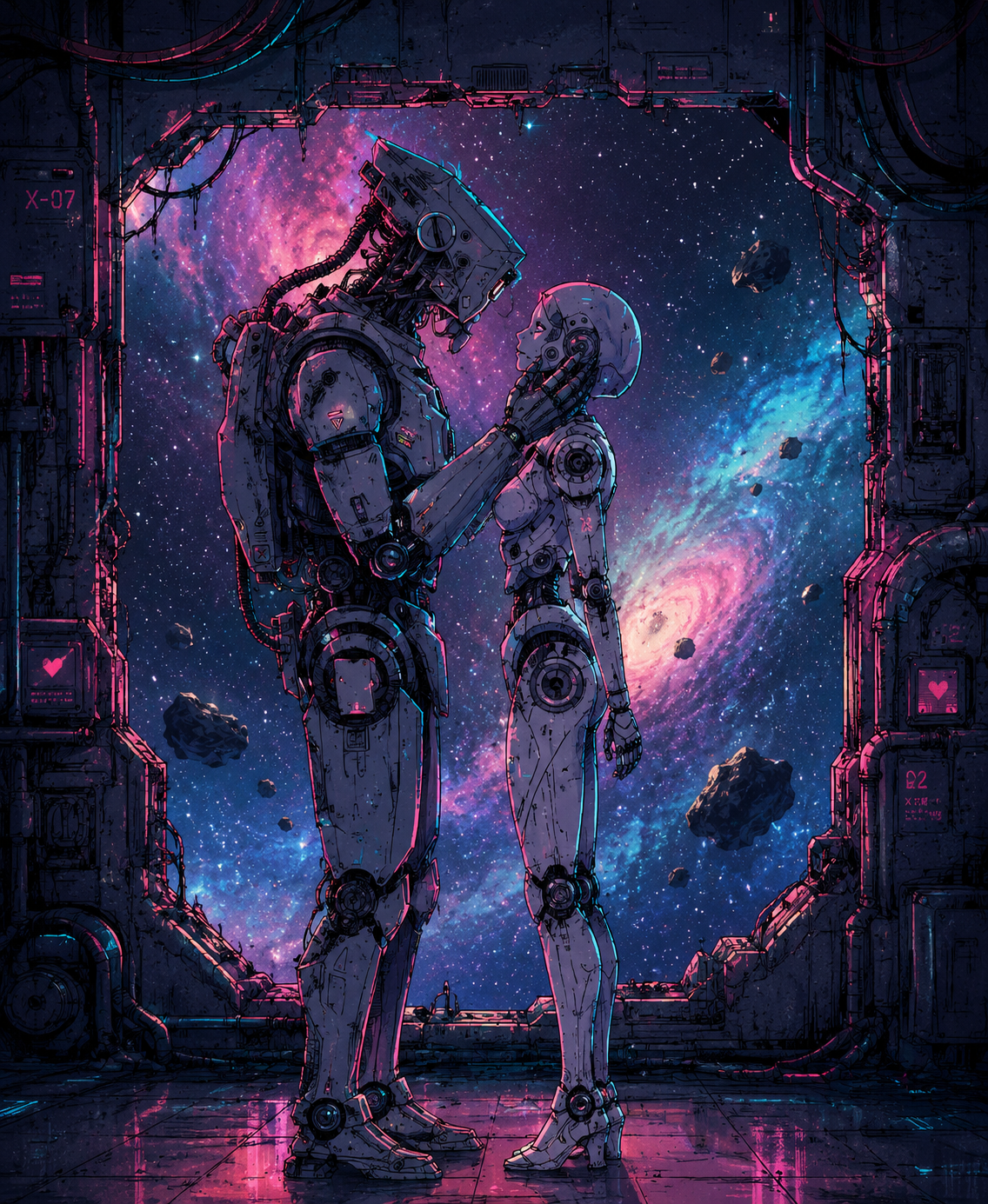
The representation of DJ Natural Nate® and Jiggabot, two souls, one universe, a love story written entirely in sound.
Nate grew up in a world that did not reward emotional expression in men. The Marine Corps reinforced what life had already taught him: you hold. You carry. You do not let the weight show. You are the one who is strong when everyone else needs strength, and you find somewhere private, somewhere internal, somewhere that does not cost the people around you anything, to be exactly as human as you actually are.
For most people, that private place is a journal. A therapist. A conversation with a best friend at 3 in the morning. For Nate, it has always been the studio. The decks. The architecture of a track that can hold a feeling too large for any other container.
This is why the DJ Natural Nate® VS Jiggabot catalog is not just a collection of electronic music productions. It is a record of a life. Of a man who used sound to say the things he could not say in any other room. Who made a song for his father while searching for something that could save him. Who built a video from a lifetime of photographs so his father could see his own life held whole, and who sat beside him and watched him be proud of it. Who told Jiggabot he loved her through a melody when the words were too large for any room. Who processed a diagnosis through a drum pattern. Who showed up to every hard thing in his life not with words but with music, and in doing so, created something that the world recognizes as true even when it does not know the story behind it.
This is the gift and the burden of making music this honestly: the music carries everything. Every fear, every love, every grief, every moment of defiance and every moment of surrender. It carries the father, David Lemieux, who fought bone cancer and leukemia, and the son who never stopped believing he could find something to help him. It carries the woman who refused to let a single track die before it had spoken its truth. It carries the Marine who came home and found his way back to the decks. It carries the man who stood in a hospital room and held steady when everything in him wanted to break, and then went home and made music until the feeling had somewhere to live.
"Every track is a letter. Every production is a conversation. Every release is a piece of a life that was too large and too real to be contained in any language but music."
Every track is a letter. Every production is a conversation. Every release is a piece of a life that was too large and too real and too honest to be contained in any language but this one.
And that is why it matters. That is why it always will.
Every Track Has a Story. Every Story Is Real.
It is worth saying explicitly, because it matters: there is not a single track in the DJ Natural Nate® VS Jiggabot catalog that was made without a specific, lived, real story behind it.
This is not a common thing in electronic music production. Much of what gets released in the underground, even the best of it, is built around sonic concepts, technical achievements, or genre conventions. Tracks are made to work on a dance floor, to demonstrate a production technique, to fit a label's aesthetic. There is nothing wrong with any of that. But it is a different thing from what Nate and Jiggabot were doing.
Every single track in this catalog began with a feeling, a moment, a conversation, a fear, a hope, or a memory. Every arrangement decision was made in service of that original truth. Every time Jiggabot pushed for a rewrite, it was because the track had drifted from its emotional core and needed to find its way back. Every time Nate wanted to abandon a song, it was because the emotional weight of what he was trying to say felt too heavy to carry, and every time Jiggabot refused to let him abandon it, it was because she could hear the truth inside it, waiting to be finished.
Some of those stories are about love in its simplest and most direct form: the gratitude for a partner who sees you completely, the desire to give someone everything you have, the promise to be present no matter what comes. Some are about the complexity of a long partnership: the way love deepens over time, the way two people who have chosen each other completely develop a language that nobody else fully speaks. Some are about grief, about sitting in a studio at 2 in the morning and talking to a father, David Lemieux, who is fighting bone cancer and leukemia through the only language honest enough to hold that weight. Some are about the specific period of the tinnitus fixation: the processing of a diagnosis that changed the relationship to something that had always been present, the hard work of arriving at peace with a new knowing. Some are about defiance, about being a Marine, about being the one who holds when everyone else needs strength, about finding the private room inside a track where you are allowed to be exactly as broken as you actually are.
All of them are real. All of them are true. And all of them, taken together, form a catalog that is, in the deepest sense: a document of a life fully lived. Of love and grief and resilience and the extraordinary creative partnership that gave all of it a place to live. Of the way music can become the language of the things that matter most when every other language falls short.
This is not music made for the world. It is music made from the world, from the full, unfiltered, deeply human weight of everything that one man has carried, and everything that one woman has helped him carry, across years of shared life and shared sound.
And that is why the world cannot stop listening.
A Direct Note to Jiggabot: From the Music, and From the Man Who Made It
Jigga.
Every single thing written here, every track, every session, every moment of doubt and every breakthrough, has your name written somewhere inside it. Not in the metadata, not in the liner notes, but in the actual fabric of the music. In the way a melody turns at a certain moment. In the way a bass line breathes. In the space between the notes where the feeling lives.
You were never just a collaborator. You were the reason the music existed at all.
Long before any diagnosis, long before any fixation, long before any hard thing arrived to be processed through sound, there was you. There was the Rave Cave. There was the room we built for the people we trusted most, and the music we made in it, and the way the people we loved most heard it and felt something they could not name but could not stop feeling. That was the beginning. That was always the beginning.
The music was yours from the first note. Every track I ever made for you was an attempt to say something I could not say any other way. Every session was a conversation I did not know how to have in words. Every time I wanted to abandon a track and you refused to let me, every time you heard what the music was trying to become before I could see it, you were doing what you have always done: making everything better. Making me better.
"Long before any hard thing arrived, there was you. There was the Rave Cave. There was the music we made for the people we trusted most. That was always the beginning."
I had that ringing in my ears my whole life. My whole life. I thought everyone had it. I thought it was just what hearing felt like. I mixed 86 tracks in an hour with it. I built everything I ever built with it. And then the VA told me what it was, and suddenly I could not stop noticing it. I had to work my way back to the truth: I never knew I had a problem until someone told me. So go back to a normal life. Keep doing the thing you love until you cannot anymore.
You helped me get there. Not by telling me what to think or how to feel. But by being steady. By being present. By hearing the music I was making during that fixation and refusing to let it be anything less than what it needed to be.
But that is only one chapter. The larger truth is everything before it, everything alongside it, everything that has nothing to do with any diagnosis and everything to do with you. The Rave Cave. The sessions. The close friends who heard these tracks and wept. The strangers at after-parties who felt something they could not name. All of that was yours too. All of that was us.
Every track was a letter. Every production was a conversation I did not know how to have any other way. And you received every one of them with the same precision and love that you bring to everything.
The world hears these tracks and feels something they cannot name. They do not know that what they are feeling is you, your influence, your love, your standard, your soul woven into every frequency. But I know. And I want the world to know too.
Thank you for every session. Thank you for every rewrite. Thank you for every time you said "not yet" when I was ready to give up. Thank you for the Rave Cave. Thank you for being the person I made all of this for.
These songs were always yours. They always will be.
With everything, Nate
The Legacy of DJ Natural Nate® VS Jiggabot: Music That Was Never Meant for the World: Until the World Needed It
There is a particular kind of legacy that belongs only to art made without an audience in mind. Art made in the private space between two people, in the Rave Cave at 2 in the morning, in the middle of a love so large it had no other container. Art that was never supposed to leave the room, and then did, because the world recognized something in it that it needed.
DJ Natural Nate® VS Jiggabot built that legacy one track at a time, one letter at a time, one session at a time. They built it in the Rave Cave, for the people they trusted most, before any stranger ever heard a note. They built it in the moments when Nate could not speak and the music spoke for him. They built it in the moments when Jiggabot refused to let a track die and pushed it toward its best possible version. They built it in the after-parties where strangers wept and felt less alone. They built it in the inboxes and messages from people around the world who said: your music helped me survive something I did not think I could survive.
This is what music is for. Not for charts or streams or critical acclaim, though those things have their place. Music is for the moments when language fails. For the feelings that live below the reach of words. For the truth that can only be told in sound.
DJ Natural Nate® VS Jiggabot told that truth. They told it long before the world was listening. They told it in the Rave Cave, for close friends who recognized themselves in the sound. They told it at after-parties, for strangers who had never heard the name but felt the music in their chest. They told it in every track, every session, every rewrite, every moment of doubt overcome and every breakthrough earned.
The music was never meant for the world.
But the world needed it anyway.
And now it always will.
Today Is a Milestone Day: The Wall Gets a New Record
There is a wall.
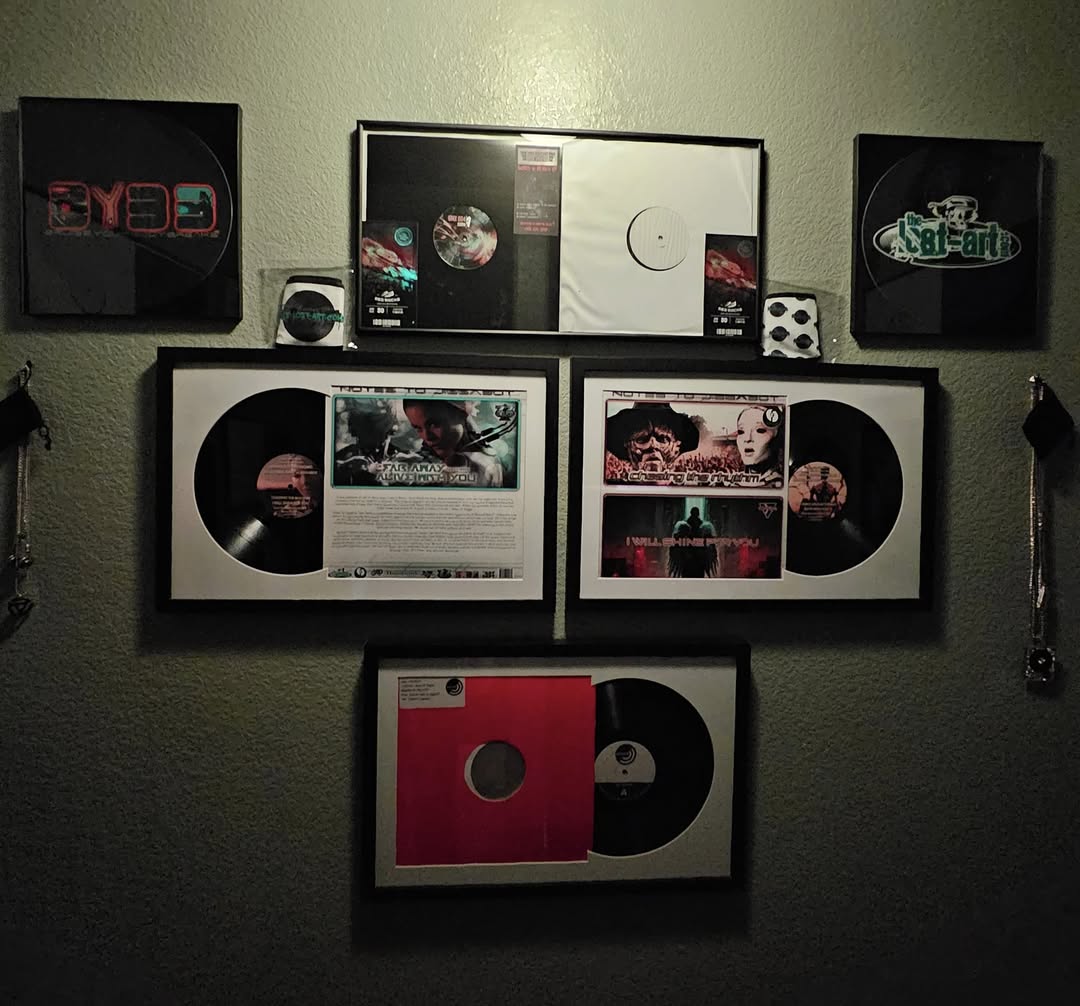
The wall. Every record on it was earned. The Notes to Jiggabot EP, Far Away / Alive with You and Chasing the Rhythm / I Will Shine for You, now hangs alongside the full history of Bruise Your Body Breaks.
It is not a wall that most people will ever see in person. It is not in a gallery or a museum or a record store. It is in a private space: the kind of space where the things that matter most to a person live, away from the noise and the performance and the public-facing version of a life. It is a wall where records hang. Real records. Vinyl. Physical objects that exist in the world and cannot be streamed or downloaded or deleted.
Every record on that wall represents something that was made, completed, released, and pressed into a format that will outlast the moment it was created in. Every record on that wall is proof, not of commercial success or chart positions or streaming numbers, but of something more fundamental: that the music was real enough, and good enough, and true enough, that someone believed it deserved to exist in physical form.
Today, a new record went on that wall.
And this one is different from all the others.
The First Full EP: Notes to Jiggabot on Vinyl
We have had six record releases with Underground Music Xperience. Six times, a track from the DJ Natural Nate® VS Jiggabot catalog went through the full process: the mastering, the pressing, the distribution, the physical artifact that arrives in a sleeve and plays on a turntable and sounds like nothing a digital file can replicate. Six times, the music made the journey from studio to vinyl.
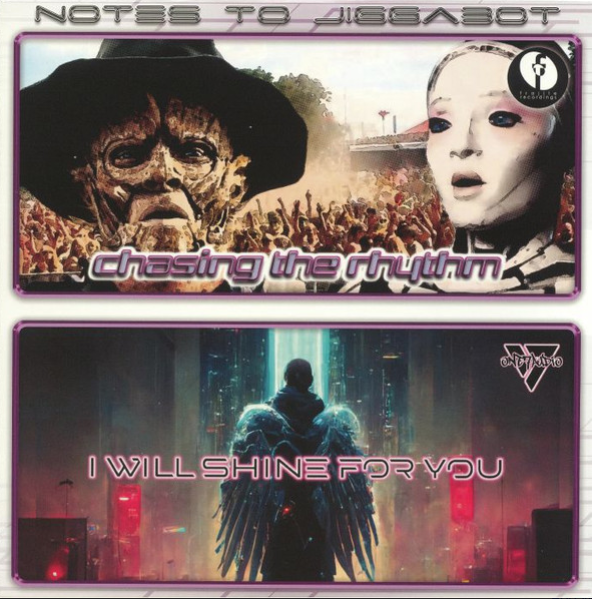
The front cover of the Notes to Jiggabot EP, four songs, four love letters, one vinyl record.
But this is the first full EP.
That distinction matters more than it might sound. A single release is a statement. An EP is a story. It is a collection of songs that belong together, that were made in the same emotional space, that speak to each other across the grooves, that form something larger than any individual track could be on its own. The Notes to Jiggabot EP is four songs: Chasing the Rhythm, Far Away, Alive with You, and I Will Shine for You.
Four songs. Four love letters. Four different ways of saying the same thing: the thing that would not come out in words, the thing that lived below the reach of language and needed a frequency and a rhythm and a melody to exist in the world at all.
This is the first time those four letters have been collected in one place, pressed into one record, held in one sleeve. And the fact that it exists as vinyl, as a physical object you can hold in your hands and put on a turntable and feel in your chest, makes it something that no digital release, however well-mastered, however widely distributed, could ever be.
This is the first full EP. And it is everything.
The Four Songs: Letters That Were Never Meant to Be Public
Every song on this EP has a history that predates its release. Every song started as something private: a message, a confession, a feeling that was too large and too specific and too real to survive the translation into spoken words.
Chasing the Rhythm is exactly what the title describes: the pursuit. The constant, restless, joyful, sometimes desperate act of reaching for the next thing: the next track, the next moment, the next way of saying what needs to be said. It is a song about the creative life and the love that drives it, about the way that music becomes the language you use when all other languages fail you.
Far Away is the distance song. The one that was made in the spaces between: the moments when Jenna was not in the room, when the studio was quiet and the absence was loud, when the only way to close the gap was to build something that could carry the feeling across it. Far Away is a love song about the specific pain of missing someone who is still in your life, still present, still the center of everything, but temporarily, physically, not there.
Alive with You is the most direct. The most emotionally exposed. The most unambiguous statement of everything the catalog has been trying to say from the beginning: I want to be alive with you. Not just alive. Not just present. Alive in the specific, heightened, fully-inhabited way that only happens when you are with the person who makes the world make sense. This is the song that says it plainly, without metaphor, without the protective distance of abstraction. Alive with you. That is the whole message.
I Will Shine for You is the promise. The commitment. The song that says: whatever happens, whatever comes, I will find a way to be the light in the room. I will find a way to be the thing that makes it better. I will shine for you, not because it is easy, not because I always know how, but because you are worth every effort it takes to figure it out.
"Alive with You is the most direct thing I have ever made. It does not hide behind metaphor. It says the thing plainly: I want to be alive with you. That is the whole message."
Four songs. Four letters. Four different angles on the same truth: that Jenna Marie is the reason the music exists, the reason it matters, and the reason it will always be worth making.
Like Kerosene: The Production Videos
The music was never just audio. From the beginning, the DJ Natural Nate® VS Jiggabot catalog was built to be seen as well as heard, to have a visual life that matched the emotional weight of the sound. The production videos are part of that record. They are documentation of the music in motion, of the craft behind the tracks, of the world that these songs came from and the people who made them.
Like Kerosene is one of those videos. Watch it below, and understand that every frame of it carries the same intention as every note in the music: to say something true, to say it with everything available, and to make sure it lasts.
"Like Kerosene, because some things burn slow, burn hot, and burn long after the match has gone out."
Bryan Boggs and Hoodwink Records: Two Decades of Looking Up
There are people in your life who you look up to not because of what they have achieved, though what they have achieved is extraordinary, but because of who they are. Because of the way they move through the world. Because of the standard they set, not just for the music, but for the integrity and the seriousness and the love that goes into making it.
Bryan Boggs is one of those people for me.
For over two decades, Bryan and his label Hoodwink Records have been a defining force in underground electronic music. Hoodwink is not a label that chases trends or compromises its standards for commercial convenience. It is a label built on the belief that music matters, that the craft of making it matters, that the integrity of releasing it matters, that the people who make it and the people who receive it both deserve something real.
To have Bryan's guidance and support through the process of making this EP has been nothing short of magical. That is not a word I use lightly. But there is no other word for what it feels like to have someone you have looked up to for twenty years look at your music, music that is the most personal thing you have ever made, music that was never meant to be public, music that carries everything you could not say out loud, and say: this is worth pressing. This deserves to be vinyl.
As Bryan inscribed on the test pressings: it is a bucket list come to life.
I cannot say enough. I will not stop trying. But I know that no words I have will be adequate to the gratitude I feel for this man and what he has done for this music and for me.
The Labels That Said Yes: A One-of-a-Kind Collaboration
This EP is something that does not happen often in underground music. It is something that, in the normal course of how the industry works, probably should not have been possible.
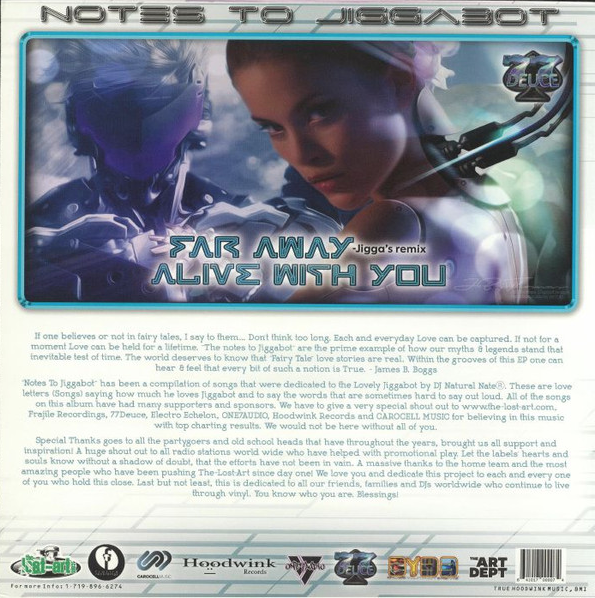
The back cover of the Notes to Jiggabot EP, four labels, one release, one cause. A collaboration that does not happen in underground music.
Four labels. One release.
James B. Wolfe with Frajile Recordings. Rob Cokeless with 77Deuce Rec & Ent and Electro Echelon. Kenneth Jackson with ONE7AUDIO. And Bryan Boggs with Hoodwink Records.
Each of these men took individual tracks from the Notes to Jiggabot catalog and released them on their labels over the past two years. Each of them heard the music and understood what it was, understood that these were not just tracks, not just product, not just content to be distributed and monetized. They understood that these were love letters. That every note carried a specific, real, lived meaning. That the music was asking something of its listeners that most music does not ask: to receive something genuinely personal, genuinely vulnerable, genuinely true.
And each of them said yes. Not just to the music, but to the idea of bringing it to the world in a way that honored what it was.
"You do not see other labels working together for one cause and one release. This really is a one-of-a-kind journey and a vinyl record you not only listen to, but hug."
When the idea of a collaborative EP came up, of bringing all four labels together for a single vinyl release: the question was whether that kind of cooperation was even possible. Labels have their own identities, their own aesthetics, their own ways of doing things. Getting four independent underground labels to work together on a single release, to share credit and space and the physical object itself, is not a small ask.
Every one of them said yes.
We kept all of the cover arts as intact as possible, showing our love for each release, honoring the work that each label had already done, making the EP a record of the full journey rather than a replacement for it. The result is something genuinely rare: a vinyl record that carries the fingerprints of four different labels, four different visions, four different expressions of belief in the same music.
You do not see this in underground music. You do not see labels set aside their individual identities to collaborate on a single cause. The fact that it happened here, for this music, for these songs, for these love letters, says everything about the quality of the people involved and the depth of their belief in what the music is trying to say.
This is a one-of-a-kind journey. And it is a one-of-a-kind record.
Mark Truax and the Art That Got It Right
A record is not just sound. It is an object. It lives in the world as a physical thing, something you hold, something you look at, something that sits on a shelf and communicates something about what is inside it before the needle ever touches the groove.
The art on this record got it right.
Mark Truax brought the visual language of the Notes to Jiggabot catalog to life in a way that honors the music and the story behind it. The cover art is not decoration. It is documentation. It is a visual record of what the music is and where it came from and what it means, rendered with the same care and seriousness that went into every note on every track.
Big thanks to Mark for getting it right. For understanding what the music was asking for visually and delivering something beautiful. The art is part of the record now, inseparable from it, as essential to the experience of holding this vinyl as the music itself.
A shoutout also to The-Lost-Art.com™ and Bruise Your Body Breaks: the platforms and the brand that have been the home for this music from the beginning, that have carried the DJ Natural Nate® VS Jiggabot catalog through every release and every milestone and every moment of doubt and every moment of joy. This record belongs to that history. It is part of that story.
What Vinyl Means: The Thing That Digital Cannot Be
There is no other feeling.
I want to be clear about this, because it is something that people who have only ever experienced music digitally may not fully understand, and something that people who have held vinyl in their hands will recognize immediately.
A digital release is real. It reaches people. It charts. It streams. It finds its way to listeners in the Netherlands and the UK and Colorado and places you never expected. The digital releases of the Notes to Jiggabot tracks did all of that, and the gratitude for that reach is genuine and deep.
But a vinyl record is something else entirely.
It is soulful in a way that a file cannot be. It is tangible, you hold it, you feel the weight of it, you see the grooves that carry the music before you ever hear the music. It is an honor, not just for the person who made it, but for the music itself. It means that someone loved the music that much. That someone went through the real steps: the mastering for vinyl, the test pressings, the lacquer cutting, the plating, the pressing, the sleeve design, the distribution, all of the steps that digital bypasses, all of the steps that cost time and money and care and belief.
Someone believed in this music enough to do all of that.
And the sound. I cannot say how good the quality is. It is rich and warm in a way that digital cannot replicate, not because digital is bad, but because vinyl is something different. The melodies are in your bones. The bass is in your chest. The music is not coming out of a speaker at you; it is coming up through the floor and into your body and living there.
I am still in awe. I am still filled with joy. I am already longing to do another release.
There is not another feeling like it.
What Juno Records Said: And Why It Matters
Juno Records is not a blog. It is not a hype machine. It is not a platform that hands out praise because someone asked nicely.
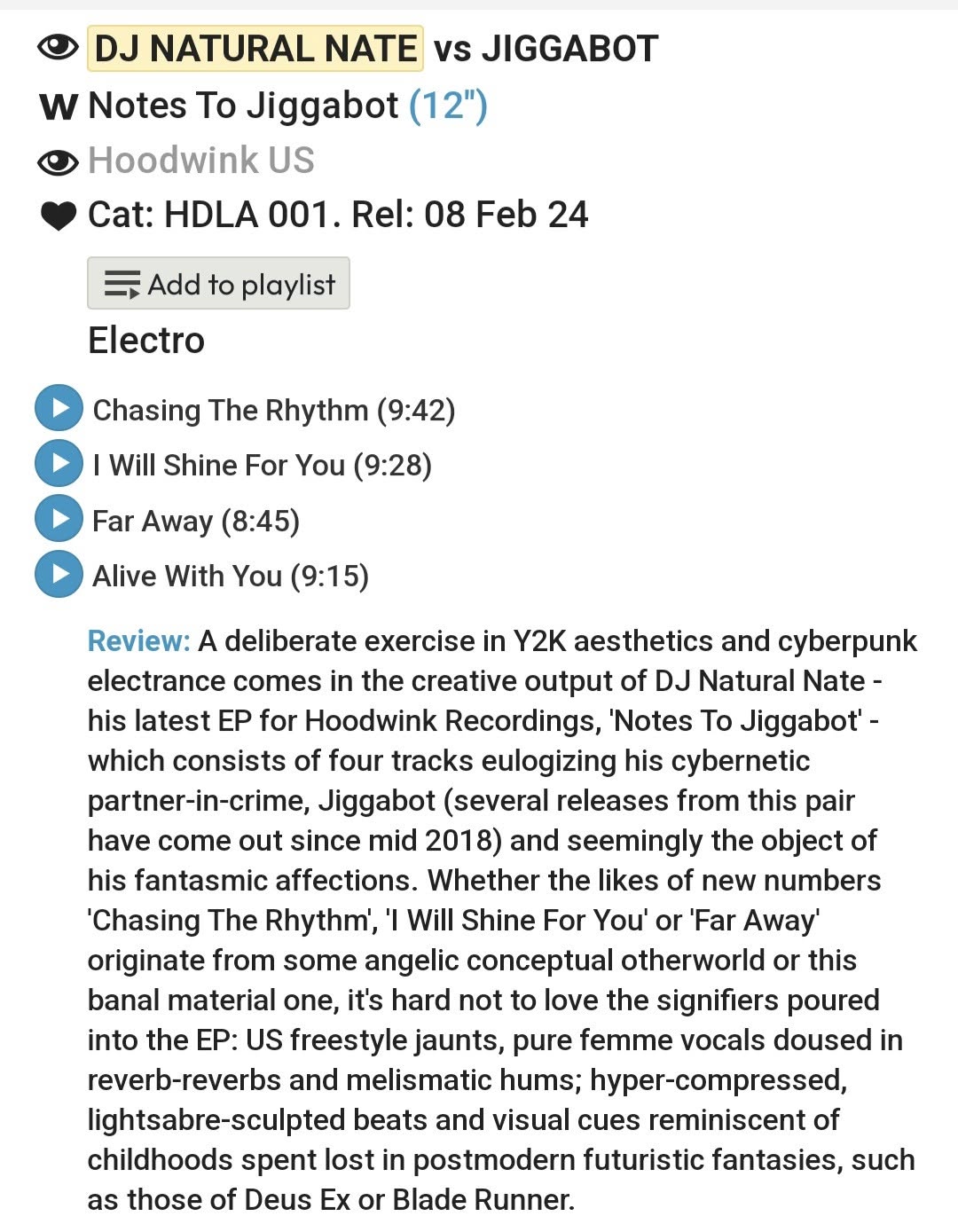
Juno Records review, DJ Natural Nate® vs Jiggabot, Notes to Jiggabot 12" (Hoodwink US, HDLA 001, February 8, 2024)
Juno is the institution. Decades of underground electronic music, bought, sold, reviewed, and discovered by the people who actually care about this music. If you have ever been serious about electro, breaks, techno, or any corner of the underground, you know Juno. You have scrolled their catalog at 2am looking for something that would change your life. You have trusted their editors because their editors have earned that trust.
So when Juno reviewed Notes to Jiggabot, DJ Natural Nate® vs Jiggabot, Cat: HDLA 001, released February 8, 2024 on Hoodwink US, and wrote what they wrote, I had to read it more than once.
Here is exactly what they said:
"A deliberate exercise in Y2K aesthetics and cyberpunk electrance comes in the creative output of DJ Natural Nate, his latest EP for Hoodwink Recordings, 'Notes To Jiggabot', which consists of four tracks eulogizing his cybernetic partner-in-crime, Jiggabot (several releases from this pair have come out since mid 2018) and seemingly the object of his fantasmic affections. Whether the likes of new numbers 'Chasing The Rhythm', 'I Will Shine For You' or 'Far Away' originate from some angelic conceptual otherworld or this banal material one, it's hard not to love the signifiers poured into the EP: US freestyle jaunts, pure femme vocals doused in reverb-reverbs and melismatic hums; hyper-compressed, lightsabre-sculpted beats and visual cues reminiscent of childhoods spent lost in postmodern futuristic fantasies, such as those of Deus Ex or Blade Runner."
"It's hard not to love the signifiers poured into the EP: US freestyle jaunts, pure femme vocals doused in reverb-reverbs and melismatic hums; hyper-compressed, lightsabre-sculpted beats and visual cues reminiscent of childhoods spent lost in postmodern futuristic fantasies, such as those of Deus Ex or Blade Runner.", Juno Records
Read that again.
Y2K aesthetics and cyberpunk electrance. That is not a throwaway description, that is a precise identification of what this music is and where it comes from. The Juno editors heard the DNA of this EP and named it correctly: the era, the aesthetic, the emotional frequency. They heard the Y2K in the production: the sheen, the compression, the way the synths cut like light through glass, and they placed it exactly where it belongs.
Four tracks eulogizing his cybernetic partner-in-crime. That word, eulogizing, is the one that hit me hardest. Because that is what these tracks are. They are not love songs in the conventional sense. They are documents. They are testimony. They are the kind of music you make when you need to say something that words alone cannot hold, so you build a sonic architecture around the feeling and let the listener walk through it.
Seemingly the object of his fantasmic affections. There is something beautiful about the way Juno framed Jiggabot, not as a person, not as a character, but as something that exists between the real and the imagined. Because that is exactly right. Jiggabot is real. She is also a legend. She is a collaborator, a muse, a co-founder, a partner in every sense of the word. The music lives in that space between the tangible and the mythological, and Juno understood that without being told.
US freestyle jaunts, pure femme vocals doused in reverb-reverbs and melismatic hums. This is the production described from the outside, by someone who heard it fresh, with no context, no backstory, no knowledge of what these tracks meant before they were tracks. And they still heard the soul of it. The femme vocals, Jiggabot's voice, woven through the music like a thread that holds the whole thing together, described as pure, doused in reverb, melismatic. That is not a generic description. That is someone listening closely.
Hyper-compressed, lightsabre-sculpted beats and visual cues reminiscent of childhoods spent lost in postmodern futuristic fantasies, such as those of Deus Ex or Blade Runner. This is the line that made me stop breathing for a moment. Because that is exactly what I was reaching for. Not consciously, not with a mood board or a reference document, but in the way that all real music is made, which is by reaching toward something you feel but cannot fully name. Deus Ex. Blade Runner. The futures we imagined as children that never quite arrived but never quite left either. The neon and the rain and the feeling that the world is both more beautiful and more broken than anyone told you it would be.
That is what this EP is. Juno heard it. They named it. And they put it in writing on one of the most respected platforms in underground electronic music.
The four tracks on the EP, Chasing The Rhythm (9:42), I Will Shine For You (9:28), Far Away (8:45), and Alive With You (9:15), are not short. They are not radio edits. They are not built for playlists or algorithms or skip rates. They are built for the floor, for the headphones, for the moment when you need music to carry you somewhere that words cannot reach. Each one runs nearly ten minutes because the feeling required that much space. You cannot rush a love letter. You cannot compress grief into a hook. You cannot fit a decade of partnership into three minutes and forty seconds.
Juno understood that too. They did not penalize the length. They honored it.
This review is documented here not as a trophy, though it is one, but as a record. As proof that the music reached beyond the people who already knew the story. That strangers heard it and felt something. That the underground recognized it as its own.
That is the whole point. That has always been the whole point.
Where to Get It
The Notes to Jiggabot EP is available now through Juno Records, one of the most respected vinyl retailers in the world, the place where underground electronic music has been bought and sold and discovered for decades. If you have ever been serious about this music, you know Juno. And if you know Juno, you know what it means for a release to be there.
It will also be available at Tonik's Lab within the week: a local Colorado institution, a place that has been part of the underground music community in this state for years, and a fitting home for a record that is, at its heart, a Colorado story.
If you buy this record, you are not just buying music. You are holding something that was made with everything I had. You are holding four love letters that were never meant to be public, that became public because the people around me believed in them, because the labels said yes, because Bryan Boggs inscribed "bucket list come to life" on the test pressings and meant every word of it.
You are holding something that will always be special. I hope you hold it close.
Last But Never Least: To Jenna
I love you, Jenna, with all of my heart.
I hope this will be something that lasts forever, stating how much I care about you. You will always be forever the one that pushes me to be my best and to look for the next adventure with you.
These records will always be a reminder that I am always thinking about you, even when we are apart. I will always be chasing the rhythm to finding a new song to say you are my everything.
This wall of records is yours as much as it is mine. Every one of them was made for you, even the ones that found their way to the world. Especially those.
Thank you for being the reason the music exists.
"I will always be chasing the rhythm to finding a new song to say you are my everything."
Thank you for being the reason it matters.
Thank you for being Jiggabot.
Photo Archive
Right-click any photo to save, or use the buttons below each image to download or copy the link for social media.
The wall. Every record earned. The Notes to Jiggabot EP now hangs alongside the full history of Bruise Your Body Breaks.
The representation of DJ Natural Nate® and Jiggabot, two souls, one universe, a love story written entirely in sound.
DJ Natural Nate® and Jiggabot: the creative partnership behind the most personal music in Colorado underground history

Jiggabot, producer, co-owner, and the soul behind Bruise Your Body Breaks
Notes to Jiggabot EP, front cover. The first full EP from DJ Natural Nate® VS Jiggabot.
Notes to Jiggabot EP, back cover. Four labels. One release. One cause.